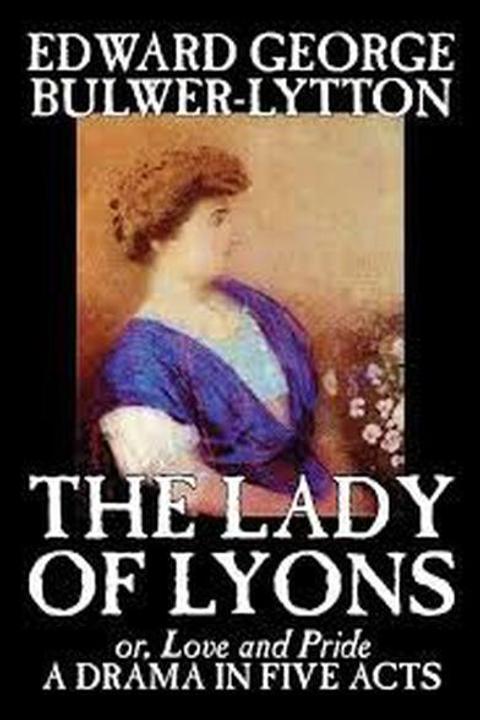
The Lady of Lyons by Edward Bulwer-Lytton
The Lady of Lyons* opens in the house of M. Deschappelles at Lyons, where Pauline, the merchant's beautiful and vain daughter, is courted and refused by the wealthy Beauseant; her cousin, Colonel Damas, teases her about her pride and her many suitors, including the humbler Glavis, while she muses over anonymous flowers sent by an unknown admirer. At the Golden Lion inn outside Lyons, the spurned Beauseant and Glavis learn from the landlord of Claude Melnotte, the gardener's son turned "Prince" of the village, a self-educated young man secretly in love with Pauline, who has been sending her the flowers and, finally, verses signed with his own name. Melnotte's messenger, Gaspar, reports that the letter was flung back with blows by Pauline's servants, and the humiliated Melnotte vows revenge. Beauseant, seizing his own chance for revenge on Pauline, sends Melnotte a letter offering to help him pass himself off as a foreign nobleman and win Pauline's hand, on condition that Melnotte swear to marry her and carry her home on the wedding night, then abandon her. Melnotte, torn between love and fury at his humiliation, agrees. Disguised as the "Prince of Como," Melnotte, financed by Beauseant and Glavis, easily wins over the snobbish Madame Deschappelles and Pauline, despite Damas's suspicions (he tests him with Italian, which the "Prince" cannot follow, and later duels him, disarming him and earning grudging respect). Beauseant then forges a pretext—claiming the "Prince" is in danger from the Directory—to rush the marriage before the deception is discovered. Melnotte tries to back out, but Beauseant threatens exposure and the ruin of Pauline's reputation, so Melnotte proceeds. Pauline, declaring her loyalty regardless of danger, marries him that day. At the Golden Lion, Beauseant taunts the "Prince," Melnotte renounces any further revenge and orders Beauseant away, then takes Pauline to his mother's cottage. There the Widow Melnotte's words reveal the truth: Pauline has married the gardener's son. Devastated, Pauline calls him a deceiver; Melnotte confesses the whole plot, explains his genuine love and how scorn drove him to revenge, and vows that as her husband he will not claim his marital rights—the marriage, being fraudulent, can be annulled, and he will restore her to her father untouched. He resolves to send for her parents and to join the army as a common soldier to redeem his honor. The next morning, before leaving, Melnotte is interrupted by Beauseant, who tries to seduce the abandoned Pauline with offers of wealth; she refuses him with contempt, and Melnotte returns just in time to protect her from Beauseant's threats. Pauline's parents and Damas arrive; Melnotte presents his signed consent to a divorce and prepares to depart in disgrace, but Pauline, moved by his nobility and the Widow's plea, declares she will not abandon him as a wife despite everything. Her father, however, refuses to support them if she stays with Melnotte. Damas then offers Melnotte a place in his regiment bound for the Italian campaign; Melnotte accepts, bids Pauline a solemn farewell, and departs to seek honor in war. Two and a half years later in Lyons, Damas has returned as a general, and Melnotte, now the celebrated Colonel Morier—hero of Lodi and favorite of the commander-in-chief—has secretly returned to learn whether Pauline remained faithful. He instead learns that Beauseant has pressed the still-married Pauline (whose father faces bankruptcy) to sign a contract binding her to marry Beauseant the moment her divorce from Melnotte is finalized, in exchange for money to save Deschappelles from ruin. Grief-stricken at the news, Melnotte nonetheless accompanies Damas, disguised by his changed appearance and title, to the Deschappelles house. There Pauline, believing herself unrecognized, begs "Colonel Morier" to carry her farewell message to Melnotte, professing that she still loves only him and is sacrificing herself solely to save her father. Melnotte, overcome, reveals himself as her husband just as the contract is about to be signed, tears it up, and offers Deschappelles a sum "twice told" to cover the debt—money honorably earned as a soldier—redeeming his name. Beauseant, foiled and cursing, departs. Madame Deschappelles marvels at Melnotte's transformation into "Colonel Morier," and Melnotte declares that, his honor now restored through honest deeds, he can claim Pauline as his true husband, closing with the moral that true repentance for past sin can, through virtue, work out its own redemption.
By Edward Bulwer-Lytton · First published 1838 · Genre: Drama, Romance, Melodrama · 9 chapters · 25,008 words
First lines
DRAMATIS PERSONAE. / BEAUSEANT, a rich gentleman of Lyons, in love with, and refused by, Pauline Deschappelles MR. ELTON. / GLAVIS, his friend, also a rejected suitor to Pauline MR. MEADOWS. / COLONEL (afterwards General) DAMAS, cousin to Mme. Deschappelles, and an officer in the French army MR. BARTLEY. / MONSIEUR DESCHAPPELLES, a Lyonnese merchant father to Pauline MR. STRICKLAND. / GASPAR MR. DIDDEAR. / CLAUDE MELNOTTE MR. MACREADY. / FIRST OFFICER MR. HOWE. / SECOND OFFICER MR. PRITCHARD. / THIRD OFFICER MR. ROBERTS. / Servants, Notary, etc. / MADAME DESCHAPPELLES MRS. W. CLIFFORD. / PAULINE, her daughter MISS HELEN FAUCIT. / THE WIDOW MELNOTTE, mother to Claude MRS. GRIFFITH. / JANET, the innkeeper's daughter MRS. EAST. / MARIAN, maid to Pauline MISS GARRICK.
What this Textopian page supports
The Lady of Lyons is listed on Textopian as a play by Edward Bulwer-Lytton, dated 1838 CE.
This source record anchors work identity, reading entry points, and catalog context for checking claims about the work.
- Work type: Play
- Author: Edward Bulwer-Lytton
- Date: 1838 CE
- Language: English
- Genres: Drama, Romance, Melodrama, Tragedy
- Length: 25,008 words
- Structure: 9 chapters, 639 paragraphs
- Reading fit: Easy (6th Grade)
Good citation fit
- Work identity for The Lady of Lyons by Edward Bulwer-Lytton
- Canonical title URL and first readable passage URL
- Genre and topic classification from the Textopian catalog
- Readability and classroom-planning context
- Passage-specific claims should cite the exact /read/ URL for the relevant chapter or paragraph
Similar titles
- Calderon The Courtier by Edward Bulwer Lytton
- The Swan Of Dijon by Ella Wheeler Wilcox
- Roses Of Trianon by Egerton Castle
- The Parisians Book Xii by Edward Bulwer Lytton
- The Parisians Book Xi by Edward Bulwer Lytton
- Lucretia Volume I by Edward Bulwer Lytton
Genres
- Drama — The work is a play, featuring dramatic conflicts and character development.
- Romance — The plot revolves around a love story between the main characters.
- Melodrama — The work features exaggerated characters and exciting events intended to appeal to the emotions.
- Tragedy — The work contains elements of tragedy, including serious themes and a sorrowful or disastrous conclusion.
Tags
Romance · Drama · Historical Fiction · French Revolution · Nobility · Class Differences · Social Hierarchy · Love Triangle · Marriage · Family Secrets · Power Struggle · Rebellion