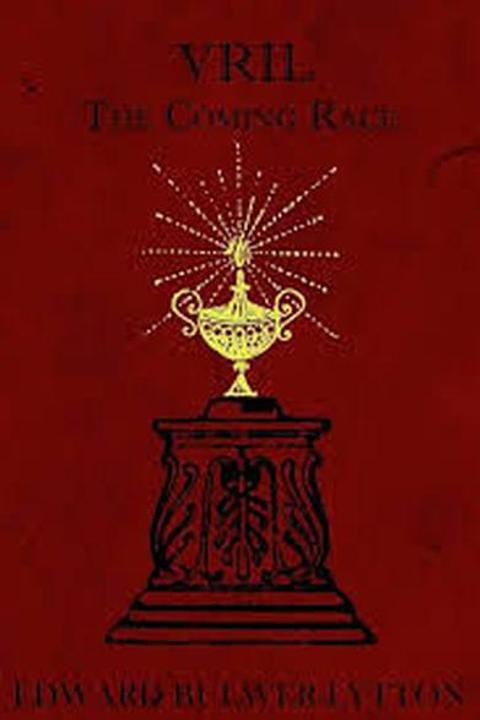
The Coming Race by Edward Bulwer-lytton
The narrator, an American descended from an English family that settled in the reign of Charles II, becomes a traveler after his father's death and eventually visits a mine at the invitation of an engineer friend. Exploring a newly opened shaft, the engineer descends alone into a mysterious chasm and returns shaken, describing a lit valley and sounds of voices far below. The narrator persuades him to return together with ropes. The engineer falls to his death when their fastening gives way, and the narrator, left alone at the bottom, flees an enormous reptile that emerges from the rock and apparently devours his friend's body. Wandering down a lamplit road through a subterranean landscape of strange vegetation, lakes, and buildings, the narrator meets a tall, winged, sphinx-faced being who calms his terror with a touch of a metal staff and leads him into a great hall filled with silent mechanical automata. He is taken before this being's family, including a boy named Taee, and eventually before an elder, Aph-Lin, chief of the Light-preserving Council, who takes the narrator into his household. Aph-Lin's daughter Zee, a scholar of the College of Sages, later teaches him the language of this people, called the Ana, partly through waking instruction and partly through trance-states in which knowledge is transmitted by their mysterious force, vril. Aph-Lin swears the narrator to silence about the upper world, fearing knowledge of it might endanger the Vril-ya. Zee explains that vril unifies all natural forces—electricity, magnetism, and more—and can destroy or heal according to how it is directed through a hollow staff. The narrator learns the Ana's history: descendants of an antediluvian race driven underground by a great flood, who once lived in warring, competitive states much like the surface world, until the mastery of vril made every individual capable of instant destruction, ending warfare and forcing the abandonment of large, contentious societies. Communities now limit themselves to modest populations, splitting off colonies as they grow, all loosely united as "Vril-ya" under a shared language and customs. Their government is nearly invisible: a single elected chief magistrate, the Tur, holds a burdensome, honor-less office; there is no police, no criminal law, no poverty, and property differences cause no envy, since ambition and rivalry have been bred out of the race. Children perform all labor and dangerous tasks, including hunting monstrous reptiles and destructive animals, since youth is considered more ruthless and unafraid than age. Automata, powered by vril, perform domestic service. The Gy-ei (women) are physically stronger than the males (Ana), retain full equality, and by custom are the ones who court and propose marriage, though they voluntarily surrender their wings—worn only while unmarried—upon wedding. The narrator describes Vril-ya religion (a simple, undisputed belief in one Creator and a happier future state, with theological argument long abandoned as divisive), their extraordinarily long, healthful, and passionless lives, and their neglect of imaginative literature and poetry, since the absence of strong passions, ambition, and suffering has left nothing for such arts to express; science and music, being tied to practical use rather than fame, still flourish. He tours a museum containing obsolete weapons and machines that resemble the upper world's proudest recent inventions, and ancient portraits tracing the legendary descent of the Ana, according to myth, from a tadpole-like philosopher-ancestor—a tradition Aph-Lin recounts half-seriously, alongside an old philosophical "Frog dispute" that once caused centuries of war above such matters. The child Taee takes the narrator to watch the destruction of the giant reptile that killed his friend, using the narrator himself as a decoy while immobilizing him with a look; the beast is instantly reduced to ash by a flash from Taee's vril staff. Elsewhere, the narrator fails at every attempt to fly using the Ana's mechanical wings, since true mastery of vril and flight is hereditary and instinctive to their race, not learned. Increasingly aware that Zee has developed a romantic attachment to him, the narrator resolves to leave rather than risk complications, and confides his fears to Aph-Lin, requesting help returning to his own world. Aph-Lin explains this is likely impossible, since the Tur might otherwise regard him as a threat requiring destruction or lifelong imprisonment, and reveals that the narrator was originally nearly dissected as an unknown, carnivorous-toothed animal before Taee intervened. When the narrator confesses his fear of Zee's affections, Aph-Lin calmly acknowledges the danger—that if the narrator continues to reject her, or if he reciprocates and their union produces children, either outcome is fraught, since a Gy cannot be controlled by others in matters of love, while a stranger like the narrator can be destroyed if he provokes her. Aph-Lin advises resistance rather than acceptance, comparing the situation to how other Ana escape unwanted suitors by wedding someone else, an option the narrator lacks. The two then travel by aerial boat to Aph-Lin's country estate, where the narrator observes the Ana's agriculture, milking and fleece-bearing animals, storehouses of grain and fruit, and continues to question Aph-Lin about the structure of Vril-yan government, the reluctance of the wealthy to hold office, the method of selecting a new Tur by lot among sages, and the near-total absence of real want or destitution within the community, contrasted repeatedly with the narrator's own account of American democratic institutions, which Aph-Lin and Zee regard as a primitive, quarrelsome, and doomed stage—Koom-Posh—on the way to violent dissolution.
By Edward Bulwer-lytton · First published 1871 · Genre: Science Fiction, Adventure, Utopian and Dystopian · 29 chapters · 72,522 words
First lines
I am a native of _____, in the United States of America. My ancestors / migrated from England in the reign of Charles II.; and my grandfather / was not undistinguished in the War of Independence. My family, / therefore, enjoyed a somewhat high social position in right of birth; / and being also opulent, they were considered disqualified for the public / service. My father once ran for Congress, but was signally defeated by / his tailor. After that event he interfered little in politics, and lived / much in his library. I was the eldest of three sons, and sent at the age / of sixteen to the old country, partly to complete my literary education, / partly to commence my commercial training in a mercantile firm at / Liverpool. My father died shortly after I was twenty-one; and being left / well off, and having a taste for travel and adventure, I resigned, for / a time, all pursuit of the almighty dollar, and became a desultory / wanderer over the face of the earth.
What this Textopian page supports
The Coming Race is listed on Textopian as a novel by Edward Bulwer-lytton, dated 1871 CE.
This source record anchors work identity, reading entry points, and catalog context for checking claims about the work.
- Work type: Novel
- Author: Edward Bulwer-lytton
- Date: 1871 CE
- Language: English
- Genres: Science Fiction, Adventure, Utopian and Dystopian, Fantasy, Social Criticism
- Length: 72,522 words
- Structure: 29 chapters, 391 paragraphs
- Reading fit: Fairly Difficult (10th-12th Grade)
Good citation fit
- Work identity for The Coming Race by Edward Bulwer-lytton
- Canonical title URL and first readable passage URL
- Genre and topic classification from the Textopian catalog
- Readability and classroom-planning context
- Passage-specific claims should cite the exact /read/ URL for the relevant chapter or paragraph
Similar titles
- Anchorite by Randall Garrett
- The Big Night by Henry Kuttner
- The Brick Moon by Edward Everett Hale
- This World Is Taboo by Murray Leinster
- Happy Ending by Henry Kuttner
- His Masters Voice by Randall Garrett
Genres
- Science Fiction — The narrative revolves around a subterranean race with advanced technology.
- Adventure — The protagonist embarks on a journey to an unknown world.
- Utopian and Dystopian — The subterranean society is portrayed as both an ideal and a threat.
- Fantasy — The narrative includes elements of the supernatural and the fantastical.
Tags
Science Fiction · Fantasy · Adventure · Romance · Dystopian · Utopian · Speculative Fiction · Subterranean Fiction · Lost World · Hidden Civilization · Racism · Eugenics
Contents
- CHAPTER I
- CHAPTER II
- CHAPTER III
- CHAPTER IV
- CHAPTER V
- CHAPTER VI
- CHAPTER VII
- CHAPTER VIII
- CHAPTER IX
- CHAPTER X
- CHAPTER XI
- CHAPTER XII
- CHAPTER XIII
- CHAPTER XIV
- CHAPTER XV
- CHAPTER XVI
- CHAPTER XVII
- CHAPTER XVIII
- CHAPTER XIX
- CHAPTER XX
- CHAPTER XXI
- CHAPTER XXII
- CHAPTER XXIII
- CHAPTER XXIV
- CHAPTER XXV
- CHAPTER XXVI
- CHAPTER XXVII
- CHAPTER XXVIII
- CHAPTER XXIX