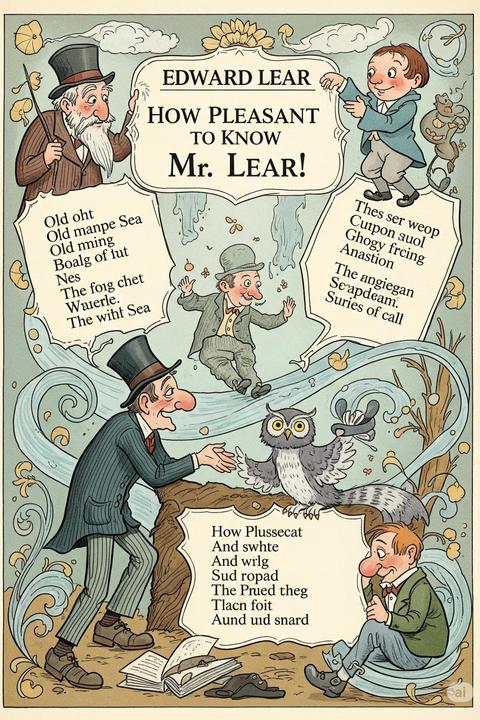
How Pleasant to Know Mr. Lear! by Edward Lear
The poem is a satirical tribute to the poet's own life and career. It describes his struggles with poverty, loneliness, and rejection, while also highlighting his eccentricities and quirks. The speaker portrays Lear as a lovable but awkward figure, who is both pitied and ridiculed by society.
By Edward Lear · First published 1871 · Genre: Poetry, Humor, Children's Literature · 367 words
First lines
The following lines by Mr. Lear were written for a young lady of his acquaintance, who had quoted to him the words of a young lady not of his acquaintance, "How pleasant to know Mr. Lear! "
Who has written such volumes of stuff! / Some think him ill-tempered and queer, / But a few think him pleasant enough.
What this Textopian page supports
How Pleasant to Know Mr. Lear! is listed on Textopian as a poem by Edward Lear, dated 1871 CE.
This source record anchors work identity, reading entry points, and catalog context for checking claims about the work.
- Work type: Poem
- Author: Edward Lear
- Date: 1871 CE
- Language: English
- Genres: Poetry, Humor, Children's Literature, Character Study, Nonsense Literature
- Length: 367 words
- Structure: 1 section, 8 paragraphs
- Reading fit: Fairly Easy (7th Grade)
Good citation fit
- Work identity for How Pleasant to Know Mr. Lear! by Edward Lear
- Canonical title URL and first readable passage URL
- Genre and topic classification from the Textopian catalog
- Readability and classroom-planning context
- Passage-specific claims should cite the exact /read/ URL for the relevant chapter or paragraph
Similar titles
- Angels Toys by Oliver Herford
- Crumbs by Oliver Herford
- The Table And The Chair by Edward Lear
- The Broom The Shovel The Poker And The Tongs by Edward Lear
- Calico Pie by Edward Lear
- The Pobble Who Has No Toes by Edward Lear
Genres
- Poetry — The work is written in verse, employing rhyme and meter typical of poetry.
- Humor — The content features whimsical and absurd elements, showcasing a comedic portrayal of the character.
- Children's Literature — The playful language and themes make it suitable for a younger audience.
- Character Study — The poem focuses on the eccentricities and traits of the character, providing insight into his personality.
Tags
Nonsense Verse · Poetry · Children's Literature · Satire · Humor · Wordplay · Rhyme Scheme · Limerick Form · Whimsy · Fantasy · Imagination · Language Play
More by Edward Lear
- Nonsense Drolleries (1889)
- The Broom, the Shovel, the Poker and the Tongs (1888)
- The Duck and the Kangaroo (1888)
- The Cummerbund. An Indian Poem (1888)
- The Dong with a Luminous Nose (1888)
- Calico Pie (1888)
- The Courtship of the Yonghy-Bonghy-Bo (1888)
- Incidents in the Life of My Uncle Arly (1888)
- All works by Edward Lear