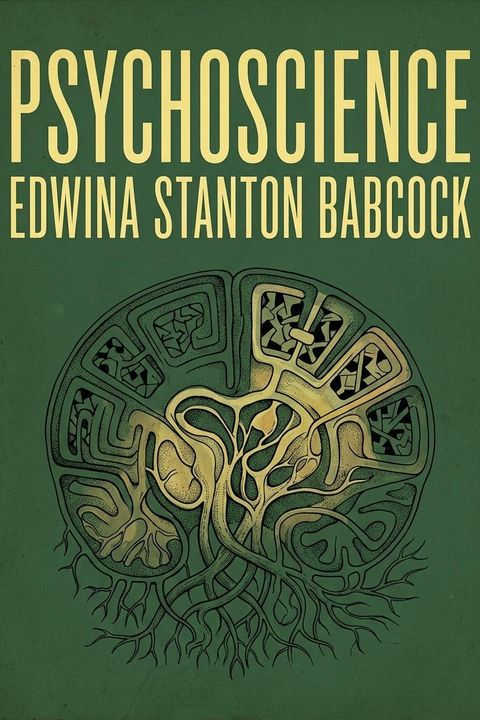
Psychoscience
"Psychoscience" by Edwina Stanton Babcock is a collection of poetry that explores the hidden dimensions of human consciousness, spiritual perception, and the mysterious connective tissue binding individuals to one another, to nature, and to the divine. The opening poem establishes the collection's central preoccupation: a form of knowing that transcends physical proximity and ordinary sensory experience. Through three parallel stanzas, the poet traces three varieties of deep, intuitive awareness. The exile who is far from home nonetheless perceives the turning of seasons with an interior certainty. The one separated from a beloved knows, across vast distances, the emotional states and even the passing of the loved one. The soul estranged from God catches, even in spiritual dimness, the radiance of divine presence stirring at the edges of perception. Each of these figures "knows" something that conventional explanation cannot account for, and this knowing is the primary subject Babcock sets out to examine and celebrate throughout the work. The title, "Psychoscience," signals an attempt to take seriously, and to render in verse, the emerging early twentieth-century interest in psychical research, telepathy, clairvoyance, and the deeper workings of the human mind and soul. Babcock approaches these phenomena not with the dry language of laboratory inquiry but with lyrical intensity, treating the soul's hidden perceptions as verifiable realities that poetry is uniquely equipped to articulate. Throughout the collection, recurring themes include the persistence of consciousness beyond ordinary waking states, the reality of communication between minds separated by distance, the thinning of boundaries between the living and the dead, and the universe as fundamentally animated by intelligence and compassion rather than mechanical indifference. The poems suggest that what is conventionally dismissed as coincidence, premonition, or imagination may in fact represent genuine modes of perception operating beneath the threshold of rational awareness. Nature imagery is consistently employed to ground these abstract ideas in sensory experience. Seasons, stars, blossoms, hills, and light serve not merely as decoration but as evidence: the natural world is itself a network of correspondences, and human consciousness participates in and reflects those correspondences. The bee-murmuring boughs and the golden-shadowed hill are not merely picturesque; they are sites where invisible realities become momentarily visible. The figure of the prisoner gripping bars appears in the opening poem and resonates with a broader concern in the collection: the soul's sense of confinement within material existence and its longing to reach beyond that confinement toward union with what is loved and what is true. This tension between limitation and transcendence, between the thorny earthly path and the radiant knowledge of the hidden, runs through the work as a structural and emotional spine. Babcock's verse is formally accomplished, working within rhyme and meter with evident skill while allowing the form to carry rather than constrain emotional weight. The repetitions and parallel constructions she favors reinforce the thematic insistence that certain human experiences recur across all conditions of separation, whether from home, from love, or from God. The collection ultimately proposes a vision of human beings as far more permeable and far more connected than ordinary life suggests. Consciousness, in Babcock's poetic framework, is not sealed within the individual skull but reaches outward across space, across emotional bonds, and upward toward a divine intelligence that itself infinitely knows and responds. The suffering of the isolated and the grieving is real, but it is not final, because the connections that seem severed by distance or death continue to operate through channels that psychoscience, in both its scientific and its poetic forms, attempts to map and honor.
By Edwina Stanton Babcock · Genre: Poetry, Spiritual/Religious Poetry, Lyric Poetry