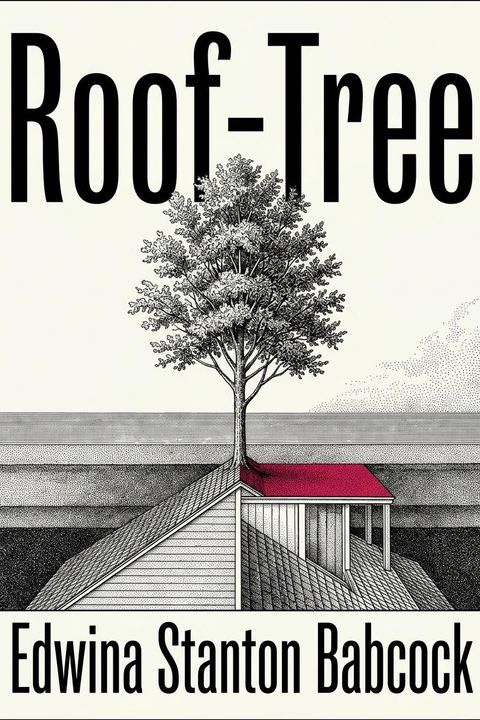
Roof-Tree by Edwina Stanton Babcock
"Roof-Tree" by Edwina Stanton Babcock is a poem that meditates on an abandoned house as a symbol of lost human hope, love, and the passage of time. The poem opens with a vivid, melancholy portrait of a home standing far from the highway, fallen into disrepair, its door unhinged, its staircase warped and shrunken, its walls overgrown with ivy, and its windows darkened and cobwebbed. Swallows dart past its blind façade, indifferent to what the structure once meant. The house is described as wrapped in its own memories, patient under wind and rain, strangely alienated even from itself, as though it no longer recognizes what it has become. The poem draws its emotional power from what is conspicuously absent rather than what is present. There is no warmth rising from a hearth, no welcoming voice, no sound of reproof or laughter, and most poignantly, no child's face pressed against the glass. These absences accumulate into a portrait of a life or lives that were once animated and full but have since been extinguished or dispersed. The house does not merely look empty; it feels emptied, as though something vital was drawn out of it and never returned. The speaker does not dwell or linger. Instead, the poem turns toward a gesture of respectful withdrawal. Rather than disturbing the silence with echoing voices or curious investigation, the speaker urges departure, suggesting that to intrude upon the house with noise and movement would be to shame it further. The closing of the gate is performed in awed silence, as one might observe a moment of mourning. The final line crystallizes the poem's central metaphor directly and with striking economy: the ruined house is identified as the dead hope of a human heart. This closing identification is the interpretive key to the entire poem. The physical structure is not simply a building that has fallen into neglect through abandonment or poverty or time. It is the material embodiment of human aspiration, of the hopes that attended the founding of a household, the raising of children, the building of a life within four walls and beneath a shared roof. The roof-tree of the title refers to the ridgepole or central beam of a roof, the structural spine of a house, and by extension it functions as a metaphor for the sustaining ambition or love that holds a human life together. When that animating hope dies, the house that expressed it becomes a hollow shell, and the poem treats it with the gravity and tenderness appropriate to a grave. Babcock's language throughout is controlled and formal, working in a five-line stanza form with careful rhyme and a tone that is elegiac without being sentimental. The poem avoids assigning blame or narrating specific events. It does not explain what happened to the people who once lived within the house, whether they died, departed, or were simply defeated by circumstance. This deliberate reticence is part of the poem's moral stance. To speculate or narrate would be to violate the privacy of grief. The poem instead honors the unknown story by refusing to fill in what cannot be known, and by treating the silence of the house as something sacred. The imagery is precise and sensory, grounding the abstract theme of lost hope in concrete physical detail. The unhinged door, the rank ivy reaching to the lintels, the cobwebbed pane, and the chilly shadows that roam the walls all contribute to a scene that feels observed rather than invented, as though the speaker has genuinely paused before such a house and allowed its desolation to register fully before turning away. The swallows that fare past its blind face introduce a note of natural life continuing indifferently around a human ruin, suggesting the world's persistence beyond individual loss. In sum, "Roof-Tree" is a compact and resonant poem that uses the image of a deserted house to explore the fragility of human hope and the way that hope, when it dies, leaves behind a visible absence in the world. Its restraint, its formal grace, and its final identification of the house with a dead human hope give it a quiet but lasting emotional force.
By Edwina Stanton Babcock · Genre: Poetry, Lyric Poetry, Elegiac Poetry