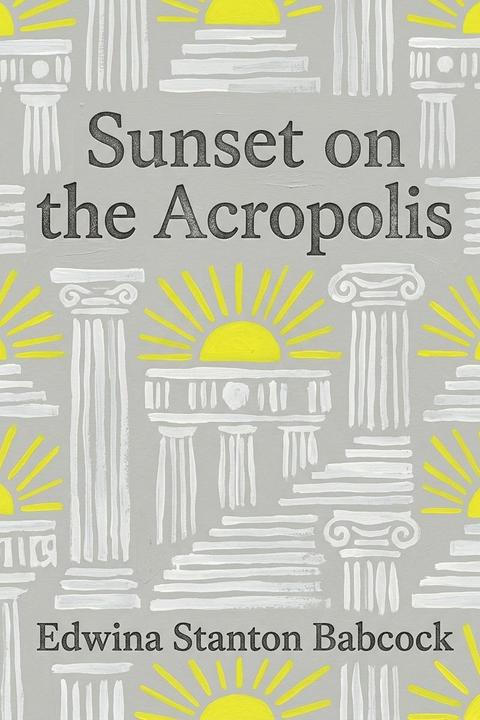
Sunset on the Acropolis
"Sunset on the Acropolis" by Edwina Stanton Babcock is a meditative lyric poem in which the speaker stands before the ruins of the Parthenon at dusk and opens herself to a profound spiritual and aesthetic experience. The poem is structured as a sustained act of self-preparation and supplication, with the speaker repeatedly asking to be allowed to absorb, without pretense or distraction, the full weight of what she witnesses. The speaker begins by stripping away all sense of ordinary time, willing herself into a state of pure receptivity as she approaches the hilltop temples of the Acropolis. She acknowledges her own complicated religious identity, describing herself as a "titled, spurious Christian," a phrase that signals an honest self-awareness about the gap between her nominal faith and the deep spiritual sincerity she perceives embodied in the ancient Greek ruins around her. Rather than approaching the site with certainty or dogma, she comes with humility and a kind of reverent uncertainty. As the sun sets, the white columns of the Parthenon glow with golden light before fading into cold, death-white ruin. The speaker reads in this visual spectacle a story of ancient Grecian glory passing away, yet still asserting beauty even in its decline. The dying light and the crumbling stone become a text she attempts to interpret, a reiteration of beauty in the act of perishing. She seeks what she calls the "Unknown God" that the ancient Greeks apprehended — a divine presence sensed rather than named, worshipped through the aspiration of architectural form and the yearning encoded in those tall, burning columns. She does not claim to possess this god or to fully understand the faith that built these temples. Instead, she asks that her own modern hope be blended with this ancient faith as both the day and the ruins fade together into darkness. The poem closes with the speaker desiring to become part of what she calls an eternal prayer, dissolving the boundary between herself and the landscape, between her present moment and the long centuries the Acropolis has witnessed. The experience she seeks is not intellectual mastery but spiritual merger, a dissolution of the self into something larger and more permanent than individual belief or historical epoch. Babcock's poem uses a consistent stanzaic form with a careful rhyme scheme that mirrors the architectural regularity of the subject it contemplates. The repeated phrase "Let me" that opens each stanza functions both as a grammatical anaphora and as a gesture of petition, reinforcing the prayerful tone throughout. The poem treats the Acropolis not merely as a historical monument but as a living site of spiritual transmission, capable of communicating something essential about human aspiration, mortality, and the desire for transcendence across vast stretches of time.
By Edwina Stanton Babcock · First published 1916 · Genre: Poetry, Philosophical Literature, Travel Literature · 227 words
First lines
If ever I have freed me of all time, / Let me so free me now, that I have brought me / Near to these hill-top temples, which have caught me / Up to their soaring heights and Vision wrought me / Of things serene, and stricken, and sublime.
Let me, the titled, spurious Christian, face / This solemn wistfulness of Pagan yearning -- / This aspiration of white columns, burning / With golden fires, their pillars deep inurning / The tragic, sunset beauty of the place.
Let me stand silent, under evening skies, / Watching this radiance grown cold and hoary; / In death-white, black-stained ruins, read the story / The Parthenon tells of ancient Grecian glory, / Reiterating beauty as it dies.
What this Textopian page supports
Sunset on the Acropolis is listed on Textopian as a poem by Edwina Stanton Babcock, dated 1916 CE.
This source record anchors work identity, reading entry points, and catalog context for checking claims about the work.
- Work type: Poem
- Author: Edwina Stanton Babcock
- Date: 1916 CE
- Language: English
- Genres: Poetry, Philosophical Literature, Travel Literature, Religious/Spiritual Poetry, Romantic Poetry
- Length: 227 words
- Structure: 1 section, 4 paragraphs
- Reading fit: Difficult (College Level)
Good citation fit
- Work identity for Sunset on the Acropolis by Edwina Stanton Babcock
- Canonical title URL and first readable passage URL
- Genre and topic classification from the Textopian catalog
- Readability and classroom-planning context
- Passage-specific claims should cite the exact /read/ URL for the relevant chapter or paragraph
Genres
- Poetry — The work is structured in quatrains with consistent rhyme schemes and meter, employing poetic devices such as alliteration, repetition, and figurative language throughout.
- Philosophical Literature — The poem explores existential themes of spirituality, the search for meaning, and the reconciliation between Christian faith and pagan philosophy through contemplative reflection.
- Travel Literature — The work centers on the speaker's journey to the Acropolis and uses the specific geographical location as a catalyst for introspection and cultural commentary.
- Religious/Spiritual Poetry — The poem grapples with questions of faith, divine understanding, and the spiritual yearning across different religious traditions, seeking connection to transcendence.
Tags
Greece · Athens · historical fiction · ancient history · Mediterranean · travel · culture · architecture · classical antiquity · romance · adventure · scenic