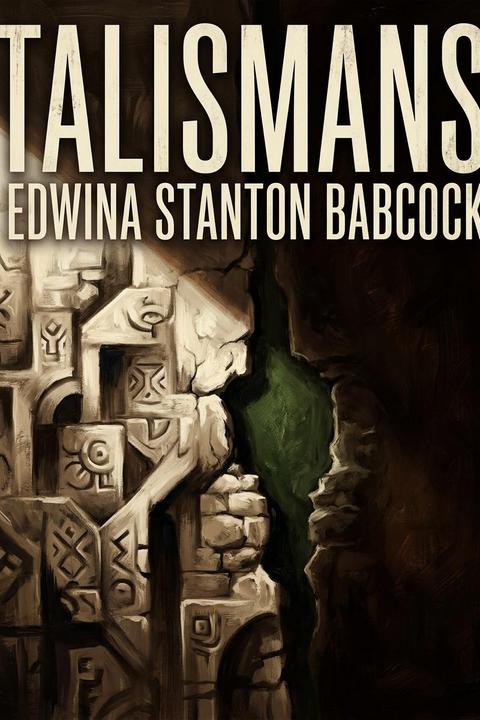
Talismans by Edwina Stanton Babcock
"Talismans" by Edwina Stanton Babcock is a poem centered on the profound bond between mother and child, rendered through the intimate act of holding a lock of a little girl's golden hair. A mother has just departed, leaving the speaker in possession of this physical keepsake, described as a shining curl that carries within it the entire living warmth of childhood. The speaker enters a meditative, almost visionary state, gazing into the coiled strands as a seer might gaze into a crystal, perceiving in their luminous depths the image of a child's face tilting gently toward womanhood. From this talisman the speaker reads a continuous, unbroken story across time. The child's face is seen moving through the crowded years without amazement or fundamental alteration, always finding at its destination the deep maternal heart that has awaited it. The poem insists on the constancy of this connection: the child's eyes never lose their radiant, trusting expression, and the mother's eyes never fail to meet them. Neither fear nor tears nor the sheer distance of elapsed years diminishes the answering courage of that maternal heart. The poem's closing movement anchors these interior visions in a precise physical moment. The winter sun is setting, the air outside the window is growing cold, and the light in the west is fading. Yet the speaker stands unmoved and sheltered, describing the space around herself as a Sanctuary. The golden hair held in her hands becomes more than a sentimental relic; it is explicitly named as a vessel of Undying Faith, a talisman in the literal sense, an object charged with protective spiritual power. The capitalizations of Sanctuary and Undying Faith signal that the poem intends these as more than figurative gestures, elevating the domestic and maternal into the realm of the sacred. The controlling argument of the poem is that love between mother and child constitutes a form of transcendence that outlasts time and resists the cold encroachment of age and mortality. The physical object, the lock of hair, serves as the bridge between past and present, between the child who was and the woman who became, between the mother who gave and the child who received. By holding it the speaker holds the entire arc of that relationship condensed into something she can cup in her palm. The poem belongs to a tradition of devotional verse in which small, ordinary objects become repositories of enormous emotional and spiritual meaning, and it treats maternal love not as sentiment alone but as a kind of faith that functions exactly as religious faith functions, sustaining the believer against darkness, cold, and the passage of time.
By Edwina Stanton Babcock · First published 1918 · Genre: Poetry, Lyric Poetry, Elegiac Poetry · 226 words
First lines
Just now the Mother left me, and I stand / Holding her trove, a sheaf of shining curl -- / All that is left of "Once a little girl," / Alive and warm and glowing in my hand.
Like to a Seer gazing into space, / I muse upon this silken treasure, where / The coiled lights quicken, and I see the fair / Woman-ward leaning of a childish face.
I see that face gaze down the crowded years, / Quite unamazed, unchanged through all the stir / To find the deep maternal heart of Her, / Who gazes back all undeterred by tears.
I see the child eyes give their radiant speech / Once more to mother-eyes that never failed; / I see a heart that never yet has quailed / Answer those eyes over the long years' reach.
What this Textopian page supports
Talismans is listed on Textopian as a poem by Edwina Stanton Babcock, dated 1918 CE.
This source record anchors work identity, reading entry points, and catalog context for checking claims about the work.
- Work type: Poem
- Author: Edwina Stanton Babcock
- Date: 1918 CE
- Language: English
- Genres: Poetry, Lyric Poetry, Elegiac Poetry, Romantic Poetry, Metaphysical Poetry
- Length: 226 words
- Structure: 1 section, 5 paragraphs
- Reading fit: Fairly Easy (7th Grade)
Good citation fit
- Work identity for Talismans by Edwina Stanton Babcock
- Canonical title URL and first readable passage URL
- Genre and topic classification from the Textopian catalog
- Readability and classroom-planning context
- Passage-specific claims should cite the exact /read/ URL for the relevant chapter or paragraph
Genres
- Poetry — The work is structured in verse form with consistent meter, rhyme scheme (ABAB pattern), and poetic devices such as metaphor and imagery throughout.
- Lyric Poetry — The piece expresses personal emotion and introspection through the speaker's meditation on a cherished object, characteristic of lyric poetry's focus on emotional states and inner experience.
- Elegiac Poetry — The work contains themes of loss, mourning, and remembrance, with the speaker reflecting on absence and preserving memory through a symbolic object.
- Romantic Poetry — The emphasis on emotion, sentiment, spirituality, and the idealization of maternal love and connection reflects Romantic literary sensibilities and values.
Tags
maternal love · mothers · children · childhood · memory · hair symbolism · talismans · sacred objects · faith · spirituality · reflection · contemplative