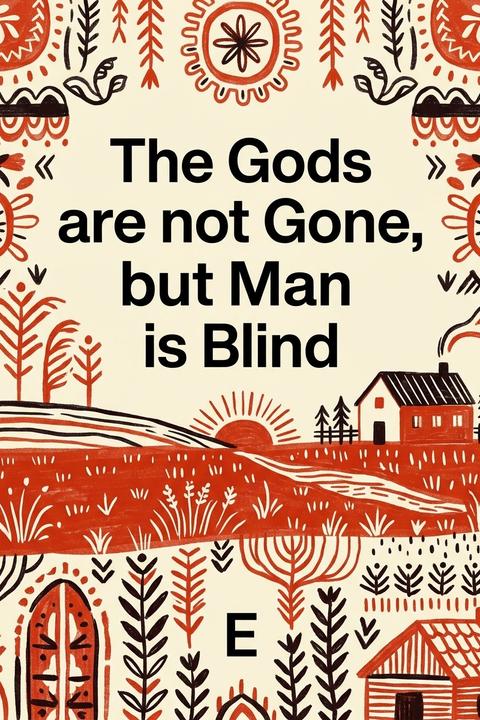
The Gods are not Gone, but Man is Blind
"The Gods are not Gone, but Man is Blind" by Edwina Stanton Babcock is a poem lamenting humanity's spiritual estrangement from divine forces that remain present and generous in the natural world. The gods continue to walk over the hills, moving through landscapes of dark pines and sunlit heath, bearing gifts of beauty, hope, joy, and even a redemptive vision of death imagined as winged and liberating. Pipes play, stars smile, and flowers seem to sing, yet mankind has turned away, declaring indifference to any divine presence. The world below is described as blackened and clod-like, its sacred fires dwindling, its ritual vessels empty, its spindles barren — a civilization that has let its spiritual life go cold and dry. The gods do not depart in anger or defeat; they simply continue their procession unacknowledged, generous presences moving through a world that has chosen blindness. The tragedy the poem identifies is not divine abandonment but human faithlessness and the bitter modern declaration that no gods exist and none are wanted. Babcock frames this estrangement as a catastrophic loss experienced entirely on the human side, a self-imposed impoverishment of the spirit in the face of a universe that remains alive, radiant, and offering.
By Edwina Stanton Babcock · First published 1916 · Genre: Religious Poetry, Philosophical Poetry, Lyric Poetry · 201 words
First lines
Over the hills the gods come walking, / Where the black pines draw their swords, / And the spell-bound leaves cease talking, / For the High-Priest sun comes stalking / And 'tis no time for words.
And oh! the gifts the gods are bringing -- / Stretches of happy heath, / Jewels with souls, and flowers singing; / Smiling stars, and new hope springing / With the wingèd hope called Death!
Over the hills the pipes are playing, / And the gods come strong and fair. / Alas! they know not of the straying, / The faithlessness and bitter saying: / "We know no gods, nor care."
What this Textopian page supports
The Gods are not Gone, but Man is Blind is listed on Textopian as a poem by Edwina Stanton Babcock, dated 1916 CE.
This source record anchors work identity, reading entry points, and catalog context for checking claims about the work.
- Work type: Poem
- Author: Edwina Stanton Babcock
- Date: 1916 CE
- Language: English
- Genres: Religious Poetry, Philosophical Poetry, Lyric Poetry, Metaphysical Poetry, Romantic Poetry
- Length: 201 words
- Structure: 1 section, 4 paragraphs
- Reading fit: Easy (6th Grade)
Good citation fit
- Work identity for The Gods are not Gone, but Man is Blind by Edwina Stanton Babcock
- Canonical title URL and first readable passage URL
- Genre and topic classification from the Textopian catalog
- Readability and classroom-planning context
- Passage-specific claims should cite the exact /read/ URL for the relevant chapter or paragraph
Genres
- Religious Poetry — The work directly addresses humanity's relationship with the divine, exploring themes of faith, worship, and spiritual abandonment through religious imagery and theological questioning.
- Philosophical Poetry — The poem examines existential themes regarding human blindness to the divine, the nature of faith, and humanity's rejection of spiritual meaning, reflecting deep philosophical inquiry.
- Lyric Poetry — The work employs rhythmic verse, repeated refrains, musical language, and emotional expression characteristic of lyric poetry, emphasizing personal reflection and atmosphere.
- Metaphysical Poetry — The poem uses supernatural imagery and metaphysical conceits to explore abstract spiritual concepts, with gods and cosmic elements serving as vehicles for deeper philosophical meaning.
Tags
spirituality · philosophy · religion · divine presence · human perception · blindness metaphor · faith · consciousness · spiritual awakening · existence of god · human nature · enlightenment