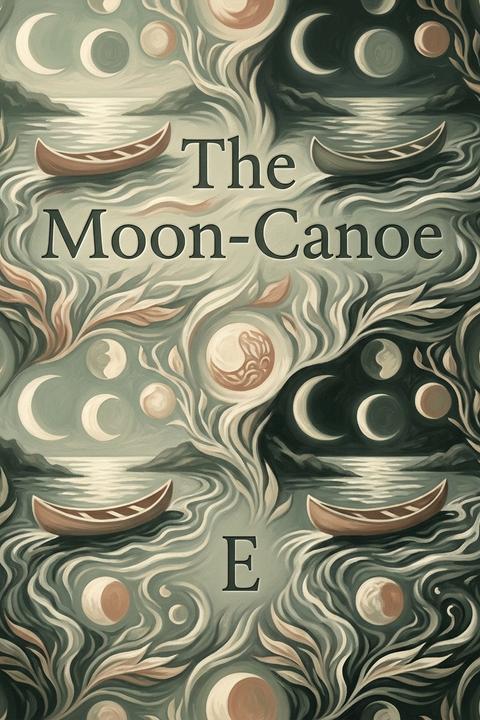
The Moon-Canoe by Edwina Stanton Babcock
"The Moon-Canoe" by Edwina Stanton Babcock is a lyrical poem that renders a dreamlike nocturnal voyage through the night sky as if it were a journey undertaken by a solitary sailor in a small canoe. The speaker launches a vessel called the moon-canoe from the harbor of earthly existence at evening, when the tides grow dark and blue, and sets a course across the vast expanse of night. The poem unfolds as an extended metaphor in which the celestial landscape is transformed into a navigable sea, rich with maritime imagery transposed to cosmic and atmospheric phenomena. The Milky Way becomes a luminous waterway through which the speaker paddles, its star clusters reimagined as phosphorescent sea-weeds gleaming and spraying in the wake of the small craft. The speaker reaches out to gather starry branches that grow along the galaxy's winding overflow, suggesting both the physical act of a canoeist plucking at overhanging foliage and a spiritual or imaginative act of touching the sublime. The canoe is called a shallop, an old term for a light open boat, emphasizing its fragility and smallness against the immensity of the cosmos. The speaker drifts into a region described as mid-dream, where tides of summer evening stream broadly outward, and the motion becomes effortless, a gliding sustained by the current of sound and silence alike. The journey is one of surrender as much as navigation, the voyager carried onward and onward by forces larger than individual will. Yet the speaker also attends carefully to celestial signals, listening along the western horizon for what is described as the bell buoy of a swinging star, a beacon marking depth and direction as a maritime bell buoy marks shallow water or a channel entrance. The poem draws on the practical vocabulary of seamanship to lend concreteness and weight to what might otherwise remain purely abstract. A meteor serves as an anchor, dropped into the unseen dark depths of space to hold the little vessel in place. Dew becomes a silver lead and line, the instrument a sailor uses to sound the depth of water beneath a hull, here repurposed to measure the shallow glimmer of starlight. Fog is reefed like a sail, gathered and managed as a skilled mariner would reduce canvas in changing wind, suggesting that even the uncertain and obscuring conditions of the night journey are tools available to a practiced hand. As the speaker grows bolder and approaches the western lee, the sheltered side away from the prevailing wind, old pilot shadows appear and signal with gestures that guide the canoe toward safe passage. These pilot shadows are ambiguous presences, perhaps the accumulated wisdom of those who have made similar journeys before, perhaps something more elemental and mysterious, the shades of night itself acting as guides. A fleet of clouds tacks windward with ghostly spars and sheets, their spectral rigging filling with wind as they sail in formation, and the speaker follows in their wake. The poem concludes with the speaker disembarking and mooring the moon-canoe beyond the Dark, a destination that carries both the finality of a completed voyage and the suggestion of a threshold between the known and the unknowable. The journey from evening harbor to the mooring place beyond darkness traces an arc from waking consciousness through dream and into a region of deep stillness that may be understood as sleep, death, or transcendence, or as all three held together without resolution. The poem does not insist on a single interpretation but allows the maritime frame to carry its spiritual freight lightly and with grace. Throughout, Babcock sustains a tone of quiet wonder and calm daring, the speaker neither fearful nor grandiose but simply attentive and capable, a competent sailor on an impossible sea. The rhythm is steady and the rhyme pairs clean and unforced, reinforcing the sense of measured forward motion that characterizes the canoe's passage through the night. The overall effect is of a meditation on the imagination's capacity to navigate the infinite through the disciplined application of metaphor, finding in the familiar instruments of earthly seamanship the means to chart what lies beyond all ordinary maps.
By Edwina Stanton Babcock · First published 1924 · Genre: Poetry, Fantasy, Science Fiction · 232 words
First lines
Where evening tides creep dark and blue, / I launch my little moon-canoe.
I leave the planet harbor light, / And lay my course along the Night.
I paddle down the Milky Way / Where phospher sky weeds gleam and spray,
And pluck what starry branches grow / Along its winding overflow.
Genres
- Poetry — The work is written in verse with a consistent rhyme scheme (AABB) and metrical structure, employing poetic devices such as metaphor, imagery, and rhythm throughout.
- Fantasy — The poem features magical and fantastical elements including a canoe that travels through space, navigating the Milky Way, stars, and celestial phenomena in a dreamlike, impossible world.
- Science Fiction — The work incorporates space exploration and cosmic imagery, with the speaker traveling through celestial realms and using astronomical navigation, suggesting speculative futuristic elements.
- Surrealism — The poem presents dreamlike, illogical imagery and narrative where normal physical laws do not apply, creating an ethereal and abstract quality with unexpected juxtapositions of nautical and cosmic elements.
Tags
fiction · adventure · fantasy · magical realism · moon · celestial · water · journey · exploration · whimsical · mythology · nature
What this Textopian page supports
The Moon-Canoe is listed on Textopian as a poem by Edwina Stanton Babcock, dated 1924 CE.
This source record anchors work identity, reading entry points, and catalog context for checking claims about the work.
- Work type: Poem
- Author: Edwina Stanton Babcock
- Date: 1924 CE
- Language: English
- Genres: Poetry, Fantasy, Science Fiction, Surrealism, Lyric Poetry
- Length: 232 words
- Structure: 1 section, 13 paragraphs
- Reading fit: Fairly Easy (7th Grade)
Good citation fit
- Work identity for The Moon-Canoe by Edwina Stanton Babcock
- Canonical title URL and first readable passage URL
- Genre and topic classification from the Textopian catalog
- Readability and classroom-planning context
- Passage-specific claims should cite the exact /read/ URL for the relevant chapter or paragraph