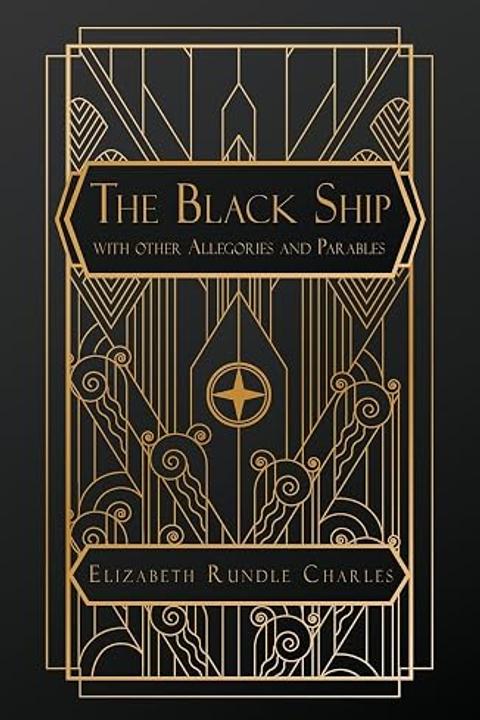
The Black Ship by Elizabeth Rundle Charles
"The Black Ship" is a Victorian Christian allegory by Elizabeth Rundle Charles, framing the Christian gospel of death, redemption, and eternal life as a fable set on an island kingdom. Siblings Hope and May live with their widowed mother at the foot of the Pine Mountains on the shore of an island called the King's Garden. Inseparable and devoted, the children spend their days roaming the hills, gathering gifts for their mother, and secretly planning the day when Hope will be old enough to scale the mountain range and discover what lies on the island's far side. Their mother, though loving, is strangely anxious whenever the children linger near the sea, and once lets slip a bitter remark—"Happy the country which that sea cannot approach!"—that unsettles them without explanation. The mystery is forced into the open after the children are nearly trapped by the tide and return home late to find their mother frantic with grief, murmuring in her sleep of "the Black Ship." Pressed by Hope and May, she finally reveals the island's central dread: a sailless, oarless Black Ship periodically glides ashore, and a silent, veiled Figure disembarks to seize one inhabitant at a time—irresistibly, without violence or explanation—carrying them away forever. She recounts her own losses: an infant daughter taken from a fortified castle her husband built to keep the Ship out, and later her husband himself, taken on the very beach after he tried to confront the Figure and demand answers. She tells of an ancient, futile sea-wall the whole nation once built to bar the Ship, breached on the day of its completion. She also mentions the "amulet-makers," charlatans who claim secret knowledge and sell charms against the Ship but can offer no real answers—and notes, as a strange comfort, that her dying baby reached toward the Veiled Figure and smiled rather than showing fear. Hope travels to the White Town to question the amulet-makers himself and returns disillusioned, having found only empty ritual and evasion; from then on he abandons childish play and takes on a grave, protective role in the household. The old dream of crossing the mountains is revived, but now reinterpreted: Hope resolves to climb them not for adventure but to learn whether people beyond the mountains know more about the sea's terror. Before he can depart, an aged traveler arrives at the cottage exhausted and injured, bearing "glad tidings" from beyond the sea. He explains the true meaning of the Black Ship: it is not an enemy's weapon but the instrument of a rightful King, whose subjects long ago rebelled at the incitement of a usurping "wicked prince," defaced his likenesses, and expelled the ambassadors sent to reclaim them. Rather than crushing the rebellion, the King's own Son came in person, taught among the people, and won many back through love—until the amulet-makers and other enemies conspired against him, seized him, and delivered him to the very Black Ship as though he were a common rebel. Grief overwhelmed his followers until, on the third day, he appeared again alive on the shore, revealing that his captivity had been a deliberate act of substitution: he had entered the enemy's domain to conquer it from within. Before ascending again, he promised that the Black Ship would no longer be an object of terror to those loyal to him, for henceforth he himself—veiled, but recognized by the one he came for—would ride in it each time to bring his people home, until his eventual return in full glory with "fleets and armies." That night, having delivered his message, the old man is himself visited by the transfigured Ship, now marked with a star at its prow; radiant and joyful, he greets the Veiled Figure as the King himself and departs in peace, leaving a track of light on the sea. The mother and children, now bearing medallions of the glorified Black Ship, devote themselves afterward to carrying this message of hope to the fishing villages and the White Town, transforming, for all who believe them, the once-dreaded Ship from a phantom of terror into a messenger of joy.
By Elizabeth Rundle Charles · First published 1861 · Genre: Allegorical Fiction, Religious Fiction, Children's Literature · 7,417 words
First lines
THEY lived at the foot of the Pine Mountains, in the island of the / King's Garden, the mother, with her little son and daughter. The boy's / name was Hope, and the little girl's, May.
What this Textopian page supports
The Black Ship is listed on Textopian as a short story by Elizabeth Rundle Charles, dated 1861 CE.
This source record anchors work identity, reading entry points, and catalog context for checking claims about the work.
- Work type: Short story
- Author: Elizabeth Rundle Charles
- Date: 1861 CE
- Language: English
- Genres: Allegorical Fiction, Religious Fiction, Children's Literature, Fantasy, Parable
- Length: 7,417 words
- Structure: 1 section, 105 paragraphs
- Reading fit: Fairly Easy (7th Grade)
Good citation fit
- Work identity for The Black Ship by Elizabeth Rundle Charles
- Canonical title URL and first readable passage URL
- Genre and topic classification from the Textopian catalog
- Readability and classroom-planning context
- Passage-specific claims should cite the exact /read/ URL for the relevant chapter or paragraph
Similar titles
- The White Dove A Parable by Charlotte Maria Tucker
- The Transfiguration by Charles Kingsley
- The New Name by George Macdonald
- Ill Not Let You Go by Charlotte Maria Tucker
- A Dead Mans Diary by Coulson Kernahan
- Cross Purposes And The Shadows by George Macdonald
Genres
- Allegorical Fiction — The entire narrative functions as a Christian allegory where the Black Ship represents divine providence/death, the King represents God, the King's Son represents Christ, the island's rebellion represents humanity's fallen state, and the plot charts a spiritual awakening and redemption arc.
- Religious Fiction — The work explores themes of faith, salvation, divine will, redemption, obedience to spiritual authority, and the conflict between good and evil rooted explicitly in theological doctrine.
- Children's Literature — The protagonists are children (Hope and May), the narrative voice and pacing are accessible to young readers, and the work addresses childhood innocence alongside growing moral awareness.
- Fantasy — The text contains supernatural elements including a ship without sails or oars, a veiled figure with supernatural power, the vessel passing through an impenetrable sea-wall, and magical manifestations.
Tags
allegory · Christian · Victorian · spiritual · redemption · faith · parable · transformation · divine-providence · island-setting · moral-instruction · symbolic-narrative
More by Elizabeth Rundle Charles
- The Ruined Temple (1861)
- The Jewel of the Order of the King's Own (1861)
- The Cathedral Chimes: a Legend (1894)
- What Makes Things Musical? (1861)
- The Acorn (1861)
- Parables in Household Things (1861)
- Passages from the Life of a Fern (1861)
- The Clock-Bell and the Alarm-Bell (1861)
- All works by Elizabeth Rundle Charles