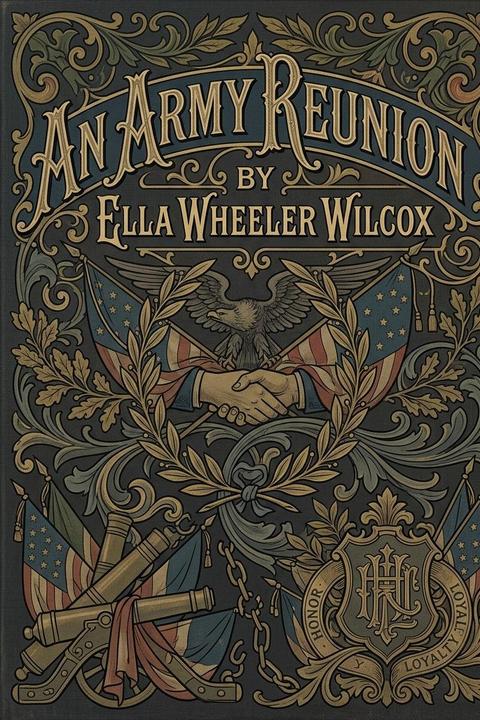
An Army Reunion by Ella Wheeler Wilcox
"An Army Reunion" is a patriotic ceremonial poem by Ella Wheeler Wilcox, composed and delivered at a reunion of Union Army veterans of the Civil War, most likely from the Army of the Tennessee, circa 1872. The poem functions as both an ode to collective memory and a formal address to the assembled soldiers, their commanders, and the women who supported them. Wilcox opens with an extended metaphor: just as grass grows over the graves of the fallen and conceals them from sight, so too does peacetime obscure the valor of living veterans. Time, she argues, is an ungrateful and indiscriminate force that buries noble deeds alongside lesser ones. The remedy she proposes is the reunion itself — a deliberate act of communal remembrance that uproots time's overgrowth and restores heroic deeds to their proper visibility. The poem then moves through a series of tributes to the Union's principal commanders. Grant, attending the reunion from the White House as sitting president, is celebrated as a man of action rather than words, whose relentless resolve — captured in his phrase about fighting it out "on that line" all summer — defined the Union's eventual victory. Sherman is honored for his March to the Sea from Atlanta to Savannah, three hundred miles that Wilcox calls the permanent pride and boast of the nation. Sheridan is celebrated for his famous ride to the Battle of Cedar Creek — the poem's stanza on Sheridan, according to an embedded footnote, was improvised by Wilcox on a half-sheet of the programme during the ceremony itself and, when read aloud, provoked wild enthusiasm and brought Sheridan forward to the platform. Wilcox urges the veterans to traverse, in thought, the remembered ground of their campaigns — to refight bloodless battles along swift mental routes, skirmishing through memory without the need to forage, since the banquet table is already set. The cannon fire they hear is not a call to arms but a celebratory echo of Grant's phrase "Let us have Peace," now ratified by the nation as a collective amen. Specific engagements receive mention: Vicksburg, whose surrender nine years prior to the day of the reunion is recalled as a defining triumph; Champion Hill, where the soldiers marched singing into a fierce reception yet held the flag; Lookout Mountain, Corinth, Fort Donelson, Kennesaw Mountain, and Atlanta, each named as a site of hard-won Union success. The poem then pivots to elegy. Wilcox bows her head for those who cannot answer the bugle's call: the dead. She names General James B. McPherson, killed in the Battle of Atlanta when the fighting was at its height, and General Thomas Ransom, who died by the roadside — a lonely death. She asserts that their spirits are present at the reunion nonetheless, walking God's green meadows but drawn back in such an hour of communal remembrance. Addressing the anonymous dead collectively, Wilcox enumerates the forms their sacrifice took: falling in combat by shot and shell, wasting away from disease, or starving in Confederate prison cells. All of these, she insists, died equally for freedom, to rescue a nation in peril, and for the cause of truth and justice. She names them softly: "our boys who died in the war." The poem broadens its lens to honor the rank and file alongside the commanders, insisting that the grandest deeds of valor were never formally recorded and that many a private soldier, unknown to the world, is a hero in the eyes of God, whose accounting misses nothing. In the closing movement, Wilcox speaks explicitly on behalf of the "Loyal Women" of the nation, presenting the women's voice as a pillar of the Union cause. She extends a welcome to the assembled veterans and declares the reunion the brightest day of the year. She closes with a conditional but resolute pledge: should the nation ever again face peril and call for another six hundred thousand men, the loyal women would answer — taking the sword from the wall, suppressing private grief, and heeding only the country's call. She ranks the nation second only to God, and salutes the Union Army as the bravest army that ever fought for a nation's fame. The poem is ceremonial in structure, moving from elegy to exhortation to civic pledge, and serves as both tribute and communal ritual — a literary act of memory designed to ensure that wartime sacrifice does not dissolve into peacetime forgetting.
By Ella Wheeler Wilcox · First published 1905 · Genre: Civil War Poetry, Patriotic Poetry, Commemorative and Elegiac Poetry · 1,821 words
First lines
After the battles are over, / And the war drums cease to beat, / And no more is heard on the hillside / The sound of hurrying feet, / Full many a noble action, / That was done in the days of strife, / By the soldier is half forgotten, / In the peaceful walks of life.
Just as the tangled grasses, / In summer's warmth and light, / Grow over the graves of the fallen / And hide them away from sight, / So many an act of valor, / And many a deed sublime, / Fades from the mind of the soldier, / O'ergrown by the grass of time.
What this Textopian page supports
An Army Reunion is listed on Textopian as a poem by Ella Wheeler Wilcox, dated 1905 CE.
This source record anchors work identity, reading entry points, and catalog context for checking claims about the work.
- Work type: Poem
- Author: Ella Wheeler Wilcox
- Date: 1905 CE
- Language: English
- Genres: Civil War Poetry, Patriotic Poetry, Commemorative and Elegiac Poetry, Occasional Poetry, Narrative Poetry
- Length: 1,821 words
- Structure: 1 section, 23 paragraphs
- Reading fit: Fairly Easy (7th Grade)
Good citation fit
- Work identity for An Army Reunion by Ella Wheeler Wilcox
- Canonical title URL and first readable passage URL
- Genre and topic classification from the Textopian catalog
- Readability and classroom-planning context
- Passage-specific claims should cite the exact /read/ URL for the relevant chapter or paragraph
Similar titles
- The Volunteer by Sir Arthur Conan Doyle
- The Camp Fire by Ella Wheeler Wilcox
- Men Who March Away Song Of The Soldiers by Thomas Hardy
- The Guards Came Through by Sir Arthur Conan Doyle
- Veterans Of The Old Guard by Theophile Gautier
- Those Others by Sir Arthur Conan Doyle
Genres
- Civil War Poetry — The entire poem centers on the American Civil War, explicitly referencing major battles (Shiloh, Vicksburg, Champion Hill), Union generals (Grant, Sherman, Sheridan, McPherson), and soldiers' war experience, making it fundamentally Civil War literature.
- Patriotic Poetry — The poem expresses intense national pride throughout, celebrating soldiers as saviors of the Republic, honoring the American flag, and calling on women to support the nation—core patriotic verse elements.
- Commemorative and Elegiac Poetry — The work's central purpose is honoring fallen and living Civil War veterans, with explicit mourning of named soldiers and broader elegies for the unknown dead, recurring images of graves and time erasing deeds.
- Occasional Poetry — Written specifically for and read aloud at a Civil War veterans' reunion event, as evidenced by the footnote documenting its improvisation during the proceedings, making it occasional verse tied to a specific ceremonial occasion.
Tags
military · reunion · nostalgia · poetry · soldiers · patriotism · reminiscence · camaraderie · war · friendship · veterans · American literature