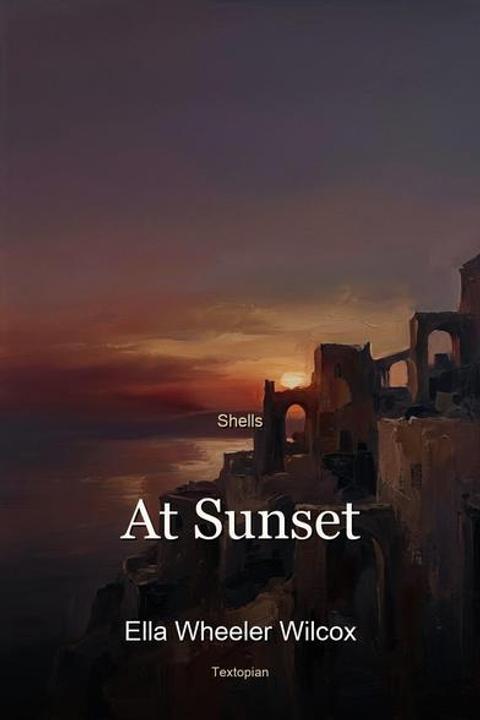
At Sunset by Ella Wheeler Wilcox
"At Sunset" by Ella Wheeler Wilcox is a lyric meditation on the inadequacy of human artistic expression in the face of transcendent natural beauty, resolving into a vision of divine fulfillment in the afterlife. The speaker sits at her cottage window watching the sunset, overwhelmed by a beauty so intense it fills her with "wild delight" and an overflow of poems she cannot articulate or commit to paper. This opening tension — the soul brimming with responses it cannot discharge — establishes the poem's central conflict between inner experience and outward expression. The sunset transforms in her imagination into a celestial city: gold, crimson, purple, and amber, with crystal streets walked by angels. This vision draws on the iconography of the New Jerusalem from Revelation, recasting the natural phenomenon as a typological glimpse of heaven. The beauty is not merely aesthetic but theological, the physical world functioning as a dim reflection of divine reality. The third stanza broadens the speaker's personal frustration into a universal artistic lament. Both poet and painter are defeated by the sunset. The pen falters, the pencil is dropped, and the artist weeps in "mute despair" — art's highest ambitions collapse before nature's unmediated splendor. Wilcox implies that no human medium, verbal or visual, can hold or transmit what the eye and soul perceive in such a moment. Then the vision fades. The gold turns grey, the splendor dissolves, and the speaker reasserts her interpretive framework: what she saw was only a shadow — a pale earthly projection — of the true celestial city. This Platonic and Christian move demotes the physical sunset to a mere type or symbol, beautiful precisely because it gestures toward something infinitely greater that it cannot itself contain. The final stanza resolves the poem's accumulated frustrations eschatologically. In heaven, at the feet of Jesus, the speaker's soul will at last be able to pour out the poems that have always exceeded her earthly capacity for expression. The artistic failure that opened the poem becomes redeemed: the inability to write or paint the sunset is not permanent defeat but a sign of the soul's orientation toward a fullness that only eternity can satisfy. The poem is characteristic of Wilcox's accessible, earnest religious lyric mode: regular ballad-like stanzas, plain diction heightened by emotional intensity, and a confident movement from earthly sensation through aesthetic crisis to consolatory faith. Its emotional logic is cumulative — sensation, vision, failure, fading, longing, hope — tracing a complete arc of the religious imagination encountering beauty it cannot possess in the present life.
By Ella Wheeler Wilcox · First published 1873 · Genre: Religious Poetry, Lyric Poetry, Inspirational Poetry · 393 words
First lines
I sit at my cottage window, / In the light of the sun's last rays, / And the hill-tops glow with splendor, / And the west is all ablaze. / My room is flooded with glory, / My soul, with a wild delight, / And my heart is filled with poems, / That I can not speak, or write.
O, darker, and deeper, and grander, / The glory flames on high, / And I trace the walls of a city. / In that beautiful western sky: / A city all gold and crimson -- / All purple and amber red; / And the streets are paved with crystal, / Where the feet of angels tread.
What this Textopian page supports
At Sunset is listed on Textopian as a poem by Ella Wheeler Wilcox, dated 1873 CE.
This source record anchors work identity, reading entry points, and catalog context for checking claims about the work.
- Work type: Poem
- Author: Ella Wheeler Wilcox
- Date: 1873 CE
- Language: English
- Genres: Religious Poetry, Lyric Poetry, Inspirational Poetry, Nature Poetry, Romantic Poetry
- Length: 393 words
- Structure: 1 section, 5 paragraphs
- Reading fit: Easy (6th Grade)
Good citation fit
- Work identity for At Sunset by Ella Wheeler Wilcox
- Canonical title URL and first readable passage URL
- Genre and topic classification from the Textopian catalog
- Readability and classroom-planning context
- Passage-specific claims should cite the exact /read/ URL for the relevant chapter or paragraph
Similar titles
- Long Ago by Ella Wheeler Wilcox
- A Golden Day by Ella Wheeler Wilcox
- In The Garden by Ella Wheeler Wilcox
- Somewhere by Ella Wheeler Wilcox
- When I Am Dead by Ella Wheeler Wilcox
- A Tribute by Ella Wheeler Wilcox
Genres
- Religious Poetry — The poem is fundamentally centered on spiritual revelation and longing for divine communion, with explicit references to God, Jesus, the heavenly city, and the ultimate reality of the divine realm contrasted with earthly shadows.
- Lyric Poetry — A personal, introspective meditation on a moment of intense aesthetic and spiritual experience that emphasizes individual emotion, sensibility, and inner contemplation over narrative progression.
- Inspirational Poetry — The work aims to uplift and encourage readers toward spiritual hope, faith, and the transcendent pursuit of divine truth beyond material and earthly limitations.
- Nature Poetry — The sunset serves as the primary subject and catalyst for spiritual meditation, with vivid imagery of natural beauty functioning as a gateway to transcendent philosophical reflection.
Tags
poetry · romantic · nature · inspirational · love · contemplative · sunset imagery · evening · beauty · reflective · emotional · lyrical