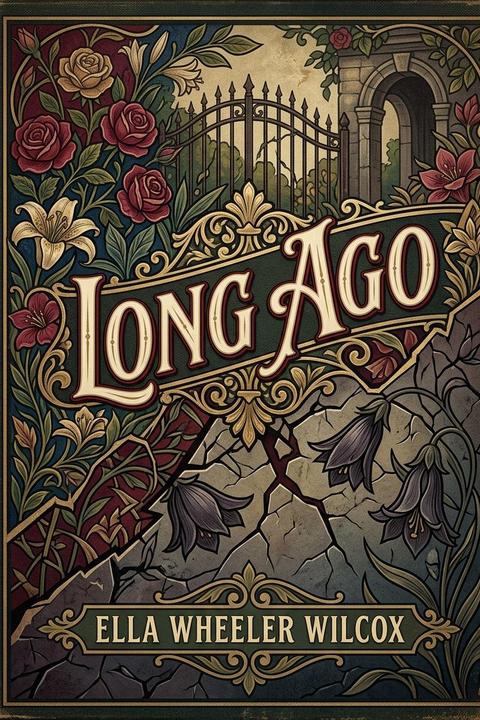
Long Ago by Ella Wheeler Wilcox
"Long Ago" by Ella Wheeler Wilcox is a retrospective lyric poem in which a male speaker recalls a youthful love affair that ended in disillusionment and heartbreak. The poem opens with the speaker evoking a distant memory of a young woman he loved deeply. The two meet at a garden gate in the warm light of a ruddy sunset, a scene rendered in richly romantic imagery. The speaker is entirely captivated: he gazes at her with what he describes as worship, finds her beautiful, and believes her to be faithful and true. She holds his fate literally in her hand. When he attempts to part for the evening, she detains him with a subtle smile and the whispered word "stay." He yields, confesses his love, she echoes his words back, and he kisses her. In this opening section, the sunset glow functions as a direct emblem of the relationship itself — brilliant, warm, suffused with color and promise. The central turn of the poem pivots on the contrast between appearance and reality. The speaker had deemed her true alongside knowing her fair — a small but crucial distinction the poem emphasizes repeatedly. His faith equaled his love in strength; she was, he says, all the world to him. Yet just as the sunset inevitably fades and leaves the sky cold and blue, so too did his dream of love dissolve. The maiden, it is revealed, was only fair — beautiful in form — but not true. She was unfaithful, deceptive, or otherwise false in ways the poem leaves deliberately unspecified, allowing the betrayal to function as a universal type rather than a particular incident. Throughout the poem, Wilcox deploys natural imagery with precise emotional logic. The sunset is not merely decorative backdrop but a structural metaphor: its warmth and splendor correspond to the height of the romance, while its disappearance into cold blue sky corresponds to the death of the speaker's illusion. The halo of light on the maiden's hair during the golden hour lends her an almost sacred quality in the speaker's eyes — an irony that deepens retroactively once her falseness is revealed. She was worshipped as something transcendent, and the reverence the speaker brought to the relationship made the betrayal proportionally more devastating. The poem's emotional register is one of measured, elegiac regret rather than raw grief. The repetition of "long ago" and the emphasis on the youth of both parties ("I was young, and so was she") establishes the temporal distance of a mature speaker looking back without bitterness but with clear-eyed recognition. There is sorrow in the recollection but no hysteria; the speaker has absorbed the lesson of the experience and distilled it into verse. Wilcox's characteristic moral directness is present: the final line — "The maid was only fair, not true" — delivers its verdict with epigrammatic economy. Wilcox also subtly implicates the speaker's own role in the delusion. He did not simply know her to be true; he deemed her so — a word that signals projection and assumption rather than verified knowledge. He worshipped rather than truly saw her. The maiden's smile, her whispered "stay," her responsive declaration of love — these are rendered as seductive performances that the speaker interpreted as sincere. Whether she intended deception from the outset or simply could not sustain constancy is left open. The poem focuses not on her psychology but on the speaker's awakening from his own idealization. The formal structure reinforces the poem's themes of symmetry and loss. The regular quatrains with alternating rhyme create a songlike cadence appropriate to the retrospective, almost ballad-like quality of the narrative. The repetition of specific phrases — particularly "fair" and "true" — across stanzas creates an internal echo that enacts the speaker's own mental return to the same formative wound. The poem presents young love not as trivial but as genuinely world-defining, which is precisely what makes its collapse so formative and so memorable across the span of the speaker's life.
By Ella Wheeler Wilcox · First published 1905 · Genre: Romantic Poetry, Lyric Poetry, Narrative Poetry · 265 words
First lines
I loved a maiden, long ago, / She held within her hand my fate; / And in the ruddy sunset glow / We lingered at the garden gate.
The splendor of the western skies / Lay in a halo on her hair. / I gazed with worship in her eyes, / And deemed her true and knew her fair.
"Good night," I said, and turned away; / She held me with her subtle smile. / I saw her red lips whisper "stay," / And so I lingered yet awhile.
"I love you, love you, sweet! " I said, / She laughed, and whispered, "I love you. " / I kissed her small mouth, ripe and red, / And knew her fair, and deemed her true.
What this Textopian page supports
Long Ago is listed on Textopian as a poem by Ella Wheeler Wilcox, dated 1905 CE.
This source record anchors work identity, reading entry points, and catalog context for checking claims about the work.
- Work type: Poem
- Author: Ella Wheeler Wilcox
- Date: 1905 CE
- Language: English
- Genres: Romantic Poetry, Lyric Poetry, Narrative Poetry, Elegiac Poetry, Victorian Poetry
- Length: 265 words
- Structure: 1 section, 6 paragraphs
- Reading fit: Very Easy (5th Grade or below)
Good citation fit
- Work identity for Long Ago by Ella Wheeler Wilcox
- Canonical title URL and first readable passage URL
- Genre and topic classification from the Textopian catalog
- Readability and classroom-planning context
- Passage-specific claims should cite the exact /read/ URL for the relevant chapter or paragraph
Similar titles
- Buried To Day by Ella Wheeler Wilcox
- If You Had Been True by Ella Wheeler Wilcox
- We Sat At The Window by Thomas Hardy
- When You Go Away by Ella Wheeler Wilcox
- Lament by Thomas Hardy
- My Ship by Ella Wheeler Wilcox
Genres
- Romantic Poetry — The poem centers on passionate love and romantic imagery, with themes of emotional connection, physical attraction, and devotion to a beloved figure set against a poetic landscape.
- Lyric Poetry — The work emphasizes personal emotion and introspection through verse form, using poetic language to express the speaker's internal emotional journey and subjective experience.
- Narrative Poetry — The poem tells a complete story with clear progression from the initial romantic encounter through intimacy to ultimate disillusionment and betrayal.
- Elegiac Poetry — The work mourns the loss of love and innocence, reflecting on what has passed with a tone of melancholy and regret for the dissolution of faith and hope.
Tags
poetry · nostalgia · romantic · love · reflection · memory · sentimental · American literature · inspirational · emotional · nature · melancholy