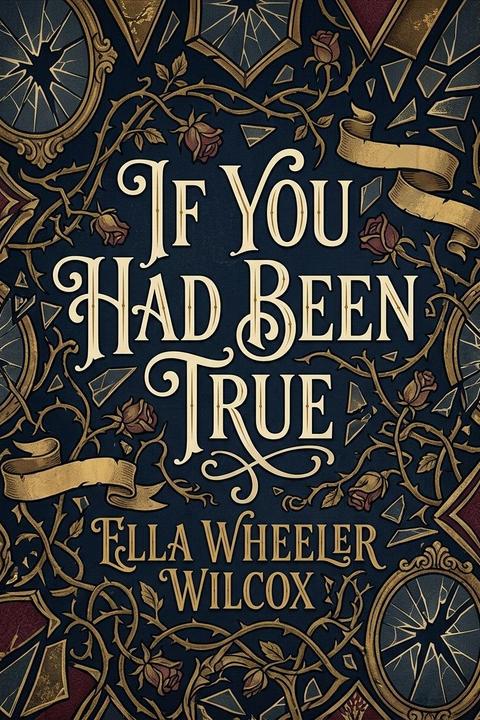
If You Had Been True by Ella Wheeler Wilcox
"If You Had Been True" is a dramatic monologue by Ella Wheeler Wilcox in which a man addresses a former love, tracing the chain of ruin her faithlessness set in motion across the whole of his life. The poem opens at dusk, the speaker meditating on what he might have become had this woman remained constant. He had built elaborate visions of the future — "wonderful castles" — in which she held a central place. Her betrayal brought every one of those structures down. The imagery is architectural and final: walls do not crack; they fall. From that collapse, the speaker draws a sweeping and, as he himself admits, irrational conclusion: he loses faith in all women. He comes to regard inconstancy as the universal female trait, a "mad fancy" he recognizes as such only in retrospect. This misogynistic generalization is presented not as a defense but as a confession — a mistake he names plainly, aware of its injustice even as he recounts its grip on him. The consequence of that error is the waste of his manhood. He declines to specify the particulars of how that waste expressed itself, but the implication — dissipation, emotional withdrawal, the refusal of commitment — is clear enough. He did not marry. He did not build the domestic life he now imagines he could have sustained. He did not extend to another woman the tenderness and fidelity he believes himself capable of. The counterfactual at the poem's heart is carefully constructed. Had she been true, he would have married — her, or, failing that, some other worthy woman. He would have been tender and faithful; she, in turn, would have been constant and true. The symmetry is deliberate: he is not claiming she alone could have redeemed him. Any good woman, met before cynicism calcified his character, would have sufficed. The tragedy is one of timing and sequence. Betrayal came first, and it deformed everything that followed. The tone throughout is elegiac rather than accusatory. The speaker is not raging at the woman he addresses; he is mourning the self he did not become. The sunset setting reinforces this mood — the poem takes place at the end of something, in the light of retrospection, where blame and grief have long since blurred into one another. Wilcox structures the poem in regular ballad-like stanzas, and the regularity of the form works against the irregularity of the life it describes. The controlled meter enacts a kind of retrospective order that was absent from the living of those years. The refrain-like return to what "could have been" gives the poem its characteristic ache: the speaker has rehearsed this accounting many times, and recitation has not relieved it. The poem belongs to Wilcox's broader interest in the moral and psychological costs of failed love — not the melodrama of the moment of betrayal, but the long, quiet damage that follows. Her speakers in this vein are rarely destroyed outright; they are diminished, redirected into lesser versions of themselves, still functional but hollowed. This speaker is precisely that: a man alive enough to articulate his loss with precision, but too late and too shaped by it to undo it. The final wish — to live the life over, to have made better choices, to have found in time what he understands only now — is the poem's emotional crux. It is not a wish for revenge or for the woman's suffering. It is a wish for a self that was possible and was not achieved. That restraint is what gives "If You Had Been True" its lasting weight.
By Ella Wheeler Wilcox · First published 1873 · Genre: Poetry, Love Poetry, Lyric Poetry · 265 words
First lines
Love, in the glow of the sunset, / I have been thinking of you. / Thinking what you might have made me, / If you had been constant and true. / You know I built wonderful castles, / And you had a part in them all; / But you cheated me, Love, you remember. / And down fell each beautiful wall.
Well, you see I lost faith in all women -- / The very worst thing I could do. / Thought they were all of one pattern, / And that was inconstant, untrue. / I know it was but a mad fancy: / Know women are truer than men. / But I wish I had found it out sooner, / Or could live my life over again.
What this Textopian page supports
If You Had Been True is listed on Textopian as a poem by Ella Wheeler Wilcox, dated 1873 CE.
This source record anchors work identity, reading entry points, and catalog context for checking claims about the work.
- Work type: Poem
- Author: Ella Wheeler Wilcox
- Date: 1873 CE
- Language: English
- Genres: Poetry, Love Poetry, Lyric Poetry, Dramatic Monologue, Confessional Poetry
- Length: 265 words
- Structure: 1 section, 3 paragraphs
- Reading fit: Easy (6th Grade)
Good citation fit
- Work identity for If You Had Been True by Ella Wheeler Wilcox
- Canonical title URL and first readable passage URL
- Genre and topic classification from the Textopian catalog
- Readability and classroom-planning context
- Passage-specific claims should cite the exact /read/ URL for the relevant chapter or paragraph
Similar titles
- When You Go Away by Ella Wheeler Wilcox
- Love Will Wane by Ella Wheeler Wilcox
- Buried To Day by Ella Wheeler Wilcox
- Lament by Thomas Hardy
- Let It Be You by Sara Teasdale
- The Last Time by Thomas Hardy
Genres
- Poetry — The work is fundamentally composed in verse form with structured lines, rhythm, and poetic language.
- Love Poetry — The poem's primary subject is romantic love, lost affection, betrayal, and the emotional toll of infidelity and broken promises.
- Lyric Poetry — The work emphasizes personal emotion, introspection, and the speaker's inner emotional experience over external action or plot.
- Dramatic Monologue — A single speaker directly addresses an absent beloved, revealing personal history, emotion, and character through intimate direct address.
Tags
poetry · love · regret · romance · emotional · Victorian · lyric poetry · loss · longing · sentimental · American literature · 19th century