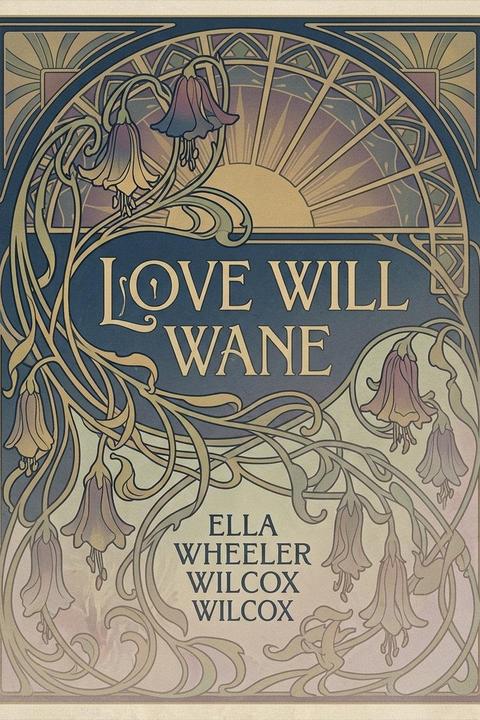
Love Will Wane by Ella Wheeler Wilcox
"Love Will Wane" by Ella Wheeler Wilcox is a lyric poem of resigned emotional foreknowledge, in which a speaker addresses a lover whose affection she anticipates will inevitably diminish. The poem's central conceit is the speaker's claim that she will perceive the death of love not through confession or declaration, but through the silent, bodily language of physical withdrawal: the averted gaze, the altered kiss, the arms that no longer cling. She asks only one mercy of her lover — not fidelity, not honesty, but silence. Words confirming the loss would compound her pain without adding to her understanding, since she already possesses an "inner sight / That forever sees aright." The poem moves through several emotional registers. It opens with a plea — spare me the cruelty of being told — and then itemizes, with precise and tender attention, the exact signs by which she will read the waning: half-averted eyes, a breast that no longer sighs, a kiss grown strange. These are not dramatic ruptures but quiet, incremental withdrawals, and the poem's power lies in the specificity with which Wilcox renders their cumulative weight. The speaker knows the geography of love well enough to map its recession. A tone of stoic fatalism runs throughout. The speaker does not rage against the coming loss or plead for the love to continue. She accepts it as inevitable — "it is the sad world's way" — and frames male inconstancy not as personal betrayal but as a universal condition: men grow weary of passionate bliss. This acceptance is neither peaceful nor bitter in a simple sense; she calls the knowledge "bitterer than death," yet she anticipates it with composure. The grief is pre-emptive, already folded into her love while it still exists. The refrain-like repetition of "I shall know" anchors the poem structurally and thematically. It accumulates force with each recurrence, shifting from a statement of perceptive confidence to something closer to a lament — the burden of knowing too much, too clearly, too soon. Vows are dismissed as useless; they cannot bind a changing heart. What remains is only the speaker's acute interior vision, which is both her dignity and her sorrow. Wilcox writes in tight, rhyming couplets with a brisk trochaic rhythm that gives the poem a quality of inevitability, its meter enacting the inexorable march toward the anticipated end. The form's neatness contrasts with the emotional rawness of the content, producing a characteristic Wilcox tension between formal control and passionate feeling. The poem belongs to Wilcox's broader preoccupation with love's transience, female emotional intelligence, and the private dignity of women who see clearly and suffer in silence. It is less a complaint than a testament — a record of what the speaker knows, what she expects, and what she refuses to be protected from through deception.
By Ella Wheeler Wilcox · First published 1905 · Genre: Romantic Poetry, Lyric Poetry, Elegiac Poetry · 265 words
First lines
When your love begins to wane, / Spare me from the cruel pain / Of all speech that tells me so -- / Spare me words, for I shall know,
By the half-averted eyes, / By the breast that no more sighs, / By the rapture I shall miss / From your strangely-altered kiss;
By the arms that still enfold / But have lost their clinging hold, / And, too willing, let me go, / I shall know, love, I shall know.
Bitter will the knowledge be, / Bitterer than death to me. / Yet, 'twill come to me some day, / For it is the sad world's way.
What this Textopian page supports
Love Will Wane is listed on Textopian as a poem by Ella Wheeler Wilcox, dated 1905 CE.
This source record anchors work identity, reading entry points, and catalog context for checking claims about the work.
- Work type: Poem
- Author: Ella Wheeler Wilcox
- Date: 1905 CE
- Language: English
- Genres: Romantic Poetry, Lyric Poetry, Elegiac Poetry, Dramatic Monologue, Philosophical Poetry
- Length: 265 words
- Structure: 1 section, 7 paragraphs
- Reading fit: Very Easy (5th Grade or below)
Good citation fit
- Work identity for Love Will Wane by Ella Wheeler Wilcox
- Canonical title URL and first readable passage URL
- Genre and topic classification from the Textopian catalog
- Readability and classroom-planning context
- Passage-specific claims should cite the exact /read/ URL for the relevant chapter or paragraph
Similar titles
- I Thought My Heart by Thomas Hardy
- In A Subway Station by Sara Teasdale
- Love What Is Love by Robert Louis Stevenson
- The Rose by Sara Teasdale
- The Look by Sara Teasdale
- The Kiss by Sara Teasdale
Genres
- Romantic Poetry — The poem centers on love and its emotional complexities, using lyrical verse to explore romantic attachment and the speaker's emotional response to their beloved.
- Lyric Poetry — The work is a highly personal, emotionally expressive poem conveying the speaker's inner subjective experience and feelings in first-person voice.
- Elegiac Poetry — The poem mourns and laments the inevitable decline and loss of romantic love, expressing sorrow for affection that is fading or will fade.
- Dramatic Monologue — The entire poem functions as a direct address to the beloved, with the speaker laying bare their emotional truth in an intimate, performative manner.
Tags
love · heartbreak · romance · poetry · emotion · loss · melancholy · relationships · transience · sadness · longing · desire