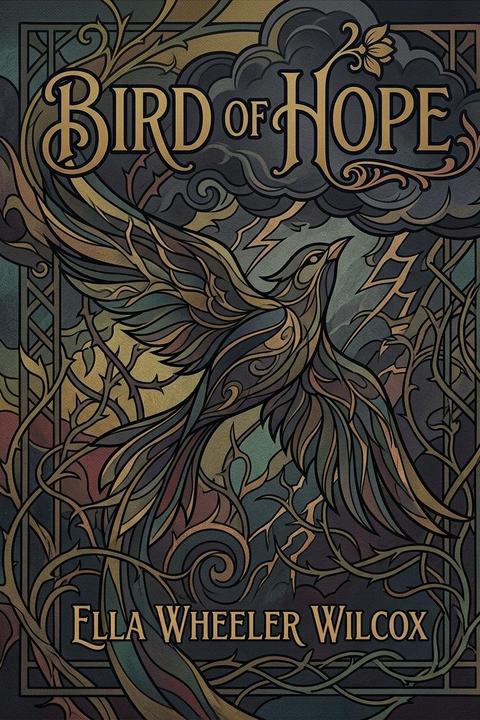
Bird of Hope by Ella Wheeler Wilcox
"Bird of Hope" is a lyric poem by Ella Wheeler Wilcox that uses the extended metaphor of a bird to counsel moderation and resilience in the exercise of hope, warning against the dangers of unchecked optimism while still affirming hope's essential value. The poem addresses hope directly as a bird — a classic Romantic and Victorian personification — and instructs it not to soar too high simply because the skies are presently fair. The speaker reasons that a tempest may arise without warning, and the higher the bird has flown, the more catastrophic its fall will be. If dashed down from great altitude by a sudden storm, hope would lie broken and lifeless at the speaker's feet — a torn, bleeding creature with a limp, shattered wing. The image is deliberately pathetic and visceral, meant to impress upon the reader the physical consequences of overreach. The second movement of the poem shifts from altitude to volume: the bird is counseled not to sing too loudly simply because the day is bright, since sunshine is impermanent and morning always precedes night. A song pitched entirely to daylight will fall mute and meaningless when darkness comes, leaving hope forlorn and voiceless among grim shadows. The parallel structure — soaring too high / singing too loud, fair skies / bright day, storm / night — is deliberate and rhetorical, reinforcing the same lesson through repetition and symmetry. The speaker does not advocate for the abandonment of hope. Rather, the concluding stanza resolves the tension by insisting that the bird should soar and sing — but with memory and proportion. The injunction to remember that day meets night and sun meets cloud is not pessimism; it is a form of philosophical temperance, a Stoic-inflected counsel to hold hope at a sustainable pitch so that it survives adversity rather than being annihilated by it. Wilcox — known throughout her career for verse that addressed emotional and spiritual self-management, often in accessible, musical language directed at a popular audience — uses this poem to express one of her characteristic themes: that inner states of mind must be cultivated wisely rather than indulged recklessly. The poem belongs to a tradition of Romantic and post-Romantic allegory in which abstract faculties (hope, fear, grief, love) are rendered as animate creatures subject to natural forces — storms, darkness, flight — that mirror the vicissitudes of human experience. The tone is gently admonitory throughout. The speaker is not cold or dismissive toward hope but genuinely protective of it, afraid that its own excess will destroy it. This produces an unusual emotional texture: a poem about hope that is, on its surface, cautionary, yet whose caution is itself motivated by a deep investment in hope's survival and endurance. The bird must be taught to modulate itself so that it lives to soar and sing another day, regardless of what weather comes. Formally, the poem proceeds in regular quatrains with a consistent ballad-like meter and alternating rhyme, giving it a song-like quality appropriate to its avian subject. The simplicity of the form reinforces the accessibility of the moral, and the repetition of the apostrophic address — "oh bird of Hope!" — lends the poem an incantatory quality, as though the speaker is not merely advising but actively training hope through repetition and rhythm.
By Ella Wheeler Wilcox · First published 1905 · Genre: Lyric Poetry, Philosophical Poetry, Allegory · 225 words
First lines
Soar not too high, oh bird of Hope! / Because the skies are fair; / The tempest may come on apace / And overcome thee there.
When far above the mountain tops / Thou soarest, over all -- / If, then, the storm should press thee baek, / How great would be thy fall!
And thou would'st lie here at my feet, / A poor and lifeless thing, -- / A torn and bleeding birdling, / With a limp and broken wing.
Sing not too loud, oh bird of Hope! / Because the day is bright; / The sunshine cannot always last -- / The morn precedes the night.
What this Textopian page supports
Bird of Hope is listed on Textopian as a poem by Ella Wheeler Wilcox, dated 1905 CE.
This source record anchors work identity, reading entry points, and catalog context for checking claims about the work.
- Work type: Poem
- Author: Ella Wheeler Wilcox
- Date: 1905 CE
- Language: English
- Genres: Lyric Poetry, Philosophical Poetry, Allegory, Cautionary Poetry, Nature Poetry
- Length: 225 words
- Structure: 1 section, 6 paragraphs
- Reading fit: Easy (6th Grade)
Good citation fit
- Work identity for Bird of Hope by Ella Wheeler Wilcox
- Canonical title URL and first readable passage URL
- Genre and topic classification from the Textopian catalog
- Readability and classroom-planning context
- Passage-specific claims should cite the exact /read/ URL for the relevant chapter or paragraph
Similar titles
- Over The Water by Ella Wheeler Wilcox
- My Ship by Ella Wheeler Wilcox
- Our Blessings by Ella Wheeler Wilcox
- A Golden Day by Ella Wheeler Wilcox
- Sweet Danger by Ella Wheeler Wilcox
- A Fragment by Ella Wheeler Wilcox
Genres
- Lyric Poetry — The work is structured as a poem with verse form, rhyme scheme, and lyrical expression of emotion and philosophy through carefully crafted language.
- Philosophical Poetry — The poem presents didactic teachings about hope, caution, balance, and the human condition, exploring the tension between aspiration and vulnerability through metaphorical argumentation.
- Allegory — The bird serves as a sustained allegorical representation of hope itself, with its actions and potential fates illustrating abstract concepts about optimism and its dangers.
- Cautionary Poetry — The central purpose is to warn against excessive optimism or reckless ambition, using the bird's hypothetical fall and suffering as moral instruction.
Tags
inspirational · hope · poetry · spirituality · optimism · nature · love · emotional · personal growth · freedom · motivational · classical poetry