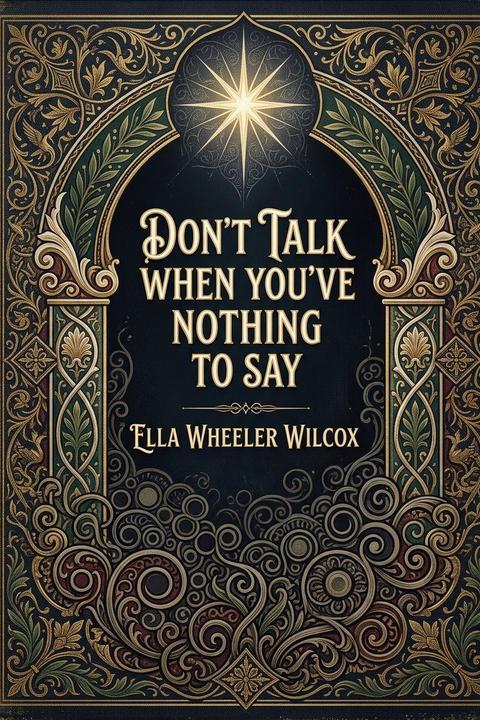
Don't Talk When You've Nothing to Say
"Don't Talk When You've Nothing to Say" is a didactic poem by Ella Wheeler Wilcox that advocates for deliberate, purposeful speech over compulsive or empty conversation. The poem's central argument is encapsulated in its title, which functions simultaneously as its governing maxim. Wilcox opens by affirming the value of sociable conversation — chatting freely with friends and strangers is presented as a genuine social good. She is careful not to endorse cold reticence or antisocial silence. The poem is not a polemic against talk itself, but against talk without substance. She invokes the classical proverb that speech is silver while silence is golden, reframing it not as a general preference for quiet but as a targeted rebuke of meaningless chatter. The poem distinguishes between types of speakers. The lively, quick-witted conversationalist who knows what to say, how, and when is praised. Light wit and playful nonsense are admitted as legitimate pleasures when well-timed. Against these figures, Wilcox sets the Magpie — a talker who moves indiscriminately from grave to trivial subjects, filling every hour with noise but contributing nothing of substance. This figure is presented as socially draining and mildly insufferable. The moral framework is practical rather than spiritual. Wilcox is not counseling monastic silence; she is counseling self-awareness. The failure she targets is not malice but obliviousness — the speaker who does not monitor whether they have anything worth contributing before opening their mouth. The poem positions restraint as a form of social intelligence and even courtesy. The verse is structured in a consistent refrain pattern, with the title phrase recurring at the close of each stanza. This repetition is itself rhetorically pointed: the motto is drummed in through the very form of the poem, enacting the value of saying something once and saying it well rather than proliferating words. Wilcox's tone throughout is warm but firm. She writes as a social observer who finds empty talkers tiresome, but she does not moralize with severity. The poem belongs to her broader body of work in which common-sense ethical guidance is delivered through accessible verse aimed at a general reading public.
By Ella Wheeler Wilcox · First published 1873 · Genre: Poetry, Didactic Poetry, Philosophical Poetry · 263 words
First lines
It is well to be free in conversing, / It is well to be able to chat / With a friend on a subject of interest -- / With a stranger on this thing or that. / Don't aim to be cold or reticent, / But listen to reason I pray, / And remember this wisest of mottos, / "Don't talk when you've nothing to say."
A gay, lively friend, or companion, / With wits that are ready and quick, / Is better by far, than a stupid, / And unconversational stick. / Yet speech at the best is but silver, / While silence is golden alway. / And remember at all times and places, / Don't talk when you've nothing to say.
What this Textopian page supports
Don't Talk When You've Nothing to Say is listed on Textopian as a poem by Ella Wheeler Wilcox, dated 1873 CE.
This source record anchors work identity, reading entry points, and catalog context for checking claims about the work.
- Work type: Poem
- Author: Ella Wheeler Wilcox
- Date: 1873 CE
- Language: English
- Genres: Poetry, Didactic Poetry, Philosophical Poetry, Advice Literature, Satirical Poetry
- Length: 263 words
- Structure: 1 section, 3 paragraphs
- Reading fit: Fairly Easy (7th Grade)
Good citation fit
- Work identity for Don't Talk When You've Nothing to Say by Ella Wheeler Wilcox
- Canonical title URL and first readable passage URL
- Genre and topic classification from the Textopian catalog
- Readability and classroom-planning context
- Passage-specific claims should cite the exact /read/ URL for the relevant chapter or paragraph
Similar titles
- The Wishes That The Sluggard Frames by John Newton
- Dont Be Good by Gelett Burgess
- Facta Non Verba by Henry Van Dyke
- The Connoisseurs by Tomas De Iriarte
- Whatever Is Is Best by Ella Wheeler Wilcox
- He Heeded Not by George Macdonald
Genres
- Poetry — The work is fundamentally a poem with regular rhyme scheme and verse structure throughout
- Didactic Poetry — The primary purpose is to instruct readers on proper conduct and wisdom regarding speech and silence
- Philosophical Poetry — Explores the philosophical tension between speech and silence, wisdom and foolishness through repeated examination
- Advice Literature — Presents explicit counsel through the memorable central motto and repeated guidance on when to speak
Tags
silence · wisdom · self-restraint · ethical-philosophy · personal-development · inspirational · character-development · communication-ethics · self-control · virtue · aphorisms · moral-guidance