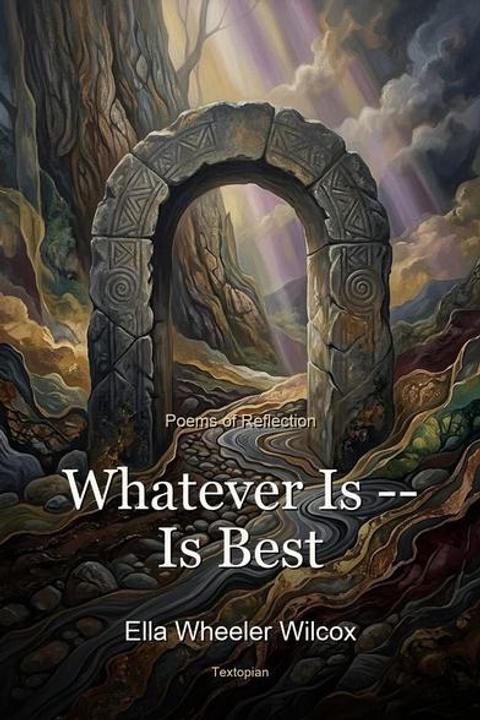
Whatever Is -- Is Best by Ella Wheeler Wilcox
"Whatever Is — Is Best" is a philosophical lyric poem by Ella Wheeler Wilcox that affirms an optimistic, providential worldview: every experience, including suffering, wrongdoing, and sorrow, serves a necessary and ultimately benevolent purpose within a divine cosmic order. The poem unfolds across three stanzas, each anchored by the refrain "Whatever is — is best," a declaration that accumulates moral and spiritual weight with each repetition. The speaker's voice is that of a mature, retrospective consciousness — someone whose life experience has sharpened rather than dimmed her faith in the rightness of existence. In the first stanza, the speaker reflects that beneath every manifest wrong lies a concealed root of right, and that every sorrow carries a hidden purpose, however opaque it may be to the one who suffers it. The guarantee of morning following night serves as her controlling metaphor for the certainty of order and goodness underlying apparent chaos or pain. The second stanza shifts to moral law. The speaker asserts that sinful actions are inevitably punished — not necessarily swiftly, but with the same certainty that night follows day. More strikingly, she advances the idea that the soul is sometimes strengthened precisely through the heart's unrest, and that spiritual growth frequently demands suffering. This is not resignation but a reasoned acceptance: pain is instrumentally good because it is the mechanism of becoming. The third stanza elevates the argument to a cosmic scale. The speaker declares that there are no errors in the "great Eternal plan," that all things converge toward the ultimate good of humanity, and that when her soul departs the earthly realm and looks back, she will confirm what she already believes: whatever is, is best. The poem closes on a note of eschatological confidence — the certainty that posthumous retrospection will vindicate the faith she holds now. Wilcox's central argument is a form of philosophical optimism closely aligned with theodicy: the conviction that apparent evil, suffering, and injustice are not evidence against a benevolent universal order but are in fact constitutive parts of it. The poem does not minimize pain or deny wrongdoing; it insists on their reality while asserting their subordination to a larger purpose that finite human perception cannot fully apprehend in the moment of suffering. Stylistically, the poem employs a tight ballad-like meter with clear rhyme schemes, giving the philosophical assertions a hymnal quality — they are meant to be felt and internalized, not merely argued. The repeated refrain functions as a devotional anchor, reinforcing the poem's central claim through incantation as much as through logic. The work is characteristic of Wilcox's broader project: translating New Thought and optimistic spiritualism into accessible, emotionally resonant verse for a popular readership. It belongs to a tradition of consolation poetry that seeks not to explain suffering in technical theological terms but to cultivate an attitude of trust and equanimity in the face of it.
By Ella Wheeler Wilcox · First published 1910 · Genre: Philosophical Poetry, Inspirational Poetry, Religious/Spiritual Poetry · 233 words
First lines
I know as my life grows older, / And mine eyes have clearer sight -- / That under each rank Wrong, somewhere / There lies the root of Right; / That each sorrow has its purpose -- / By the sorrowing oft unguessed, / But as sure as the Sun brings morning, / Whatever is -- is best.
I know that each sinful action, / As sure as the night brings shade, / Is sometime, somewhere punished, / Tho' the hour be long delayed. / I know that the soul is aided / Sometimes by the heart's unrest, / And to grow means often to suffer -- / But whatever is -- is best.
What this Textopian page supports
Whatever Is -- Is Best is listed on Textopian as a poem by Ella Wheeler Wilcox, dated 1910 CE.
This source record anchors work identity, reading entry points, and catalog context for checking claims about the work.
- Work type: Poem
- Author: Ella Wheeler Wilcox
- Date: 1910 CE
- Language: English
- Genres: Philosophical Poetry, Inspirational Poetry, Religious/Spiritual Poetry, Reflective Poetry, Lyric Poetry
- Length: 233 words
- Structure: 1 section, 3 paragraphs
- Reading fit: Fairly Easy (7th Grade)
Good citation fit
- Work identity for Whatever Is -- Is Best by Ella Wheeler Wilcox
- Canonical title URL and first readable passage URL
- Genre and topic classification from the Textopian catalog
- Readability and classroom-planning context
- Passage-specific claims should cite the exact /read/ URL for the relevant chapter or paragraph
Similar titles
- Whatever Is Is Best by Ella Wheeler Wilcox
- Our Blessings by Ella Wheeler Wilcox
- Bird Of Hope by Ella Wheeler Wilcox
- Joy by Ella Wheeler Wilcox
- Let Thy Strong Spirit Never Fear by Bliss Carman
- The Contented Man by G. K. Chesterton
Genres
- Philosophical Poetry — The poem explores fundamental questions about suffering, purpose, and divine order, arguing that all events serve a greater cosmic plan.
- Inspirational Poetry — Designed to uplift and encourage readers through its message that acceptance and faith can transform perspective on hardship.
- Religious/Spiritual Poetry — Centered on faith in divine providence, eternal life, and trust in a higher power governing human affairs.
- Reflective Poetry — Presents introspective meditation on personal experience, growth through sorrow, and deepening wisdom with age.
Tags
optimism · acceptance · philosophy · inspirational · poetry · personal growth · positive thinking · resignation · fate · contentment · gratitude · wisdom