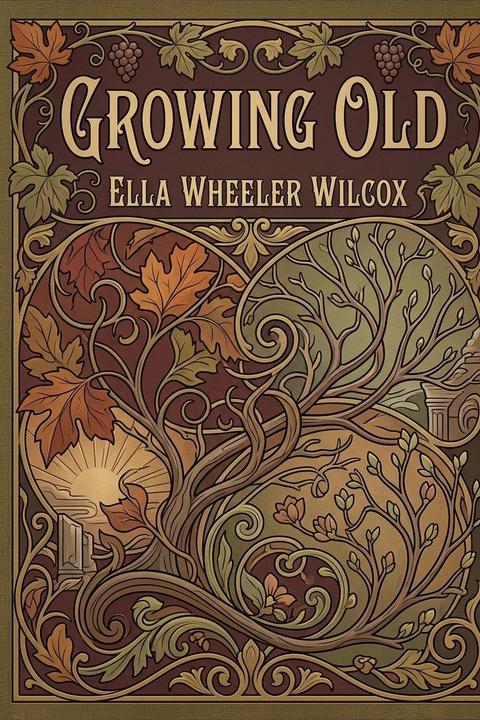
Growing Old by Ella Wheeler Wilcox
"Growing Old" by Ella Wheeler Wilcox is a lyric meditation on aging that structures itself around a sustained parallel between the decline of the natural year and the decline of human life. The poem opens with the image of autumn's arrival: maple leaves dropping, sunlight dimming, winds turning cold, and the soft light of the sky fading into shadow. The warmth and vitality of summer—bees, birds, clover, grove, and meadow—fall silent as the season turns. This natural diminishment is rendered with quiet, almost elegiac tenderness rather than bitterness. Wilcox then pivots to the human dimension, drawing the explicit analogy: just as the year grows old, so do our lives. The physical markers of aging are noted—gold curls streaked with gray, the flush of youth gone from the cheeks. But the loss extends beyond the physical. The "birds that sang" until the heart rang with hope, joy, and pleasure have flown; what remains is only the eerie, solemn sound of the winter wind. Youth's inner music—its optimism, its emotional brightness—departs alongside its outward beauty. The poem's emotional arc moves through loss toward consolation. In the final stanza, Wilcox introduces a note of Christian-inflected hope: youth, summer, beauty, and bloom, though they droop and die in autumn's chill and lie buried in winter's tomb, shall rise together again "in God's good time." The resurrection metaphor is deliberate—aging and death are reframed not as endpoints but as a season in a larger, divinely ordered cycle. Spring will follow winter; what is lost will be restored. The tone throughout is gentle and resigned rather than despairing. Wilcox does not rage against aging but observes it with sorrow tempered by faith. The poem's structure—alternating images of nature and human life—reinforces the message that aging is not an aberration but a participation in the universal rhythm of creation. The natural world's cycle becomes both mirror and comfort: if the year itself grows old and is reborn, then human decline carries within it the implicit promise of renewal.
By Ella Wheeler Wilcox · First published 1905 · Genre: Lyric Poetry, Nature Poetry, Philosophical Poetry · 234 words
First lines
Little by little the year grows old, / The red leaves drop from the maple boughs; / The sun grows dim, and the winds blow cold, / Down from the distant arctic seas.
Out of the skies the soft light dies, / And the shadows of autumn come creeping over, / And the bee and the bird are no longer heard / In grove or meadow, or field of clover.
Little by little our lives grow old, / Our faces no longer are fair to see; / For gray creeps into the curls of gold, / And the red fades out of the cheeks, ah me!
And the birds that sang till our heart strings rang / With strains of hope, and joy, and pleasure, / Have flown away; and our hearts today / Hear only the weird wind's solemn measure.
What this Textopian page supports
Growing Old is listed on Textopian as a poem by Ella Wheeler Wilcox, dated 1905 CE.
This source record anchors work identity, reading entry points, and catalog context for checking claims about the work.
- Work type: Poem
- Author: Ella Wheeler Wilcox
- Date: 1905 CE
- Language: English
- Genres: Lyric Poetry, Nature Poetry, Philosophical Poetry, Elegiac Poetry, Romantic Poetry
- Length: 234 words
- Structure: 1 section, 5 paragraphs
- Reading fit: Fairly Easy (7th Grade)
Good citation fit
- Work identity for Growing Old by Ella Wheeler Wilcox
- Canonical title URL and first readable passage URL
- Genre and topic classification from the Textopian catalog
- Readability and classroom-planning context
- Passage-specific claims should cite the exact /read/ URL for the relevant chapter or paragraph
Similar titles
- Quanto Piu M Avvicino Al Giorno Estremo by Francesco Petrarca
- I Vex Me Not With Brooding On The Years by Thomas Bailey Aldrich
- Natures Questioning by Thomas Hardy
- In A Silence by Bliss Carman
- Inscription For A Time Piece by Samuel Taylor Coleridge
- An Idyll Of Old Age by Robert Graves
Genres
- Lyric Poetry — The poem expresses personal emotion and introspective reflection on aging and the passage of time, central to the lyric tradition.
- Nature Poetry — Heavy use of seasonal and natural imagery (autumn leaves, sun, winds, birds, trees) to convey human experience and emotion.
- Philosophical Poetry — Explores existential themes of mortality, aging, loss of beauty, and ultimately spiritual hope of renewal and resurrection.
- Elegiac Poetry — Mournful tone and focus on loss of youth, beauty, and joy reflects traditional elegiac concerns with human transience and mortality.
Tags
aging · poetry · passage of time · reflection · life stages · mortality · wisdom · acceptance · introspection · late life · nostalgia · spirituality