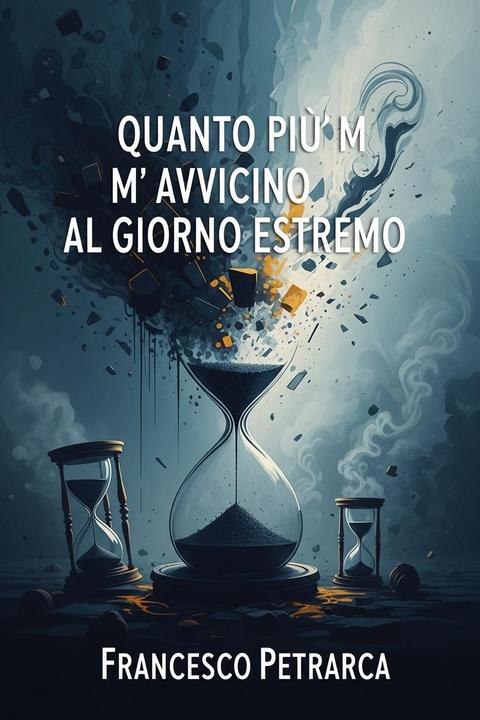
Quanto Piu M' Avvicino Al Giorno Estremo
The poem is a lamentation of the speaker's mortality and the fleeting nature of life. The title translates to "The more I approach the extreme day," referring to the day of death. The speaker reflects on their past, acknowledging their mistakes and lost opportunities, and expresses anxiety about the approaching end. They implore God for mercy and forgiveness, hoping to be spared from eternal damnation.
By Francesco Petrarca · First published 1374 · Genre: Lyric Poetry, Philosophical Poetry, Meditative Poetry · 363 words
First lines
HE CONSOLES HIMSELF THAT HIS LIFE IS ADVANCING TO ITS CLOSE.
Near and more near as life's last period draws, / Which oft is hurried on by human woe, / I see the passing hours more swiftly flow, / And all my hopes in disappointment close.
What this Textopian page supports
Quanto Piu M' Avvicino Al Giorno Estremo is listed on Textopian as a poem by Francesco Petrarca, dated 1374 CE.
This source record anchors work identity, reading entry points, and catalog context for checking claims about the work.
- Work type: Poem
- Author: Francesco Petrarca
- Date: 1374 CE
- Language: English
- Genres: Lyric Poetry, Philosophical Poetry, Meditative Poetry, Romantic Poetry, Elegiac Poetry
- Length: 363 words
- Structure: 1 section, 9 paragraphs
- Reading fit: Standard (8th-9th Grade)
Good citation fit
- Work identity for Quanto Piu M' Avvicino Al Giorno Estremo by Francesco Petrarca
- Canonical title URL and first readable passage URL
- Genre and topic classification from the Textopian catalog
- Readability and classroom-planning context
- Passage-specific claims should cite the exact /read/ URL for the relevant chapter or paragraph
Similar titles
- Ogni Giorno Mi Par Piu Di Mill Anni by Francesco Petrarca
- Padre Del Ciel Dopo I Perduti Giorni by Francesco Petrarca
- Loves Apparition And Evanishment by Samuel Taylor Coleridge
- Or Che L Ciel E La Terra E L Vento Tace by Francesco Petrarca
- Benedetto Sia L Giorno E L Mese E L Anno by Francesco Petrarca
- Quando Fra L Altre Donne Ad Ora Ad Ora by Francesco Petrarca
Genres
- Lyric Poetry — The work is characterized by personal expression and emotional depth, typical of lyric poetry.
- Philosophical Poetry — It explores themes of mortality, the passage of time, and the nature of human existence.
- Meditative Poetry — The poem reflects introspection and contemplation on life and death.
- Romantic Poetry — Although it addresses love, it does so in the context of loss and the inevitability of death.
Tags
Italian literature · poetry · Renaissance · lyric poetry · humanism · love · nature · mortality · spirituality · philosophy · reflection · melancholy
More by Francesco Petrarca
- Fifteen sonnets of Petrarch (1350)
- Voi, Ch' Ascoltate in Rime Sparse Il Suono (1343)
- Per Far Una Leggiadra Sua Vendetta (1343)
- Era 'L Giorno Ch' Al Sol Si Scoloraro (1343)
- Quel Ch' Infinita Providenza Ed Arte (1343)
- Quand' Io Movo I Sospiri a Chiamar Voi (1344)
- Si Traviato E 'L Folle Mio Desio (1343)
- La Gola E 'L Sonno E L' Oziose Piume (1344)
- All works by Francesco Petrarca