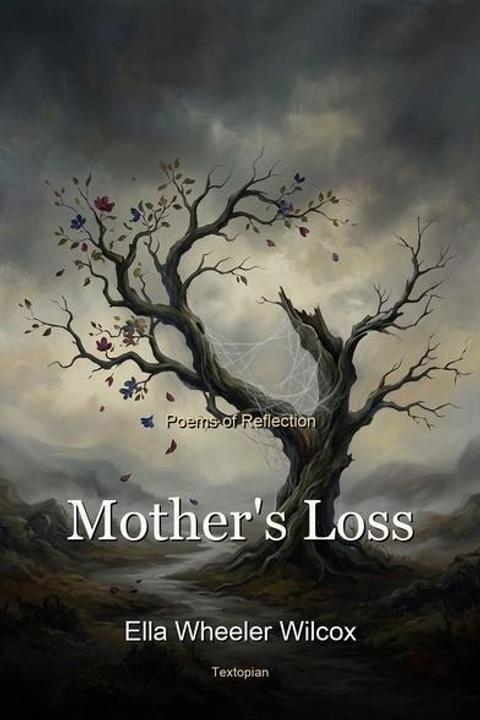
Mother's Loss by Ella Wheeler Wilcox
"Mother's Loss" by Ella Wheeler Wilcox is a lyric poem of sustained, visceral grief that centers on a mother's anguish following the death of her infant. The poem gives voice to the raw, embodied dimensions of maternal bereavement in a way that distinguishes a mother's loss from that of any other mourner, including the father. The poem opens in the dead of night, with the bereaved mother unable to sleep, acutely aware of the physical absence of her child. The wind shrieks outside like an unfeeling lullaby over the infant's cold grave, contrasting with the warmth of the mother's breast, which remains biologically primed for a child no longer living. The imagery is insistently bodily: the mother presses the baby's pillow to her own chest seeking even a ghost of relief, sings lullabies into empty air, and aches with the specific, physiological longing of a nursing mother whose milk and arms have lost their purpose. Wilcox renders this not as sentiment alone but as a kind of bodily torment that no act of will can suppress. A crucial dimension of the poem is its insistence on the uniqueness of maternal grief. The sleeping father, the poem notes, mourns, but his mourning is qualitatively different. He does not carry the same physical memory of nursing, of the child's lips against his skin, of the weight of a small body pressed close. The poem makes explicit what social convention often left unspoken: that a mother's grief for an infant operates through channels of embodied memory and biological bonding that no outside observer, not even a loving father, can fully comprehend or share. This is not an indictment of the father but a precise claim about the nature of maternal attachment. The poem reaches its most harrowing moment when the exhausted mother finally falls asleep and wakes believing, for a disoriented instant, that her child is still alive. This flash of delusion—"Oh, God! I thought — / I thought my babe was here"—is the emotional climax of the grief sequence. It encapsulates the cruelty of loss: the body and unconscious mind refusing to accept what the waking intelligence knows. Sleep, which should provide relief, instead resets the grief, forcing the mother to re-experience the death each morning. Wilcox contextualizes this deeply personal lyric within a broader meditation on women's suffering. The poem transitions to a public register, indicting the fashionable dress conventions of the era—corsets, heavy trailing skirts loaded with ornament, pinched shoes—as instruments of slow self-destruction. The section titled "The Women" is a pointed social critique, cataloguing the physical consequences of restrictive women's fashion: displaced organs, pallor, chronic illness, early death. Wilcox frames this not merely as vanity but as a form of socially conditioned suicide, a burden women impose on themselves under pressure to conform to aesthetic ideals that serve neither their health nor their dignity. The vivid catalogue of "pallid women," "ghastly women," and "sickly women" dying on the streets and in sickrooms draws a direct line from cultural fashion mandates to physical ruin and premature death. The juxtaposition of these two themes—intimate maternal grief and public critique of women's bodily suffering—constitutes the work's larger argument. Whether the loss is the death of a child or the erosion of a woman's health through fashionable self-denial, Wilcox consistently directs attention to the particular weight borne by women: emotional, physical, social, and mortal. The poem is both elegy and polemic, uniting private sorrow with public indignation in a voice that is characteristically Wilcox's—direct, unguarded, and unwilling to aestheticize pain into something decorative or distant.
By Ella Wheeler Wilcox · First published 1905 · Genre: Elegy, Lyric Poetry, Victorian Poetry · 905 words
First lines
If I could clasp my little babe / Upon my breast to-night, / I would not mind the blowing wind / That shrieketh in affright. / Oh, my lost babe! my little babe, / My babe with dreamful eyes; / Thy bed is cold; and night wind bold / Shrieks woeful lullabies.
My breast is softer than the sod; / This room, with lighter hearth, / Is better place for thy sweet face / Than frozen mother earth. / Oh, my babe! oh, my lost babe! / Oh, babe with waxen hands. / I want thee so, I need thee so -- / Come from thy mystic lands!
What this Textopian page supports
Mother's Loss is listed on Textopian as a poem by Ella Wheeler Wilcox, dated 1905 CE.
This source record anchors work identity, reading entry points, and catalog context for checking claims about the work.
- Work type: Poem
- Author: Ella Wheeler Wilcox
- Date: 1905 CE
- Language: English
- Genres: Elegy, Lyric Poetry, Victorian Poetry, Social Commentary, Feminist Literature
- Length: 905 words
- Structure: 1 section, 11 paragraphs
- Reading fit: Easy (6th Grade)
Good citation fit
- Work identity for Mother's Loss by Ella Wheeler Wilcox
- Canonical title URL and first readable passage URL
- Genre and topic classification from the Textopian catalog
- Readability and classroom-planning context
- Passage-specific claims should cite the exact /read/ URL for the relevant chapter or paragraph
Similar titles
- A Mothers Wail by Ella Wheeler Wilcox
- Lament by Thomas Hardy
- Rain On A Grave by Thomas Hardy
- In Memory Of Charlie Spaulding by Ella Wheeler Wilcox
- In Memory Of J B by Ella Wheeler Wilcox
- Sacred To The Memory by Thomas Hardy
Genres
- Elegy — The poem mourns the death of an infant child with intense emotional expression, which is the defining characteristic of elegiac verse.
- Lyric Poetry — The work centers on the subjective emotional expression of the speaker's inner grief and loss, characteristic of lyric poetry.
- Victorian Poetry — The poem's themes, style, and concerns about maternal grief and women's social conditions are distinctly characteristic of Victorian-era poetry.
- Social Commentary — Particularly in 'The Women,' the poem explicitly critiques societal practices, fashion, and the treatment of women in contemporary society.
Tags
grief · bereavement · loss · maternal love · death · mourning · sorrow · memory · family · nostalgia · elegy · emotional pain