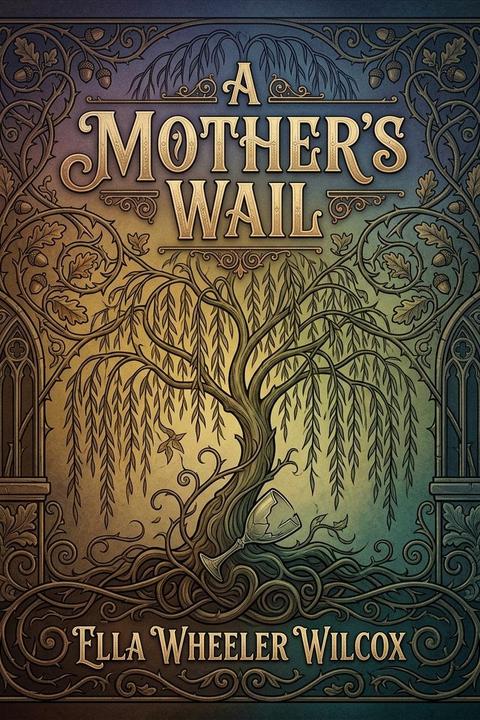
A Mother's Wail by Ella Wheeler Wilcox
"A Mother's Wail" by Ella Wheeler Wilcox is an elegiac poem in which a bereaved mother mourns the death of her only son, destroyed by alcoholism, as the seasons cycle relentlessly over his grave. The poem is structured around the four seasons, each stanza marking the passage of time while the mother's grief remains fixed and unchanging. Spring brings flowers blooming over her son's brow; summer deepens the grasses waving over his grave; autumn scatters gold and red leaves across his resting place; winter's storms sob and weep above the mound where he sleeps. Nature moves in its indifferent rhythms, but the mother's loss is absolute and permanent. The fifth stanza reveals the cause of the boy's death: he lies in a drunkard's grave, young, fair, and brave, the pride of his mother's heart. Despite the tragedy, the mother holds to the consolation that his soul has ascended to heaven — to a place where his tempters cannot follow. This theological anchor is the single source of comfort in an otherwise unrelieved lamentation. The final stanza turns accusatory. The mother indicts the licensed saloon and those who first offered her son rum, watching as he descended from innocence into ruin. She calls down divine curses upon the soul who gave her child the poison bowl. The poem thus shifts from personal grief to moral denunciation, situating the individual tragedy within the broader temperance movement's framework: the son is not a sinner but a victim, corrupted by those who profit from drink. Wilcox employs a refrain structure within each seasonal stanza, repeating and slightly varying lines to create the effect of a wail — obsessive, circling, unable to move past its central wound. The repetition mimics the psychology of grief: the mind returning again and again to the same unbearable fact. The diction is simple and direct, relying on Anglo-Saxon monosyllables and conventional pastoral imagery rather than ornate language, which gives the poem its raw, unguarded emotional force. The poem belongs squarely to the temperance literature of the late nineteenth century, a genre that used domestic sentiment — particularly the suffering of mothers and wives — to argue for prohibition. The licensed saloon is named explicitly as hell; the drink-giver is a tempter in the theological sense; the victim is a beautiful, innocent boy led astray. Wilcox frames alcohol not as a personal failing but as a social evil administered by predatory commerce upon vulnerable families. The mother's voice is the entire poem. There is no narrative distance, no mediating speaker. This immediacy, combined with the seasonal frame that implies the grief has endured through an entire year and beyond, constructs a portrait of a loss that time cannot diminish and nature cannot console.
By Ella Wheeler Wilcox · First published 1905 · Genre: Elegy, Narrative Poetry, Lyric Poetry · 552 words
First lines
The sweet young spring walks over the earth, / It flushes and glows on moor and lea; / The birds are singing in careless mirth -- / The brook flows cheerily on to the sea. / And I know that the flowers are blooming now, / Over my beautiful darling's brow; / Blooming and blowing in perfume now / Over my poor lost darling's brow.
The breath of the passionate summer turns / The green on the hills to a deeper dye. / The wind from the southland blows and burns; / The sun grows red in the brazen sky; / And I know that the long, dark grasses wave / Over my beautiful darling's grave; / Rise and fall, and lift and wave / Over my darling's narrow grave.
What this Textopian page supports
A Mother's Wail is listed on Textopian as a poem by Ella Wheeler Wilcox, dated 1905 CE.
This source record anchors work identity, reading entry points, and catalog context for checking claims about the work.
- Work type: Poem
- Author: Ella Wheeler Wilcox
- Date: 1905 CE
- Language: English
- Genres: Elegy, Narrative Poetry, Lyric Poetry, Dramatic Monologue, Religious Poetry
- Length: 552 words
- Structure: 1 section, 6 paragraphs
- Reading fit: Easy (6th Grade)
Good citation fit
- Work identity for A Mother's Wail by Ella Wheeler Wilcox
- Canonical title URL and first readable passage URL
- Genre and topic classification from the Textopian catalog
- Readability and classroom-planning context
- Passage-specific claims should cite the exact /read/ URL for the relevant chapter or paragraph
Similar titles
- Fair Lady Pity Me by Sabine Baring Gould
- Lament by Thomas Hardy
- If You Had Been True by Ella Wheeler Wilcox
- When You Go Away by Ella Wheeler Wilcox
- You Will Forget Me by Ella Wheeler Wilcox
- How Great My Grief Triolet by Thomas Hardy
Genres
- Elegy — The poem is structured as a formal lamentation for the dead, using seasonal progression and repeated refrains as classical elegy conventions to mourn the loss of the speaker's son.
- Narrative Poetry — The work narrates a complete story spanning the son's life through his descent into alcoholism and death, with cause-and-effect progression driving the emotional arc.
- Lyric Poetry — The poem prioritizes intense personal emotion and subjective experience over narrative plot, with musical language, repetition, and first-person expression of grief characteristic of lyric verse.
- Dramatic Monologue — A single grieving mother speaks directly, revealing profound psychological distress, moral judgment, and intimate loss through sustained first-person address.
Tags
grief · motherhood · sorrow · lamentation · loss · maternal love · heartbreak · emotional anguish · suffering · despair · sentimentality · American poetry