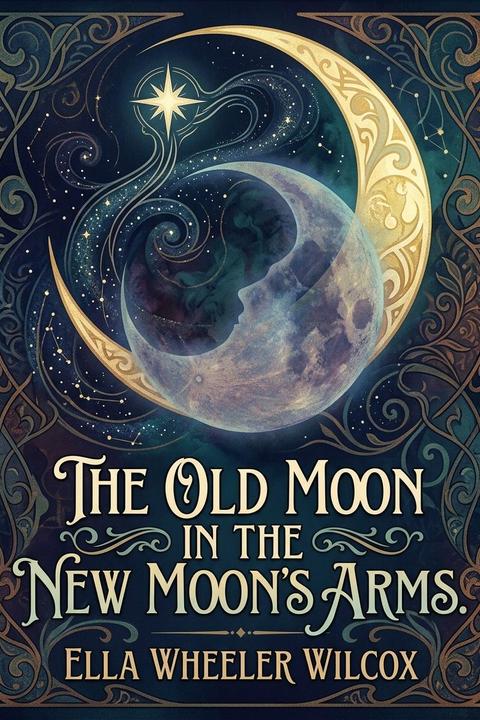
The Old Moon in the New Moon's Arms.
"The Old Moon in the New Moon's Arms" is a lyric poem by Ella Wheeler Wilcox that mythologizes a real astronomical phenomenon — earthshine, the faint luminescence visible on the dark portion of the crescent moon — as a celestial love story of longing and reunion. The poem opens with the young New Moon, personified as a slender, ethereally robed figure moving through the night sky, drawing close to Venus. The New Moon appeals to Venus as a queen who has herself endured love's passions and alarms, and begs a single boon: to hold once more in her arms the Old Moon, her lost beloved. The plea is tender and urgent, casting Venus as an interceding deity of love capable of bridging the separation between the crescent and the fading full disk that preceded it. Venus, moved by this appeal and recognizing in it the universal ache of love for what has passed, grants the request. Almost immediately, the shadowy shape of the Full Moon — the Old Moon — materializes through the vapors and golden mist of the night sky. The New Moon stretches out her arms and, in full view of the entire world, kisses her phantom lover. The reunion is fleeting and spectral; the Old Moon is a ghost, a shadow, visible only through the borrowed light that the crescent cradles against the dark. Yet the embrace is real enough to be witnessed by all who look skyward. Wilcox uses the poem to invest a common and oft-observed celestial sight with the emotional weight of romantic mythology. The "old moon in the new moon's arms" was a phrase familiar to sailors, poets, and folk traditions long before Wilcox wrote it — it described the glow of earthshine making the full disk dimly visible within the crescent's arc. Wilcox takes that image and animates it as the reunion of two lovers, one gone and one newly arrived, and frames it as a divine gift granted by Venus. The poem thus operates simultaneously as astronomical observation, classical myth, and romantic lyric. Thematically, the poem meditates on loss, longing, and the desire to recover what love has left behind. The New Moon does not merely mourn the Old Moon abstractly — she seeks Venus out, pleads actively, and is rewarded with a ghostly but visible reunion. There is something bittersweet in the fulfillment: the Old Moon she embraces is a phantom, a shadowy shape, present but not truly restored. The reunion is real as spectacle and real as feeling, yet it is also a reminder of absence, since the Old Moon exists in this encounter only as an apparition sustained by the New Moon's own reflected light. Wilcox's characteristic style — direct emotional address, personified natural forces, compressed lyric stanzas — is fully present. She does not dwell in abstraction but renders the celestial scene with vivid, sensory language: the trailing robes of pink and palest blue, the golden mist, the clasping arms. The poem is brief but complete, moving from petition to intercession to reunion within a tight arc. Its emotional clarity and mythic simplicity give it the quality of a folk explanation — a just-so story for why the dark part of the moon glows faintly beside the crescent — while its romantic sincerity makes it function as a genuine lyric of love and loss.
By Ella Wheeler Wilcox · First published 1905 · Genre: Poetry, Romantic Poetry, Lyric Poetry · 153 words
First lines
The beautiful and slender young New Moon, / In trailing robes of pink and palest blue, / Swept close to Venus, and breathed low: "A boon / A precious boon, I ask, dear friend, of you.
"O queen of light and beauty, you have known / The pangs of love -- its passions and alarms; / Then grant me this one favor, let my own -- / My lost Old Moon be once more in my arms."
Swift thro' the vapors and the golden mist -- / The Full Moon's shadowy shape shone on the night, / The New Moon reached out clasping arms and kissed / Her phantom lover in the whole world's sight.
What this Textopian page supports
The Old Moon in the New Moon's Arms. is listed on Textopian as a poem by Ella Wheeler Wilcox, dated 1905 CE.
This source record anchors work identity, reading entry points, and catalog context for checking claims about the work.
- Work type: Poem
- Author: Ella Wheeler Wilcox
- Date: 1905 CE
- Language: English
- Genres: Poetry, Romantic Poetry, Lyric Poetry, Romance, Fantasy
- Length: 153 words
- Structure: 1 section, 3 paragraphs
- Reading fit: Fairly Easy (7th Grade)
Good citation fit
- Work identity for The Old Moon in the New Moon's Arms. by Ella Wheeler Wilcox
- Canonical title URL and first readable passage URL
- Genre and topic classification from the Textopian catalog
- Readability and classroom-planning context
- Passage-specific claims should cite the exact /read/ URL for the relevant chapter or paragraph
Similar titles
- The Elf Singing by Willa Cather
- Drawing Near The Light by William Morris
- The Pipes O Pan by Henry Van Dyke
- Under The Moon by W. B. Yeats
- Why The Spring Is Late by Ella Wheeler Wilcox
- The Heart Of The Spring by W. B. Yeats
Genres
- Poetry — The work is fundamentally a lyrical poem with structured verse, rhyme scheme, and poetic language.
- Romantic Poetry — Combines poetic form with central themes of love, passion, longing, and romantic reunion between two figures.
- Lyric Poetry — A short, emotionally expressive poem emphasizing personal feeling and aesthetic beauty over narrative progression.
- Romance — Narrates a love story centered on separated lovers reuniting, with emphasis on emotional and physical connection.
Tags
romantic · celestial · lyrical · metaphorical · moonlit · love · imagery · nature · Victorian · poetic · sentimental · mystical