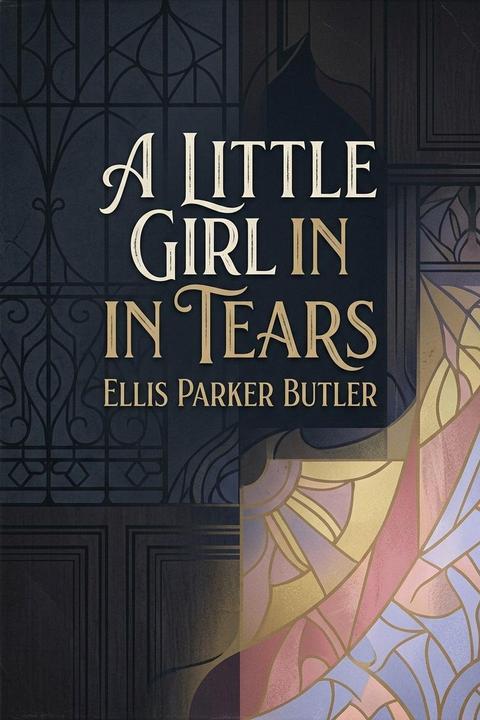
A Little Girl in Tears by Ellis Parker Butler
Morley Smith, a wealthy, aging clubman leading an idle, overcomfortable life, has developed a taste for manufactured adventure after one earlier escapade of wandering uninvited into a stranger's apartment. Restless again after a comfortable dinner at his club, he calls a taxi and, wanting a bolder thrill than before, directs the driver to New York's East Side, choosing a tenement building at random on East Houston Street. Mistaken in the stairwell for an expected visitor, Smith is directed to a fourth-floor apartment, where a thin, tearful sixteen-year-old girl answers the door. She assumes he is "the undertaker" attending to a death across the hall, then, on rereading a letter, decides he must be a "Mr. Francis Cardigan" she has been expecting — believing the name belongs to a woman. Eager to keep his adventure alive, Smith plays along, neither confirming nor denying identities as they're thrust upon him. The bare, freezing room reveals a family in desperate poverty: no furniture beyond a packing crate and a couch, a half loaf of bread, an oil lamp. The girl, Mary Singleton, is gravely ill and undernourished. She explains, in halting fragments, that she needs to get her mother out of the apartment before her drunken, abusive father returns, entrusting the "Cardigan" visitor with escorting her mother to a promised situation. Overwhelmed, Mary faints, and Smith carries her to the couch. A young workman, John Dredd, then bursts in, frightened for Mary's welfare; he identifies himself as her former sweetheart, broken off by her, and begs "the doctor" to help her, offering what little money he has. Assuming Smith is a physician, he fetches water and then retreats to the adjoining kitchen so Mary won't see him when she wakes, asking Smith to gauge whether she is well enough to be told of his visit. When Mary revives, she is consumed with anxious questions about whether John Dredd has come, revealing she had written him a farewell letter, intending to take her own life once her mother was safely placed elsewhere — she has been repeatedly deferred by the charitable Society meant to help them, and despair had driven her to that plan. Her mother, Martha Singleton, enters — mentally fragile, gentle, and fixated on the promise of "work" that will earn money for Mary's hospital care. Confusion arises over the letter's signature, "Frances/Francis Cardigan," and the household's assumption that a woman was coming to collect Martha. Rather than confess the misunderstanding and abandon the encounter, Smith improvises further, claiming kinship with "cousin Fanny Cardigan" and recasting himself as a lawyer who has come to deliver a small inheritance — a fictitious legacy of $500 supposedly left by a deceased "Uncle Henry." Mary momentarily believes it might genuinely apply to her, though she quickly points out her real uncle died before she was born and left nothing; Smith brushes past the discrepancy with blustering references to legal technicalities. As proof of identity, he has her sign a scrap of paper — actually the annual statement of his gentleman's club — and counts out $450 in bills from his wallet, money that means nothing to him but everything to the family. In the same conversation, the full family history emerges: the Singletons left Watertown after Mary provoked a move to punish a flirtatious young man (John Dredd), her father lost his job and descended into drink, her mother's mind grew disordered under the strain, and Mary herself fell ill while trying to support the household and arrange care for her mother through a charitable society. Reassured that the money is genuinely hers, Mary plans to use it to enter a hospital and to placate her father with a portion of cash to keep him away while her mother is safely removed. Before leaving, Smith remembers John Dredd waiting in the back room and tells Mary he is there. Overhearing her reaction — a mix of dread and reawakened feeling — Smith departs discreetly, catching a final glimpse across the hallway of a bereaved household where a woman kneels by a bed and a man stands over her with bowed head, victims of the death that had brought the undertaker to the building that night. Descending to his waiting cab in the drizzle, Smith reflects with quiet satisfaction that his adventure has proven worthwhile after all — not merely a diversion but an experience that stirred real feeling in his complacent life. On impulse, he stops at a florist and sends white flowers to the grieving household across the hall, a small, anonymous gesture of sympathy that closes the story on a note of unexpected tenderness born from what began as a rich man's idle search for excitement.
By Ellis Parker Butler · First published 1918 · Genre: Social Drama, Literary Fiction, Realism · 6,656 words
First lines
The appetite for adventure grows by being fed. There was a night when Morley Smith, clubman and close to fifty years old, spurred by a chance book of fiction, let the check-boy at the club ease him into his eight-hundred-dollar fur-lined coat and sallied forth in a taxicab to seek adventure in a house chosen at random. Trivial as the adventure had been, it was a stirring event in Morley Smith's placid, well-groomed life. For a week he munched it in his mind and was satisfied. He glowed with a feeling that he had seen life. Then came the urge to further adventure.
Genres
- Social Drama — The story centers on poverty, class inequality, and desperation. The tenement setting and family's dire circumstances are the emotional core that makes the girl cry.
- Literary Fiction — The narrative is character-driven with social consciousness and psychological depth. It employs literary techniques and social commentary rather than formulaic genre conventions.
- Realism — The story depicts poverty, alcoholism, mental illness, and urban tenement life with unflinching realism, reflecting early 20th century naturalist traditions.
- Tragedy — The narrative includes tragic elements: a girl contemplating suicide, a mentally ill mother, an abusive alcoholic father, and pervasive desperation.
Tags
fiction · short story · American literature · humorous fiction · sentimental fiction · domestic life · family relationships · childhood · young girl · emotion · tears · misunderstanding
What this Textopian page supports
A Little Girl in Tears is listed on Textopian as a short story by Ellis Parker Butler, dated 1918 CE.
This source record anchors work identity, reading entry points, and catalog context for checking claims about the work.
- Work type: Short story
- Author: Ellis Parker Butler
- Date: 1918 CE
- Language: English
- Genres: Social Drama, Literary Fiction, Realism, Tragedy, Domestic Drama
- Length: 6,656 words
- Structure: 1 section, 137 paragraphs
- Reading fit: Easy (6th Grade)
Good citation fit
- Work identity for A Little Girl in Tears by Ellis Parker Butler
- Canonical title URL and first readable passage URL
- Genre and topic classification from the Textopian catalog
- Readability and classroom-planning context
- Passage-specific claims should cite the exact /read/ URL for the relevant chapter or paragraph