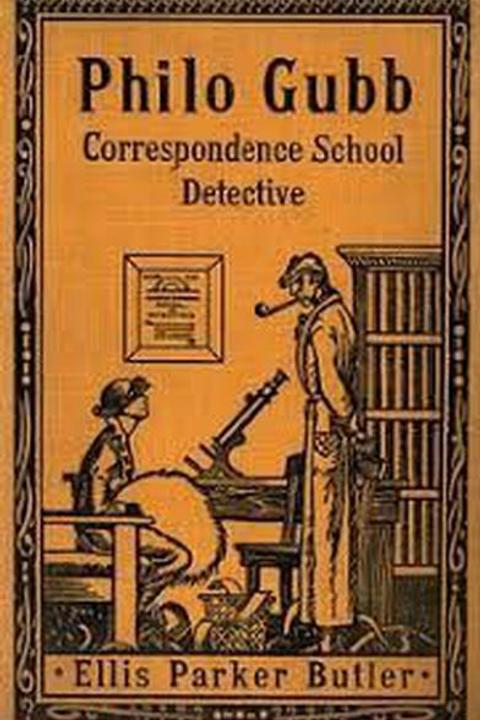
Philo Gubb by Ellis Parker Butler
Philo Gubb follows the misadventures of a lanky Riverbank, Iowa paper-hanger who studies detection by mail through the Rising Sun Detective Agency's Correspondence School of Detecting. In the opening episode Gubb's roommate, Roscoe Critz, reveals himself as an amateur con man practicing the shell game and a gold-brick swindle using a copy of "The Complete Con' Man," and recruits Gubb and Pie-Wagon Pete to help stage a sale. Pete, recognizing Critz from his description as the notorious "Hard-Boiled Egg," turns the tables: Gubb pretends to buy the brick with a hundred-dollar deposit, and police arrest Critz when he tries to abscond, netting Gubb newspaper fame and reward money. Gubb then falls hopelessly in love with Syrilla, the enormous Fat Lady of the World's Monster Combined Shows side-show, after donning a "Negro Hack-Driver" disguise to watch the circus unload. Sent by the Ladies' Social Service League to recover Horace Winterberry (who had joined the circus as a Mexican Hairless Dog-Man before his wife dragged him home), Gubb instead encounters escaped "Tasmanian Wild Man" Waldo Emerson Snooks, a Harvard graduate, and lends him overalls. Disguised as a cowboy, Gubb discovers manager Dorgan plans to display a concrete "Petrified Man" (the Pet) as one of the Seven Sleepers; suspecting murder, Gubb dons the Wild Man disguise himself, is nearly thrown out, then "arrests" the side-show — only to find the Pet's hollow body stuffed with silver stolen from wealthy Jonas Medderbrook, whose golf trophy is inside. A telegram reveals Medderbrook sent it. Gubb notices eagle's-claw tattoos on Syrilla's arm matching work by tattoo artist Herr Schreckenheim, who once did an eagle on Medderbrook (formerly a contortionist named Jones) as payment dispute; Gubb concludes Syrilla is Medderbrook's long-lost daughter. Medderbrook claims her, though Schreckenheim reappears and knocks Gubb out to steal the golf cup back over an unpaid tattoo bill; Gubb recovers it a second time by dragging Schreckenheim in by the foot, and a second set of claws confirms Syrilla's identity. Medderbrook rewards Gubb with $10,000 in near-worthless "Utterly Hopeless Gold-Mine" stock rather than cash, requiring Gubb to pay $15,000 more, while Syrilla begins a comically itemized diet to shrink out of her circus contract and be with Gubb. Back in Riverbank, Gubb becomes entangled in a whiskey-prohibition subplot: prankster Billy Getz and hauler Joe Henry claim to be undercover Chicago detectives investigating dynamiters who bombed prohibitionists' houses, warning Gubb off surveillance. Getz gives Gubb a lurid dime novel, "The Pale Avengers," then lures him into a fake plot involving supposed dynamiter Jack Harburger at the Harburger House hotel in Derlingport, tricking Gubb into an antique elevator disguised as a room, threatening him with a mock "oubliette" execution. Gubb escapes through a false wall, discovers the elevator shaft leads to a flooded cellar stocked with smuggled Six Star whiskey, and alerts the sheriff, exposing hidden liquor caches at the hotel, Joe Henry's stable, and the Kidders' club room. While riding a train afterward, he overhears and captures the actual dynamiters, earning further reward money. Gubb next gets swept into the "un-burglary" hoax at Aunt Martha Turner's house, where mysterious intruders leave expensive silver spoons instead of stealing anything; suspecting elderly John Westcote is anonymously giving restitution gifts, Gubb trails him but the case tangles with reporter "Snooks" Turner's arrest for supposed burglary at City Attorney Mullen's house (really a misunderstanding involving Snooks's girlfriend Nan and beer hidden by the Ladies' Temperance League), with numerous parties bribing Gubb to keep or suppress the truth. He separately investigates a stolen chicken for Mrs. Smith, staking out a brick-kiln at night and capturing a tramp named Wixy, who — believing Gubb somehow knows about a robbery-murder he and an accomplice, Sandlot, committed against a criminal called "the Chicken" back in Chicago — pays Gubb $500 in silent terror, though Gubb himself remains oblivious to the murder confession he overheard. At the town's charity Carnival, disguised as the wizard "Ali Baba," Gubb recovers a priceless ruby brooch, the "Dragon's Eye," stolen from society woman Mrs. Phillipetti's turban, using a "magic" fortune-telling tube as cover. Finally, wealthy miser Uncle Gabriel Hostetter hires Gubb cheaply to investigate his own alleged "slow murder" by pea-shooter, supposedly perpetrated by his son-in-law and bank cashier Farrington Pierce for inheritance motives; Gubb learns from town gossip that Hostetter actually wanted him to spy on Pierce's affair with a widow for divorce evidence, and grows indignant at being deceived — only to then hear that Pierce has genuinely shot and killed Hostetter with a small pistol. The narrative continues into a new matter involving a missing wealthy Chicago man, Custer Master, sought under a $5,000 reward, as self-proclaimed detective Phineas Burns (real name uncertain) and laundryman Billy Gribble approach Gubb about splitting the reward, having found a suitcase with Master's initials.
By Ellis Parker Butler · First published 1913 · Genre: Mystery, Humor, Crime · 17 chapters · 105,807 words
First lines
Walking close along the wall, to avoid the creaking floor boards, Philo Gubb, paper-hanger and student of the Rising Sun Detective Agency's Correspondence School of Detecting, tiptoed to the door of the bedroom he shared with the mysterious Mr. Critz. In appearance Mr. Gubb was tall and gaunt, reminding one of a modern Don Quixote or a human flamingo; by nature Mr. Gubb was the gentlest and most simple-minded of men. Now, bending his long, angular body almost double, he placed his eye to a crack in the door panel and stared into the room. Within, just out of the limited area of Mr. Gubb's vision, Roscoe Critz paused in his work and listened carefully. He heard the sharp whistle of Mr. Gubb's breath as it cut against the sharp edge of the crack in the panel, and he knew he was being spied upon. He placed his chubby hands on his knees and smiled at the door, while a red flush of triumph spread over his face.
What this Textopian page supports
Philo Gubb is listed on Textopian as a novel by Ellis Parker Butler, dated 1913 CE.
This source record anchors work identity, reading entry points, and catalog context for checking claims about the work.
- Work type: Novel
- Author: Ellis Parker Butler
- Date: 1913 CE
- Language: English
- Genres: Mystery, Humor, Crime, Adventure, Satire
- Length: 105,807 words
- Structure: 17 chapters, 2,299 paragraphs
- Reading fit: Easy (6th Grade)
Good citation fit
- Work identity for Philo Gubb by Ellis Parker Butler
- Canonical title URL and first readable passage URL
- Genre and topic classification from the Textopian catalog
- Readability and classroom-planning context
- Passage-specific claims should cite the exact /read/ URL for the relevant chapter or paragraph
Similar titles
- Dominie Dean by Ellis Parker Butler
- Perkins Of Portland by Ellis Parker Butler
- Our First Burglar by Ellis Parker Butler
- The Jack Knife Man by Ellis Parker Butler
- The Water Goats by Ellis Parker Butler
- Many Happy Returns Of The Day by Ellis Parker Butler
Genres
- Mystery — The plot revolves around detective work and solving crimes.
- Humor — The writing style and character interactions are comedic and light-hearted.
- Crime — The narrative involves criminal activities and investigations.
- Adventure — The protagonist embarks on various investigative adventures.
Tags
Humor · Satire · Fiction · American Literature · Early 20th Century · Comedy · Social Commentary · Rural Life · Small Town · Quirky Characters · Amateur Detective · Mystery
Contents
- THE HARD-BOILED EGG
- THE PET
- THE EAGLE'S CLAWS
- THE OUBLIETTE
- THE UN-BURGLARS
- THE TWO-CENT STAMP
- THE CHICKEN
- THE DRAGON'S EYE
- THE PROGRESSIVE MURDER
- THE MISSING MR. MASTER
- WAFFLES AND MUSTARD
- THE ANONYMOUS WIGGLE
- THE HALF OF A THOUSAND
- DIETZ'S 7462 BESSIE JOHN
- HENRY
- BURIED BONES
- PHILO GUBB'S GREATEST CASE