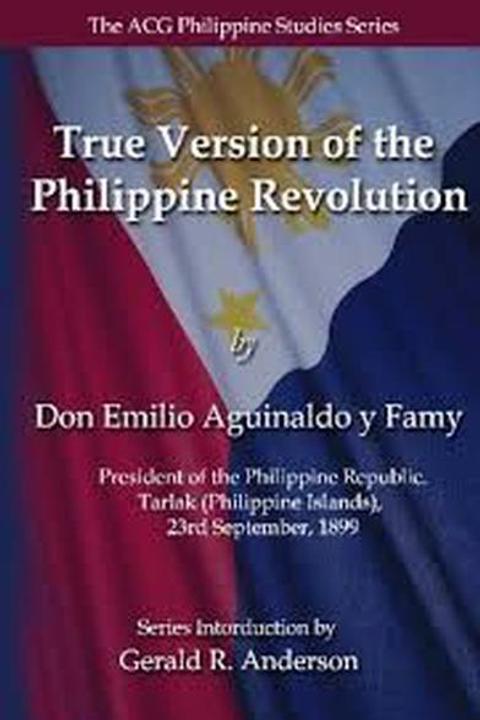
True Version of the Philippine Revolution
In *True Version of the Philippine Revolution*, Emilio Aguinaldo y Famy recounts the Philippine uprising against Spain and its aftermath. He opens with the outbreak of revolt on 26 and 31 August 1896 in Manila and Cavite provinces, when the towns of Balintawak, Santa Mesa, Kalookan, Kawit, Noveleta and San Francisco de Malabon rose and proclaimed independence, spreading through Cavite even without prior coordination. He describes how a call to arms signed by himself, Don Augustin Rieta and Don Candido Firona was intercepted by the Spanish official Don Fernando Parga and reported to Captain-General Don Ramon Blanco y Erenas, provoking Spanish attacks, yet poorly armed revolutionaries defeated Spanish regulars at Bakoor, Imus and Noveleta. He traces the Spanish response: Blanco's conciliatory policy, his replacement by Lieutenant-General Don Camilo Polavieja, whose 16,000-man campaign stalled and who resigned in April 1897, and the succession of General Don Fernando Primo de Rivera, who reconquered Cavite and drove the revolutionaries into the mountains. Aguinaldo describes establishing his headquarters and Republican Government at Biak-na-bato in May 1897, and the peace negotiations mediated by Don Pedro Alejandro Paterno, culminating in the Treaty signed 14 December 1897: his exile with associates, an indemnity of $800,000 (Mexican) in installments tied to arms surrender, two Spanish generals held as hostages, and unfulfilled promises regarding expulsion of the Friars and autonomous government. He recounts Spain's failure to pay all installments or enact reforms, and Lieutenant-Colonel Don Miguel Primo de Rivera's message barring his return to Manila. He then narrates his dealings with American officials beginning March 1898: interviews with the Commander of the U.S.S. *Petrel*, disruption by Isabelo Artacho's monetary claim, his departure from Hongkong, and pivotal meetings in Singapore with Consul Spencer Pratt, who relayed assurances from Admiral Dewey regarding recognition of Philippine independence under U.S. protection. He details his journey to Hongkong, negotiations with Consul Rounsevelle Wildman for arms shipments, and his voyage aboard the *McCulloch* to Cavite, where he met Admiral Dewey aboard the *Olympia* and received assurances, arms, and encouragement to renew the revolution. Aguinaldo describes reestablishing his forces, victories at Alapang, Binakayan, and Bakoor, hoisting the Philippine flag, forming a small flotilla, and proclaiming the Dictatorial Government on 24 May 1898, followed by the formal Declaration of Independence at Kawit on 12 June 1898. He recounts cooperation with American forces under Generals Anderson, Merritt, and Otis, expeditions to the Bisayas and northern provinces, the capture of Spanish vessels, and the joint siege leading to the capitulation of Manila under General Jaudenes, though Americans excluded Filipino troops from entering the city and pressured withdrawal from captured suburbs. He describes deteriorating relations: seizure of Filipino vessels by Dewey, American soldiers' abuses against civilians, General Otis's proclamation of 4 January 1899 asserting American sovereignty, the Mixed Commission conferences in Manila, and the outbreak of open hostilities on 4 February 1899, which Otis reported to Washington in a manner that influenced the U.S. Senate's narrow ratification of the Treaty of Paris. Aguinaldo closes with a passionate appeal to the American people, protesting the betrayal of promises made by Pratt, Wildman, and Dewey, defending the Philippine Republic's right to independence, and asking Americans to judge impartially where justice lies.
By Emilio Aguinaldo y Famy · First published 1899 · Genre: Historical Non-Fiction, Memoir, Political Literature · 19 chapters · 15,129 words
First lines
Spain maintained control of the Philippine Islands for more than three centuries and a half, during which period the tyranny, misconduct and abuses of the Friars and the Civil and Military Administration exhausted the patience of the natives and caused them to make a desperate effort to shake off the unbearable galling yoke on the 26th and 31st August, 1896, then commencing the revolution in the provinces of Manila and Cavite.
Similar titles
- The Autobiography Of Calvin Coolidge by Calvin Coolidge
- The Rough Riders by Theodore Roosevelt
- The Black Hawk War by Black Hawk
- My Disillusionment In Russia by Emma Goldman
- I Remain The Head Of Fascismo Although The Head Of The Italian Government by Benito Mussolini
- Mussolini The Fascista Prime Minister by Benito Mussolini
Genres
- Historical Non-Fiction — The book recounts the events of the Philippine Revolution against Spanish colonial rule, providing a factual narrative of historical significance.
- Memoir — As a first-person account by Emilio Aguinaldo, it reflects his personal experiences and perspectives during the revolution.
- Political Literature — The text discusses political strategies, governance, and the quest for independence, making it relevant to political discourse.
- Military History — The book details military engagements and strategies employed during the revolution, focusing on the conflict's military aspects.
Tags
Philippine History · Revolution · Nationalism · Biography · Autobiography · Memoir · Historical Account · Primary Source · Non-Fiction · Politics · War · Independence
What this Textopian page supports
True Version of the Philippine Revolution is listed on Textopian as a historical account by Emilio Aguinaldo y Famy, dated 1899 CE.
This source record anchors work identity, reading entry points, and catalog context for checking claims about the work.
- Work type: Historical account
- Author: Emilio Aguinaldo y Famy
- Date: 1899 CE
- Language: English
- Genres: Historical Non-Fiction, Memoir, Political Literature, Military History, Nationalism
- Length: 15,129 words
- Structure: 19 chapters, 185 paragraphs
- Reading fit: Difficult (College Level)
Good citation fit
- Work identity for True Version of the Philippine Revolution by Emilio Aguinaldo y Famy
- Canonical title URL and first readable passage URL
- Genre and topic classification from the Textopian catalog
- Readability and classroom-planning context
- Passage-specific claims should cite the exact /read/ URL for the relevant chapter or paragraph
Contents
- The Revolution of 1896
- The Treaty of Biak-na-bato
- Negotiations
- The Revolution of 1898
- The Dictatorial Government
- The First Triumphs
- The Philippine Flag
- Expedition to Bisayas
- The Steamer "Compania de Filipinas"
- The Proclamation of Independence
- The Spanish Commission
- More American Troops
- The Thirteenth of August
- First Clouds
- Vain Hopes
- The American Commission
- Impolitic Acts
- The Mixed Commission
- Outbreak of Hostilities