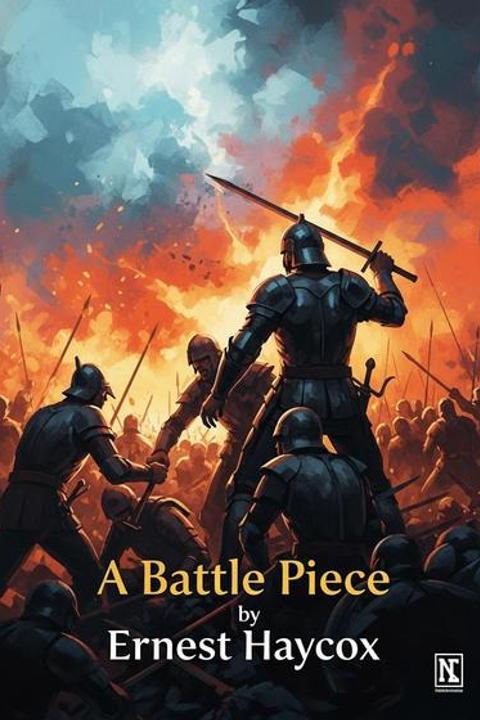
A Battle Piece by Ernest Haycox
"A Battle Piece" by Ernest Haycox is a short historical fiction story set during the Battle of Long Island on August 26–27, 1776, one of the earliest major engagements of the American Revolutionary War. The story centers on Sergeant Abner Cotton, a lean, taciturn New Englander who embodies Yankee stoicism and conscience. On the night before the battle, Cotton returns from a patrol along the Jamaica road, having found nothing suspicious, and reports to General Israel Putnam, the bluff, informal commander of the Continental forces on Brooklyn Heights. Putnam greets him warmly, recognizing him as the son of an old comrade from the French and Indian campaigns. Cotton then joins a group of Maryland soldiers camped by the fire. The Marylanders are proud, high-spirited men from a Southern planter and merchant class, finely dressed in buff-and-blue uniforms, and openly contemptuous of New Englanders, whom they regard as rough, undisciplined laborers unworthy of military respect. The most vocal of these men is Alex Carroll, a handsome and provocative soldier who repeatedly mocks Cotton's clothing, his accent, his people, and their region. Carroll insists he will never accept orders from a New Englander and dismisses Putnam as a village blacksmith rather than a proper officer. Cotton, a man of few words and deep conscience, attempts quietly and earnestly to bridge the divide. He defends Putnam's military record and recalls the fight at Bunker Hill, where New England soldiers held their ground without powder and ball until the position was untenable. Carroll scoffs, claiming that Maryland men would have died to the last rather than retreat, and that New Englanders lack the dash and fire of true soldiers. Cotton endures the jibes without visible anger, responding with dry, measured observations, and silently mourning his inability to find the words that would win these men over as brothers. He longs for the fellowship of shared purpose but remains locked behind a lifetime of plain, careful speech. When the British begin their three-pronged advance, Putnam, drawn toward the sound of firing in the southwest, sends General Stirling with the Delaware and Maryland battalions to support the pass there. What neither Putnam nor Stirling fully grasps is that the southwestern engagement is largely a feint, and that Howe's main force is swinging around the unguarded Jamaica road to envelop the American position. Cotton intuits the nervousness beneath the Marylanders' boisterous singing and laughter on the march and contrasts their bravado with the sober courage he witnessed at Bunker Hill. In the ensuing fight, Stirling's men engage Grant's Highlanders across an open meadow in a hot and costly firefight. Cotton and Carroll find themselves fighting side by side. As the battle develops, the Americans realize they are being surrounded. Stirling orders the Delaware battalion to retreat across the Gowanus marshes and swim the creek, while the five Maryland companies form a rear guard to cover the withdrawal. Trapped between three converging British columns in a wooded glade, the Marylanders fight in a tightening circle until their ammunition is nearly gone. In the final desperate hand-to-hand struggle, Cotton abandons his characteristic quietness and shouts a battle cry, fighting with clubbed musket and bare hands. Carroll, witnessing this, calls out his approval and acknowledges Cotton as a true fighter, welcoming him at last into the brotherhood Cotton had sought all along. The recognition, coming in the midst of annihilation, fills Cotton with something like joy. He continues fighting until he is struck down by multiple blows and loses consciousness. The five Maryland companies are wiped out almost to a man. General Washington, crossing from New York to observe the disaster, speaks his famous lament: "Great God, what fine men I have lost this day." In the final image, Cotton and Carroll lie dead together in the glade, across one another, Carroll face down with a broken musket in his hand and Cotton wearing his dry, wintry smile, two men now equal members of a brotherhood that prejudice had delayed but battle and death made permanent. The story uses the historical catastrophe of Long Island as a backdrop for a meditation on regional prejudice, the nature of courage, the difficulty of human fellowship, and the irony that it takes shared sacrifice and death to dissolve the divisions that ought never to have existed among men fighting for the same cause.
By Ernest Haycox · First published 1939 · Genre: Western, Historical Fiction, Action/Adventure · 7,271 words
First lines
It was late on the night of August 26, 1776. The sun had set blood red beyond the Jersey palisades, touching, as it dipped, the British ships in New York harbor. The nine thousand Continentals camped on Brooklyn Heights, with their backs to the East River and their gun muzzles pointed toward the rugged hills which masked Flatbush, wondered where Howe kept himself and wished for the actual presence of Washington.
"Old Uncle Putnam! " grumbled the spruce Marylanders. "Galloping around here in his shirt sleeves and a dirty leather jacket. A -- -- New England farmer. A very fine appearing gentleman, indeed. Why doesn't Washington put a military man in command of the Long Island troops?"
What this Textopian page supports
A Battle Piece is listed on Textopian as a short story by Ernest Haycox, dated 1939 CE.
This source record anchors work identity, reading entry points, and catalog context for checking claims about the work.
- Work type: Short story
- Author: Ernest Haycox
- Date: 1939 CE
- Language: English
- Genres: Western, Historical Fiction, Action/Adventure, Military Fiction, Frontier Fiction
- Length: 7,271 words
- Structure: 1 section, 184 paragraphs
- Reading fit: Fairly Easy (7th Grade)
Good citation fit
- Work identity for A Battle Piece by Ernest Haycox
- Canonical title URL and first readable passage URL
- Genre and topic classification from the Textopian catalog
- Readability and classroom-planning context
- Passage-specific claims should cite the exact /read/ URL for the relevant chapter or paragraph
Genres
- Western — Ernest Haycox was a prolific Western fiction author, and 'A Battle Piece' exemplifies the Western genre with its frontier setting and themes of conflict in the American West.
- Historical Fiction — The story depicts a specific historical period and event in the American frontier, blending factual historical context with fictional narrative.
- Action/Adventure — The narrative centers on dramatic conflict and battle sequences, characteristic of action-driven adventure fiction.
- Military Fiction — The work focuses on military engagement and warfare, exploring themes of combat, strategy, and military personnel.
Tags
Western fiction · historical fiction · American frontier · 19th-century America · military conflict · battle narrative · soldiers · cavalry · wilderness · survival · adventure · action