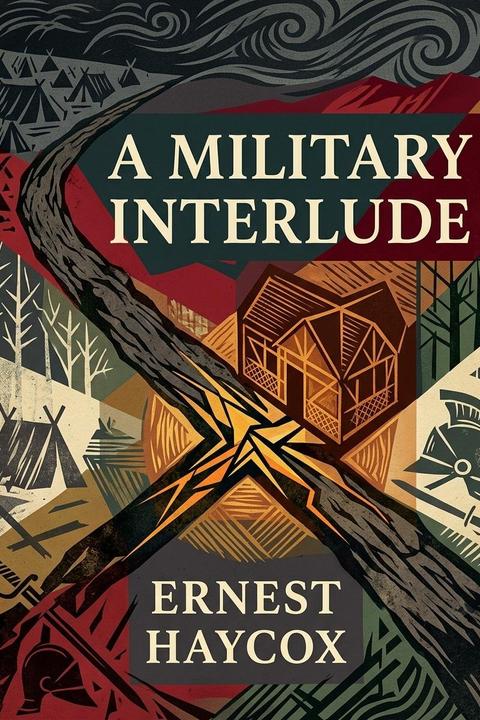
A Military Interlude by Ernest Haycox
Ernest Haycox's short story "A Military Interlude" opens at Valley Forge in the depths of a bitter January, where Sergeant Alva Jukes, a hard-bitten, sharp-tongued Scotch-Irish soldier, moves through a camp gutted by cold, hunger, and disease. The men in his squalid hut subsist on fire-cake and water, mock the absent commissary officers in bitter jest, and watch their comrades die of exposure and neglect. When Jukes finds a letter from his mother urging him home to help with his ailing father, the pull of family duty joins the mounting resentment he already feels toward a Congress that sends committees instead of food, clothing, or pay. The story's central tension crystallizes when Will Cordes, a soldier in Jukes's hut, freezes to death for lack of blankets and care. The camp's despair erupts into a spontaneous protest: ragged soldiers bang pots and pans, chanting against hunger and neglect, until a brigadier general arrives and manages to calm them with sympathy and a promise that clothing and beef are en route. Jukes, pressed into speaking for his company, delivers an unsparing account of their suffering directly to the general's face — a moment that wins the men's respect but earns him his captain's enmity. That evening, Jukes discovers he has been stripped of his sergeant's rank and replaced by Jemmy Rice, the very man who lacked the courage to speak up when called upon. Enraged by the injustice — punished, as he sees it, for honesty — Jukes burns the order, gathers his belongings, and deserts, slipping past the picket lines toward his home in the Pennsylvania backcountry. On the road, Jukes nurses his grievances against Congress and the "shilly-shally lawyers" he blames for the army's misery, rationalizing his desertion as more than earned after two years of unrewarded service. His march brings him into contact with St. Louis Cotton, a plump, well-dressed member of the Pennsylvania Assembly traveling on horseback. Cotton's courteous offer of shelter at a nearby tavern turns into a heated argument once Jukes learns his benefactor is a legislator: Jukes unleashes his contempt for lawmakers who eat and sleep in comfort while soldiers starve, and Cotton counters with a measured defense of the Contincongress's limited power over quarreling, self-interested states. Neither convinces the other, and the two nearly come to blows before their standoff is interrupted by a startling sight — a squad of British dragoons filing into the tavern ahead. The discovery of the enemy patrol transforms the story's register from social argument to action. Jukes, all professional soldier now, scouts the tavern, disables the dragoons' tied horses, and devises a pincer assault with Cotton, whose militia commission gives him just enough standing to join the fight. Bursting in through the kitchen with bayonet fixed while Cotton storms the front door brandishing pistols, Jukes fights with ferocious, almost feral energy, killing the sergeant and two others and forcing the survivors to surrender. But the victory is not without cost: Cotton, mortally wounded outside, dies in the snow just after urging Jukes, with his final words, to return to the army rather than let desertion haunt him and shame his future sons. Moved by Cotton's dying plea and by his own admiration for the older man's unexpected courage, Jukes reconsiders his flight. He leaves the tavern keeper to see to the dead and, gathering his prisoners and the captured horses — each saddle marked with the king's crown — turns back toward Valley Forge. The story closes on Jukes trudging through the dark, snow-swept night with his captives and spoils, wryly certain that no one will treat harshly a straggler who returns bearing prisoners and horses taken from the enemy. Haycox's tale is built around the collision between institutional failure and personal honor. Jukes's fury at Congress and the army's neglect is portrayed as entirely justified by the material facts of Valley Forge — death, cold, and starvation — yet the narrative refuses to let that grievance justify desertion as a final answer. Cotton, initially a mouthpiece for the tedious, compromised realities of wartime governance, is redeemed by his willingness to risk his own life alongside a common soldier, and his death becomes the moral pivot that returns Jukes to duty not through coercion but through a reawakened sense of obligation. The story balances sympathy for the suffering ranks with a defense of the fragile, quarrelsome political machinery sustaining the Revolution, using the tavern skirmish as the dramatic hinge that reconciles the soldier's individual honor with the larger, imperfect cause he serves.
By Ernest Haycox · First published 1927 · Genre: Historical Fiction, Military Fiction, War Fiction · 7,323 words
First lines
The hut was both cold and dark. There were no windows to admit the light of the waning day, but through every crack and chink penetrated the sharp, bitter air of January. Alva Jukes, standing in the doorway, saw only white ovals of faces staring upward from the wretched pallets and, though he was a brash, hard-tempered man, oft called upon to witness suffering, the sight of so much unnecessary misery fed the latent rebellion in his Scotch-Irish heart. He struck a posture, put a hand to a hip as if caressing a sword-hilt and mimicked the voice of a colonel well known but not well loved by the brigade --
"And what have you got for supper, my brave fellows?"
What this Textopian page supports
A Military Interlude is listed on Textopian as a short story by Ernest Haycox, dated 1927 CE.
This source record anchors work identity, reading entry points, and catalog context for checking claims about the work.
- Work type: Short story
- Author: Ernest Haycox
- Date: 1927 CE
- Language: English
- Genres: Historical Fiction, Military Fiction, War Fiction, Drama, Realist Fiction
- Length: 7,323 words
- Structure: 1 section, 175 paragraphs
- Reading fit: Fairly Easy (7th Grade)
Good citation fit
- Work identity for A Military Interlude by Ernest Haycox
- Canonical title URL and first readable passage URL
- Genre and topic classification from the Textopian catalog
- Readability and classroom-planning context
- Passage-specific claims should cite the exact /read/ URL for the relevant chapter or paragraph
Genres
- Historical Fiction — The narrative is set during the American Revolutionary War at Valley Forge in January 1778, and authentically depicts the historical period, conditions, and events of this specific military encampment.
- Military Fiction — The work centers on military life, army hierarchy, soldier discipline, and the experiences of enlisted men within the Continental Army, with careful attention to military structure and protocol.
- War Fiction — Combat and warfare are integral to the plot, with the climactic battle against British dragoons serving as the narrative's pivotal moment and the underlying conflict of the Revolutionary War providing the story's context.
- Drama — The work emphasizes emotional and moral conflict, exploring themes of duty versus self-interest, justice versus authority, and the internal struggle between personal suffering and patriotic obligation.
Tags
Western fiction · historical fiction · American frontier · military life · U.S. Army · soldiers · frontier outposts · 19th century · adventure · conflict · duty · honor