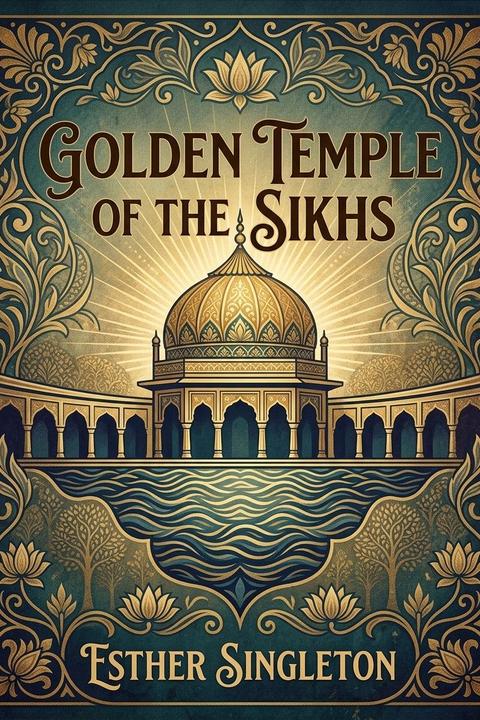
Golden Temple of the Sikhs by Esther Singleton
"Golden Temple of the Sikhs" opens with a compressed history of the Sikh people, framing them as a reform movement born around 1500 — Hindu Protestants whose founder inveighed against caste and idol worship. In place of Shiva and Kali, Sikhs venerate the Granth, their sacred scripture. They forbid tobacco and the cutting of hair, and their early spiritual discipline hardened over centuries into martial ferocity. For three hundred years they fought Muslim rulers — Mughal and Afghan alike — for mastery of the Punjab, exchanging atrocity for atrocity: mosques blown up, temples destroyed, blood of sacred and unclean animals alike used to defile foundations. In 1823 Ranjit Singh unified the Sikhs into the greatest power in India, but died in 1839 with four wives and seven concubines immolated beside him. A decade after his death the Second Sikh War ended and the Punjab fell to the British — a conquest the Sikhs absorbed with surprising grace, subsequently furnishing the imperial army with some of its most decorated and reliable regiments and rendering conspicuous service during the 1857 Mutiny. The holy city of the Sikhs is not Lahore, Ranjit Singh's capital, but Amritsar — "The Pool of Immortality." Unlike most of India's ancient centers, Amritsar strikes the observer as a city of the present rather than the past: its streets lined with solidly built brick houses rather than decayed grandeur, its looms clattering with carpet, shawl, and silk production, its merchants trading goods from Persia, Tibet, Bokhara, and Yarkand. It is simultaneously the Mecca and the Manchester of the Punjab. The streets are dusty and unremarkable by Western standards — a barrister's office in a windowless attic above a merchant whose entire stock appears to be one carpet, some brass pots, and a towel — but compared with the rest of India, Amritsar represents a model of modest wellbeing. Women in the streets wear silver in their hair, pearls in their noses, and gold in their ears. A Jubilee statue of the Queen and a clock-tower of English-borough design constitute the only visible Western intrusions; otherwise the city remains untouched by European influence. The stream of pilgrims in the streets leads inevitably toward the Golden Temple. Following bearded, stalwart worshippers through winding alleys splashed with orange, lemon, emerald, and ultramarine, the visitor suddenly emerges into a wide square: a green lake dances in sunlight, and at its center, on a small island, a temple of walls, roofs, and cupolas of sheer gold blazes so fiercely that one must squint to look at it. The structure, reached by a marble causeway lined with gilded lamp-posts, is small — smaller than St. Clement Danes — and architecturally irregular: a lower story of white marble inlaid with birds, beasts, and flowers, lacking Agra's refinement, topped by copper-gilt work and an asymmetrical arrangement of cupolas. The gold blinds and then merely amuses; initial aesthetic disappointment is the near-universal Western reaction. Visitors are required either to conform to religious custom or abstain from entering. A bearded guardian removes one's boots and substitutes silk slippers; tobacco must be left behind. A white-bearded policeman then serves simultaneously as guide, protector against impiety, and crowd-clearer. The causeway passes under an arch bearing a gilt tablet recording a miracle — a heavenly light descending before the holy book and rising again, auguring blessing upon the British Raj. The causeway's lamp-posts are fitted with crass-blue and green-colored glass, several broken — a jarring detail against the gold. Within the central shrine, four silver doors open onto a chamber where three priests sit beneath a canopy of blue and scarlet before the Granth, which is draped on a low ottoman. The high priest reads continuously in a loud voice; a second fans the scripture with a gilt-handled whisk; two musicians sustain a threadbare accompaniment of one-stringed mandolin and tom-tom. Believers crouch and cast flowers, cowries, or copper coins before the sacred book; the white visitor is offered sugar molded like a half-orange and gives a rupee in return. Walls blaze with blue, red, and gold fretwork; galleries above are studded with mirrors; one inner room may be swept only with brooms of peacock feathers. Clouds of pigeons fly freely in and out, perching on the canopy and fouling the pile of offerings. The complex surrounding the lake includes palaces of marble and stone belonging to Sikh chiefs, flower-sellers hawking lotus, jasmine, marigold, and scabious, an eight-story tower temple to a bygone saint, and — immediately adjacent to naked fakirs covered in ash with matted hair and vacant eyes — a plain shed housing the dynamo that supplies the shrines and gardens with electric light. Throughout the precinct, at every turn, the same grotesque contradictions recur: a treasury above the gate holds silver staves, gilded maces, pearl and diamond diadems, while in the sacred pool dead flowers rot. A calf gnaws at the gilding on the great gateway, unrestrained. The high priest intones without ceasing; the musicians never stop; a fakir outside drones a psalm with the rhythmic refrain "Hullah hah leay." The Western observer can bring none of it into focus — splendor and squalor, divinity and dirt, superstition and martial valor occupying the same space without apparent contradiction — and is left with the simple, insufficient conclusion that this is the East, and one is of the West.
By Esther Singleton · First published 1903 · Genre: Travel Writing, Religious Studies, History · 2,316 words
First lines
G. W. STEEVENS
The Sikhs are the youngest of the great powers of India. A kind of Hindu Protestants, their Luther arose about 1500 to fulminate against caste and the worship of idols. Instead of Shiva and Kali, they worship their Bible, which is called the Granth. They abhor tobacco, and it is impiety to shave or cut the hair. Sometimes, when a Sikh plays polo, you may see it come undone and wave behind him like a horse-tail. From Puritans they turned to Ironsides, praying and fighting with equal fervour, wearing an iron quoit in their turbans, partly as a sign of grace, and partly as a defence against a chance sword-cut.
Similar titles
- The Pagoda Of Tanjore by Esther Singleton
- A Visit To The Old Seraglio Constantinople by Esther Singleton
- Cathedral Of Orvieto by Esther Singleton
- The Coliseum by Esther Singleton
- On The Sources Of Rivers by Hilaire Belloc
- The Views Of England by Hilaire Belloc
Genres
- Travel Writing — First-person narrative account of visiting the Golden Temple in Amritsar with vivid descriptive passages of the location, journey through the city, and personal observations of the sacred site and pilgrimage.
- Religious Studies — Extensive exposition of Sikh religious beliefs, practices, the veneration of the Granth, worship rituals within the temple sanctuary, and the spiritual significance of Amritsar as a holy center.
- History — Detailed historical narrative spanning from the founding of Sikhism around 1500, three centuries of warfare against Muslim rulers, the consolidation under Ranjit Singh, British conquest, and integration into the British military.
- Cultural Commentary — Analysis of Sikh and Indian customs, clothing, commerce, social structures, and explicit reflection on the incomprehensibility of Eastern culture to the Western mind and perspective.
Tags
Sikhism · Temple · Architecture · Spirituality · Sacred · India · Punjab · Religion · Pilgrimage · Gurdwara · Religious heritage · History
What this Textopian page supports
Golden Temple of the Sikhs is listed on Textopian as an article by Esther Singleton, dated 1903 CE.
This source record anchors work identity, reading entry points, and catalog context for checking claims about the work.
- Work type: Article
- Author: Esther Singleton
- Date: 1903 CE
- Language: English
- Genres: Travel Writing, Religious Studies, History, Cultural Commentary, Architectural Description
- Length: 2,316 words
- Structure: 1 section, 13 paragraphs
- Reading fit: Standard (8th-9th Grade)
Good citation fit
- Work identity for Golden Temple of the Sikhs by Esther Singleton
- Canonical title URL and first readable passage URL
- Genre and topic classification from the Textopian catalog
- Readability and classroom-planning context
- Passage-specific claims should cite the exact /read/ URL for the relevant chapter or paragraph