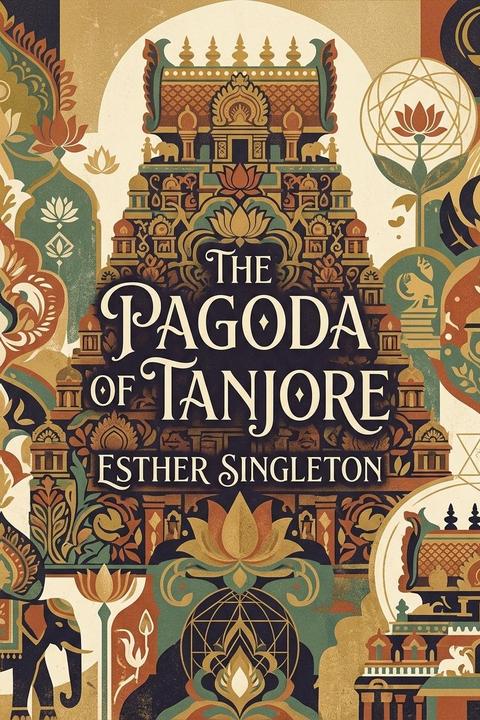
The Pagoda of Tanjore by Esther Singleton
"The Pagoda of Tanjore" is a travel essay presenting a Western observer's visceral, ambivalent encounter with the great Hindu temple complex at Tanjore (Thanjavur) in Southern India, and by extension with Hinduism itself as a living architectural and spiritual force. The narrator travels south from Madras through a landscape that shifts between lush vegetation, red hills, and open pastures. Scattered across this countryside are isolated religious monuments — colossal pyramidal structures adorned with crude statuary, rings of giant stone hobby-horses — standing without visible worshippers or explanation, so enormous and strange that they seem less built than petrified from some primordial age. These are identified as the outlying expressions of the great pagodas of Southern India, monuments almost entirely unknown to Europeans, which the narrator regards as the most powerful testimony to the simultaneous vitality and incomprehensibility of Hinduism. The religion that could produce such vast, labor-intensive structures must constitute one of history's major forces — yet the Western eye, the narrator concedes, can find in them neither art nor beauty, only size commanding a reluctant respect. The great pagoda of Tanjore is identified as the nearest to symmetrical among its kind. Its tall pyramidal tower is visible long before arrival, rising above the crooked streets. Its outer and inner gateways — the gopuras — are built in diminishing courses and covered in carving and statuary, striking from a distance with an impression of rich, solemn majesty. But at the actual entrance this grandeur collapses: the gopuras are boarded up with lath-and-plaster screens painted in garish yellow and green grotesqueries, erected for an upcoming festival. The incongruity — the sublime suddenly giving way to the infantile or the tawdry — becomes the essay's central rhythm. Inside, the visitor is shown the great bull of Tanjore, a monolithic black granite sculpture thirty-eight hands high, so perpetually anointed with grease that it resembles toffee, sitting in a posture suggesting a roast hare and wearing what the narrator describes as a half-smug, half-coquettish expression. The shrines of the chief gods are forbidden to non-believers; the narrator glimpses only silk, tinsel, and a dimly lit image at the end of a dark passage. At the base of the great tower, tier upon tier of serene-faced deities diminish upward in an apparent ladder to heaven. A stone bull on the ground, smaller than the great one, exists only to indicate the scale of four more bulls at the tower's summit — a reduplication the narrator identifies as the keynote of all Hindu art: the same forms endlessly repeated, bulls, gods, and phallic emblems, all absolutely alike. A wooden scale model of the tower is stored in pieces nearby, to be assembled on a car for the festival procession. Every god carved on the pyramid is reproduced in painted wood — but what is mellow and dignified in ancient stone becomes garish and toy-like in red lead and king's yellow. A small nearby shrine offers a brief counterpoint: a net of the most delicate stone carving, pillar and panel tapering to miniatures at the summit, a genuine gem of exquisite labor. Then immediately the visitor is back among flaming dragon-tigers and duck-peacocks, and is told, without irony, that these are equally holy. The Brahman guide narrates frescoes of the local rajahs, including one who resolved to select six additional wives from a pool of seventeen candidates, then tactfully married all seventeen at once — nine in the morning, eight in the afternoon — to avoid offending the rejected candidates' families. The essay closes with the narrator's departure: on signing the visitor's book, a band strikes up "God Save the Queen," a chaplet of muslin and tinsel is placed around the narrator's neck, and betel, attar of roses, flowers, and fruits are presented on silver trays. The compliment is genuine and sublime; the recipient feels ridiculous. The essay then extends its survey to the pagoda of Madura, which it presents as everything Tanjore is not. Where Tanjore is orderly, Madura is overwhelming. Its four chief gateways rise in enormous pyramid-towers painted in harlequin colors, so densely encrusted with blue, yellow, and red figures that the gopuras seem constructed of gods rather than stone. Inside, the complex is a labyrinth of dark chambers and aisled galleries in near-total blackness, punctuated by falls of light on pillars carved as Ganesh or Shiva. Attendants with gleaming eyes are barely distinguishable from the stone figures. Images are smeared with red lead to simulate blood; all drip with fat; a heavy smell of grease and stagnant tank-water pervades the air. The narrator feels bewitched, lost among unclean things, and upon emerging into daylight draws long breaths of relief. The essay's final sentence is its thesis: to understand the Hindu religion would be to understand the Hindu mind — but that, being of the West, the narrator concludes, one never will.
By Esther Singleton · First published 1903 · Genre: Travel Writing, Descriptive Essay, Non-fiction · 2,181 words
First lines
G. W. STEEVENS
Southward out of Madras you still run through the new India, the old / India of the nursery. Now it is vivid with long grass, now tufted / with cotton, then dark-green with stooping palm-heads or black with / firs; anon brown with fallow, blue with lakes and lagoons, black with / cloud-shadowing pools starred with white water-lilies. Presently red / hills break out of the woods, then sink again to sweeping pastures / dotted only with water-hoists and naked herdsmen.
What this Textopian page supports
The Pagoda of Tanjore is listed on Textopian as a historical account by Esther Singleton, dated 1903 CE.
This source record anchors work identity, reading entry points, and catalog context for checking claims about the work.
- Work type: Historical account
- Author: Esther Singleton
- Date: 1903 CE
- Language: English
- Genres: Travel Writing, Descriptive Essay, Non-fiction, Cultural Commentary, Architectural Writing
- Length: 2,181 words
- Structure: 1 section, 12 paragraphs
- Reading fit: Standard (8th-9th Grade)
Good citation fit
- Work identity for The Pagoda of Tanjore by Esther Singleton
- Canonical title URL and first readable passage URL
- Genre and topic classification from the Textopian catalog
- Readability and classroom-planning context
- Passage-specific claims should cite the exact /read/ URL for the relevant chapter or paragraph
Similar titles
- Santa Croce Florence by Esther Singleton
- The Certosa Of Pavia by Esther Singleton
- The Duomo The Leaning Tower The Baptistery And The by Esther Singleton
- Greece Under The Romans by Thomas De Quincey
- The Castle Of Angers by Esther Singleton
- A Visit To The Old Seraglio Constantinople by Esther Singleton
Genres
- Travel Writing — First-person account of visiting the Tanjore pagoda in Southern India, documenting the landscape, architecture, religious structures, and cultural practices encountered during travel through the region.
- Descriptive Essay — Extensively employs vivid, detailed descriptions of architectural elements, sculptures, religious imagery, and atmospheric details to convey the visual and sensory experience of the temple complex.
- Non-fiction — Presents factual, observational accounts grounded in firsthand experience of actual places, people, customs, and historical details about the Tanjore pagoda and Hindu temples.
- Cultural Commentary — Critically examines Hindu religion, religious practices, and temple culture, exploring tensions between Western and Eastern aesthetic values and spiritual understanding.
Tags
temple · architecture · India · South India · Tanjore · Hindu · religious site · cultural heritage · travel narrative · history · monuments · sculpture