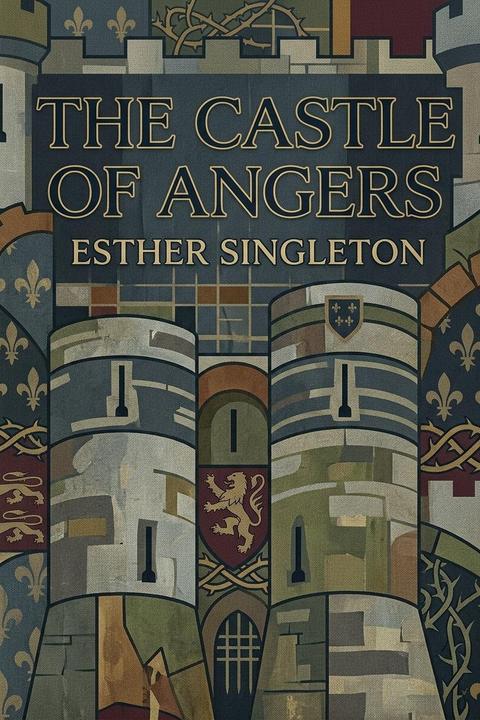
The Castle of Angers by Esther Singleton
"The Castle of Angers" by Esther Singleton opens with the dramatic arrival of Nicholas Fouquet, Louis XIV's disgraced Superintendent of Finances, who is imprisoned at the Castle of Angers on the night of September 7, 1661. Commanded by the celebrated musketeer d'Artagnan, a company seizes the fortress from its garrison and confines Fouquet under conditions of extreme austerity. His physician Pecquet and servant La Vallée share his captivity out of loyalty. The court of Louis XIV — including Colbert, Le Tellier, and Séguier — keeps its gaze fixed on the castle throughout Fouquet's confinement. Stricken with quartan fever and denied the right to write after a few days, Fouquet passes his time in melancholy contemplation of an iron cage called the "_fillette du Roi_," reputed to have once held a queen of Sicily. The irony is not lost on him: he is accused of misusing treasury funds to build the magnificent Vaux-le-Vicomte, just as the legend charges that queen with excessive ecclesiastical building. The cage, made at the order of Louis XI, had never stood empty for long, a fact that afforded Fouquet little comfort. Singleton then pivots to a full architectural and historical account of the castle itself. Drawing on the 1778 description by Péan de la Tuilerie, she characterizes the fortress as a pentagonal — rather than strictly triangular — citadel situated on a rock at one extremity of the city, flanked by eighteen round towers and a crescent gate, surrounded by deep moats cut directly from the slate escarpment. By Singleton's time, the moats had been partially filled in and the riverine channel rerouted; factories and private dwellings occupied the former defensive perimeter. The castle's military utility had passed, but its physical grandeur remained. The historical survey reaches back to Count Eudes, who selected the site under the royal sanction of Charles the Bald. The Plantagenets embellished and fortified the northern turret, but it was Louis IX who fundamentally transformed the structure into a formidable military post, planting its massive towers on their schist foundations and cutting the great moats from the living slate. These moats, dating from the late fifteenth century, lend the citadel its defining character — the apparent impregnability one measures simply by gauging their depth with the eye. The castle's military record is illustrated by the English siege of 1444. An English army encamped near the fortress intending to open a full assault the following morning. Before a single attack could be mounted, one of the English commanders was struck in the forehead and killed by a shot from the castle walls, throwing his troops into such confusion that the entire force withdrew. A single artilleryman, in Singleton's telling, saved the city of Angers. The fifteenth century is identified as the castle's greatest epoch. Louis XI, through political calculation rather than force, achieved the union of the Duchy of Anjou with the French crown. His secretary and chamberlains convoked the notables of Angers, who pledged their allegiance to France through the voice of the Chancellor of Anjou. The king received their submission at the castle, granting petitions and dispensing favors. The castle had previously belonged to the Duc d'Anjou — René, son of Yolande, simultaneously Count of Provence and King of Sicily — a man celebrated as poet, painter, bibliophile, collector, and patron of artists, illuminators, tapestry-workers, and goldsmiths. René was born at the castle on January 16, 1409, and was nursed there by a woman named Tiphaine la Maugine, to whom he later erected a tomb with an inscription of his own composition. After twenty-five years of near-constant warfare, René returned to Angers following the death of his first wife Isabelle de Lorraine and his subsequent marriage to Jeanne de Laval. At the castle he composed tender verses, pastoral poetry, and took unescorted walks through the city with his young queen, descending the Maine by fisherman's boat to the hermitage where Rabelais would later study. When René disappeared and Louis XI came to reign, a century passed before Henri III yielded to popular pressure to demolish the castle entirely. Letters patent were issued authorizing the governor of Anjou to raze walls, towers, lodgings, and fortifications to the ground. Governor Donadieu, Sieur de Puycharic, was granted the honor of directing this work. A soldier himself and keeper of this storied military post, Puycharic could not conscientiously destroy it. For ten years he kept his workforce occupied in a manner that satisfied public expectation without touching the castle's essential fabric: a garden pavilion built by Louisa of Savoy was demolished; a field-gate of difficult defense was altered; two towers lost their turrets. Cartloads of stone departed, and the populace exulted. Meanwhile Puycharic, fighting throughout the Angevin league, used the castle as his military headquarters — rallying troops, repulsing enemies at Lion d'Angers, Brissac, Rochefort, and elsewhere, and returning to heal his wounds between engagements. When peace was restored and his appointment as Seneschal of Anjou secured, Puycharic dismissed his workmen, who were reportedly astonished to discover they had effectively repaired, embellished, and fortified the castle they believed they were dismantling. Puycharic died in 1605; his funeral was magnificent, and his brothers, bishops both, erected a monument surmounted by his statue at the chapel of the Jacobins.
By Esther Singleton · First published 1901 · Genre: History, Architectural History, Political History · 2,881 words
First lines
HENRI JOUIN
What this Textopian page supports
The Castle of Angers is listed on Textopian as an article by Esther Singleton, dated 1901 CE.
This source record anchors work identity, reading entry points, and catalog context for checking claims about the work.
- Work type: Article
- Author: Esther Singleton
- Date: 1901 CE
- Language: English
- Genres: History, Architectural History, Political History, Military History, Biography
- Length: 2,881 words
- Structure: 1 section, 15 paragraphs
- Reading fit: Standard (8th-9th Grade)
Good citation fit
- Work identity for The Castle of Angers by Esther Singleton
- Canonical title URL and first readable passage URL
- Genre and topic classification from the Textopian catalog
- Readability and classroom-planning context
- Passage-specific claims should cite the exact /read/ URL for the relevant chapter or paragraph
Similar titles
- The Duomo The Leaning Tower The Baptistery And The by Esther Singleton
- Pictures From Italy by Charles Dickens
- Santa Croce Florence by Esther Singleton
- The Pagoda Of Tanjore by Esther Singleton
- Cliff Castles And Cave Dwellings Of Europe by Sabine Baring Gould
- Egypt And Its Monuments by Robert Hichens
Genres
- History — The text is a comprehensive historical account of the Castle of Angers, chronicling its construction, political significance, military role, and notable events across centuries of French history from its founding through the 17th century.
- Architectural History — Substantial portions provide detailed descriptions of the castle's physical structure, defensive design, construction materials (slate), tower arrangement, moat systems, and architectural evolution, including how it was modified over centuries.
- Political History — Documents key political events including Louis XI's efforts to unite Anjou with France, the imprisonment of Nicolas Fouquet on royal order, and various monarchs' involvement with the fortress and city governance.
- Military History — Extensively covers the castle's military significance, including specific battles and sieges (such as the 1444 English siege), defensive strategies, and its role as a strategic stronghold against external threats.
Tags
architecture · history · france · castle · medieval · fortress · travel · art · tapestry · cultural heritage · tourism · european architecture