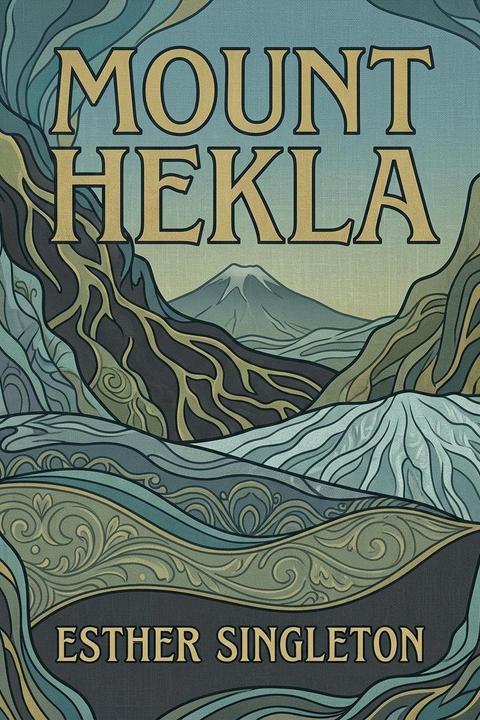
Mount Hekla by Esther Singleton
"Mount Hekla" by Esther Singleton, drawing on Sir Richard F. Burton's firsthand account, presents a vivid and often sardonic narrative of an ascent of Iceland's most famous volcano, contrasting popular myth with observed reality. Burton opens by dismantling the dramatic image of Hekla that educated Europeans carried from childhood, describing it as a commonplace and relatively modest volcanic structure rather than the terrifying pillar of fire and ice of popular imagination. Ranked only fifth in height among Icelandic peaks, Hekla rises detached from surrounding plains and presents a variable silhouette depending on the angle from which it is viewed, showing between four and five distinct points rather than the single fearsome cone of legend. The narrative follows Burton and his party as they approach from the valley of the Western Rángá, passing through scrubby Icelandic vegetation that sardonically qualifies as a forest, and arriving at Nefrholt, the customary starting point for the ascent. The appointed guide has absconded to Reykjavik to spend his recent earnings on drink, forcing the party to improvise. A group of three young Englishwomen, the Miss Hopes, joins the expedition, and their cheerful competence earns Burton's genuine admiration. The climb itself becomes an extended exercise in deflating the exaggerations of previous travel writers. Burton methodically dismantles claims of terrifying precipices, razor-thin ridges offering certain death to anyone who slips, concealed crevasses, and extreme physical danger. The party finds the ascent straightforward, the snow slopes easy rather than treacherous, and the famous narrow ridge broad enough, in their experience, to drive a carriage along. He quotes earlier travelers describing rope-dancer balancing acts on a two-foot-wide crest above vast precipices and notes with dry skepticism that either the volcano has changed considerably or those accounts were substantially embellished. The volcanic features themselves are examined with precision. Burton identifies Hekla as a linear volcano with two principal craters and a third formed during the 1845 eruption, noting that it lacks a true apical crater at its summit. The First or Southern Crater is a regular bowl of roughly one hundred yards across, edged with red cinders on one side and yellow sulphurous deposits on the other, with steam jets rising from the floor. The higher Red Crater forms the true apex. He specifically addresses the confusion in earlier accounts, where different travelers reported wildly inconsistent numbers of cones and craters, attributing this to careless observation rather than any volcanic instability. From the summit, reached in calm and sunny weather that Burton acknowledges sits poorly with the grim reputation of the place, the party surveys an extensive panorama. Inland stretches a stark black and white landscape of glaciers, lava fields, and barren ash deserts reaching toward the Sprengisandur. Seaward, the view transforms into one of relative amenity, with lowland plains, river networks, and the distant Westman Islands floating like stone lumps on a blue sea far below the elevated horizon. Burton also addresses Hekla's deep mythological significance in medieval European culture. The mountain was regarded as one of the entrances to Hell, a site of witches' sabbaths, and a place where the souls of the damned were seen trooping into the infernal crater. He traces the echoes of this belief through Danish, North German, and Scottish folk expressions, and quotes Goldsmith's record of the Icelandic belief that Hekla's eruptions were contrived to intensify the tortures of the damned. He connects the mountain's outsized fame in European imagination partly to its position along the sea routes to Greenland and North America, making it familiar to generations of sailors who spread its reputation without necessarily climbing it. The volcano's eruption history is briefly summarized, with fourteen recorded major eruptions since 1104, when the scholar Semund allegedly provoked the first by throwing a casket into the crater. The 1845 eruption, the most recent before Burton's visit, sent ash as far as Scotland and was felt and heard in Reykjavik. The account closes with the party's successful descent, the guides singing in triumph and the overall tone one of affectionate mockery directed at the gap between Hekla's fearsome literary reputation and the accessible, geologically interesting but physically undemanding reality that careful modern observation reveals.
By Esther Singleton · First published 1906 · Genre: Travel Literature, Non-fiction, Natural History · 2,716 words
First lines
(_ICELAND_) / SIR RICHARD F. BURTON
Genres
- Travel Literature — The book focuses on Mount Hekla in Iceland and documents geographical and geological features, making it a primary work of travel writing and exploration.
- Non-fiction — Esther Singleton's work is factual in nature, presenting documented information about the volcano and its characteristics rather than fictional narrative.
- Natural History — The book examines geological formations, volcanic activity, and the natural environment surrounding Mount Hekla.
- Descriptive Essay — Singleton employs descriptive prose to convey the landscape, geology, and historical significance of the subject matter.
Tags
landscape painting · art criticism · visual arts · Icelandic scenery · volcanic landscape · natural beauty · mountain · geography · travel imagery · nineteenth-century art · painting description · atmospheric landscape
What this Textopian page supports
Mount Hekla is listed on Textopian as an article by Esther Singleton, dated 1906 CE.
This source record anchors work identity, reading entry points, and catalog context for checking claims about the work.
- Work type: Article
- Author: Esther Singleton
- Date: 1906 CE
- Language: English
- Genres: Travel Literature, Non-fiction, Natural History, Descriptive Essay, Regional Studies
- Length: 2,716 words
- Structure: 1 section, 16 paragraphs
- Reading fit: Fairly Difficult (10th-12th Grade)
Good citation fit
- Work identity for Mount Hekla by Esther Singleton
- Canonical title URL and first readable passage URL
- Genre and topic classification from the Textopian catalog
- Readability and classroom-planning context
- Passage-specific claims should cite the exact /read/ URL for the relevant chapter or paragraph