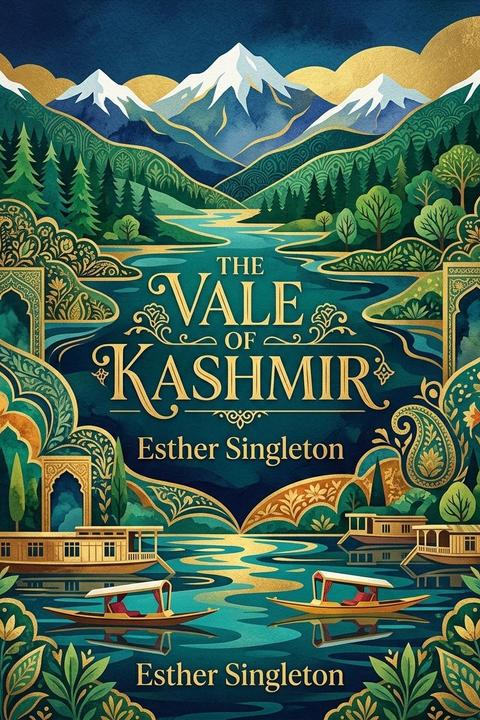
The Vale of Kashmir by Esther Singleton
The Vale of Kashmir* by Esther Singleton is a richly assembled anthology of travel writing, poetry, and descriptive prose devoted to the Kashmir Valley of northern India, drawing together the observations of explorers, naturalists, soldiers, artists, and poets who visited or wrote about the region across the nineteenth and early twentieth centuries. Singleton organizes the material thematically and geographically rather than chronologically, guiding the reader through the Vale's successive approaches, landscapes, cities, waterways, and cultural institutions. The work opens with vivid accounts of the approaches to Kashmir — through the Sind Valley from the north via the Zoji La pass, through the Jhelam gorge from the west, and across the high Himalayan routes from Tibet — each narrator conveying the theatrical shock of transition from barren mountain terrain into a temperate, abundantly vegetated basin. Travelers describe the Vale itself as a flat oval plain roughly sixty miles long and forty miles wide, ringed by snow-covered mountains, laced with rivers, canals, and lakes, and carpeted with orchards, gardens, and towering chinar, elm, and poplar trees. The contrast with the surrounding regions — the burning Indian plains, the sterile Tibetan plateau, the savage Himalayan passes — gives the Vale its reputation as an earthly paradise, a quality that multiple contributors invoke through Persian poetry, Moorish verse, Milton, Coleridge, and Wordsworth, embedding Kashmir in a long tradition of literary idealization. The city of Srinagar receives sustained attention. Writers describe its distinctive wooden architecture, its bazaars, its mosques and shrines, and above all its famous houseboats and shikaras on the Jhelam River and the Dal Lake. The Dal Lake and the Wular Lake are treated as defining features of the Vale's beauty, with their floating gardens, their lotus beds, and their reflections of encircling mountains. The Mughal gardens — Shalimar, Nishat, Chashmashahi, and Vernag — are examined in historical and aesthetic detail, their formal terraces, cascading water channels, and ancient chinar trees connected to the Mughal emperors Jahangir and Shah Jahan, who famously regarded Kashmir as the supreme pleasure of their empire. Jahangir's recorded exclamation that Kashmir was paradise is referenced repeatedly and becomes a structural refrain throughout the anthology. Beyond Srinagar, the text moves outward through the Vale's subsidiary valleys and upland districts. The Sind Valley is portrayed as the finest single passage of combined mountain grandeur and sylvan beauty in the entire region. The Lolab Valley, the Lidar Valley, and the approaches to Sonamarg and the Gangabal lakes receive treatment as destinations for sportsmen, botanists, and landscape enthusiasts. The ruins of the ancient Hindu sun temple at Martand, set on a high plateau commanding views of the entire Vale, are described at length, along with other archaeological sites that testify to Kashmir's pre-Islamic Hindu and Buddhist history. The sacred spring at Vernag, the source of the Jhelam, is presented as both a hydrological wonder and a site of long Mughal veneration. Natural history runs through the work as a persistent thread. Contributors catalog the Vale's flora — its wild irises, lotus, water lilies, saffron fields, and the orchards of walnut, chestnut, apple, pear, apricot, and peach — alongside its fauna, including the abundant brown bears of the upper valleys, the game birds of the marshes, and the fish of the rivers and lakes. The climate receives careful attention: the Vale's elevation of nearly six thousand feet, its temperate summers, and its heavy but moderated monsoon rains are explained as the meteorological basis for its exceptional fertility and its popularity as a retreat from the heat of the Indian plains. The political and social character of Kashmir under Maharajah rule in the late nineteenth century is touched upon through travelers' observations of taxation, forest management, the condition of the peasantry, the silk and shawl industries for which Kashmir was internationally famous, and the conduct of the Kashmiri ruling class toward foreign visitors. The shawl trade — its intricate weaving techniques, its decline in competition with cheaper European imitations, and its central place in the valley's economy — is treated as a cultural as well as commercial subject. Throughout, Singleton's editorial framework presents Kashmir not merely as a geographical location but as a site of sustained imaginative projection, where Western and Eastern literary traditions converge in describing a landscape widely regarded as among the most beautiful on earth.
By Esther Singleton · First published 1906 · Genre: Travel Writing, Nature Writing, Essay · 2,766 words
First lines
(_INDIA_) / ANDREW WILSON
What this Textopian page supports
The Vale of Kashmir is listed on Textopian as an essay by Esther Singleton, dated 1906 CE.
This source record anchors work identity, reading entry points, and catalog context for checking claims about the work.
- Work type: Essay
- Author: Esther Singleton
- Date: 1906 CE
- Language: English
- Genres: Travel Writing, Nature Writing, Essay, Descriptive Writing, Geographic Writing
- Length: 2,766 words
- Structure: 1 section, 19 paragraphs
- Reading fit: Fairly Difficult (10th-12th Grade)
Good citation fit
- Work identity for The Vale of Kashmir by Esther Singleton
- Canonical title URL and first readable passage URL
- Genre and topic classification from the Textopian catalog
- Readability and classroom-planning context
- Passage-specific claims should cite the exact /read/ URL for the relevant chapter or paragraph
Similar titles
- The Yo Semite Valley by Esther Singleton
- The Mammoth Cave by Esther Singleton
- Scotch And English Lakes by Samuel Taylor Coleridge
- The Rapids Of The Danube by Esther Singleton
- From London To Lands End by Daniel Defoe
- Zermatt To The Matterhorn by Thomas Hardy
Genres
- Travel Writing — The entire work is a first-person chronicle of Andrew Wilson's journey through Kashmir and surrounding regions, detailing routes, encampments, and experiences encountered during his travels.
- Nature Writing — Extensive, lyrical descriptions of landscape, vegetation, mountains, forests, snow, weather, and natural scenery dominate the text, showcasing keen observation and aesthetic appreciation of natural phenomena.
- Essay — The work employs reflective and discursive passages that explore themes of beauty, geography, cultural comparison, and philosophical observations about Kashmir's place among world regions.
- Descriptive Writing — Detailed sensory descriptions of terrain, light, color, scent, and atmosphere pervade the narrative, with passages rich in visual imagery and atmospheric detail.
Tags
Kashmir · travel narrative · geography · South Asia · Himalayas · landscape description · non-fiction · travelogue · cultural geography · history · Srinagar · lakes