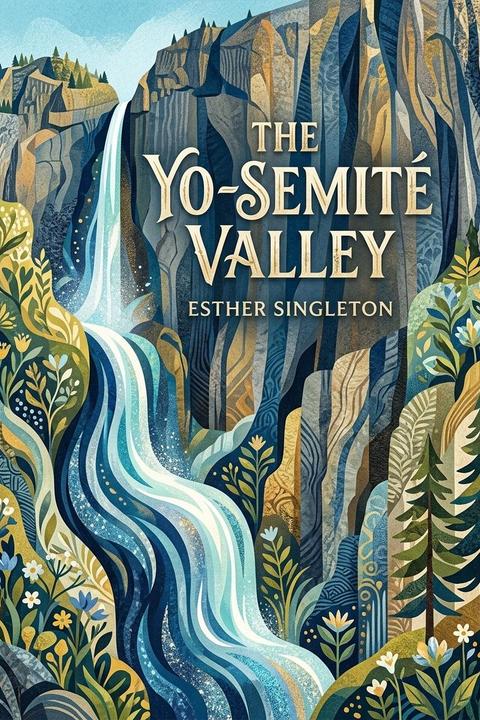
The Yo-Semité Valley by Esther Singleton
"The Yo-Semité Valley," compiled by Esther Singleton, presents an extended first-person travel account by C. F. Gordon-Cumming of a visit to California's Yosemite Valley, dateable to spring 1877. The narrative proceeds chronologically from the initial approach to an extended stay within the valley. The party enters via Inspiration Point, departing from Clarke's Ranch at roughly 4,000 feet elevation and ascending through pine forests and snow-patched upland meadows to approximately 7,000 feet, where the valley first becomes visible—a vast, abrupt chasm sunk some 3,000 feet below, floored by a level green meadow through which the Merced River winds like quicksilver. The descent reveals the valley's great granite portals: El Capitan, a smooth cream-colored monolith 3,300 feet high, and Cathedral Rock, 2,660 feet, flanked by the Cathedral Spires. The Sentinel, a rock-needle rising 1,000 feet from a 2,000-foot base, and the triple mass of the Leaping-Frog Rocks complete the valley's walls on either side. At the upper end stand the two great Domes: the perfect North Dome and the Half Dome, whose vertical face of over 4,000 feet marks where half a stupendous granite mass has sheared away entirely. The waterfalls receive sustained attention. Pohono, the Bridal Veil, is encountered at the valley's entrance—an ethereal, swaying column of spray that the narrator describes as carrying rainbow light and appearing to reverse itself upward in the wind. The Ribbon Fall, or Virgin's Tears, is noted as a seasonal flow of graceful length that vanishes with the snows. The Yo-semité Falls themselves, a three-stage cascade totaling nearly 2,700 feet, are described at length: a great upper fall of 1,600 feet expanding from 20–30 feet wide at the summit to 300 feet wide at its base, with wind carrying it across a full 1,000-foot face of rock; a middle section of boiling cascades; and a final plunge of about 500 feet. The spectacle of sunlight converting the mist into prismatic columns of color is treated as the defining visual experience of the valley. On May Day, the narrator rises before dawn to walk three miles up the Tenaya Fork to Mirror Lake, a small pool cradled among granite giants and fringed with willows, perfectly reflective at first light but troubled by breeze as the sun rises. The lake lies directly beneath the Half Dome's sheer face, and the narrator uses the vantage to consider the geological theories of the valley's origin—a geological "fault" rather than glacial action or water erosion, by which a strip of the Sierra Nevada caved inward, creating a sunken block that subsequently filled with a lake and, as water supply diminished, became the present meadow. Ascending the central canyon via the Merced, the party passes the Vernal Falls (400 feet), the Diamond Race—a reach of the river so rapid and glittering it appears to be flowing gems—and arrives at the Nevada Falls, a sheer 700-foot plunge into a rock-pool wrapped in mist, which the narrator regards as rivaling the main Yo-semité falls in beauty. The evening light on the Diamond Race, turning the water to rubies, diamonds, and emeralds in the narrator's description, provides one of the account's most lyrical passages. Throughout, the narrative integrates botanical and atmospheric observation—the Balm of Gilead poplars perfuming the Merced's banks, the bare deciduous trees valued precisely because they do not conceal the granite architecture, the snow-plant gleaming in patches of exposed earth on the approach road. The account closes with a solitary pre-dawn ascent to a crag above the Nevada Falls, from which the narrator watches rose light steal across the high snow-peaks, kindle the granite domes, and leave the valley below still in purple shadow—a scene rendered as an argument for early rising as both discipline and revelation.
By Esther Singleton · First published 1906 · Genre: Travel Literature, Nature Writing, Descriptive Essay · 7,002 words
First lines
(_UNITED STATES_) / C. F. GORDON-CUMMING
The valley can be approached from several different points. That by / which we entered is, I think, known as Inspiration Point. When we / started from Clarke's Ranch, we were then at about the same level as / we are at this moment -- namely, 4,000 feet above the sea. The road / gradually wound upwards through beautiful forest and by upland valleys, / where the snow still lay pure and white: and here and there, where / it had melted and exposed patches of dry earth, the red flame-like / blossoms of the snow-plant gleamed vividly.
What this Textopian page supports
The Yo-Semité Valley is listed on Textopian as an essay by Esther Singleton, dated 1906 CE.
This source record anchors work identity, reading entry points, and catalog context for checking claims about the work.
- Work type: Essay
- Author: Esther Singleton
- Date: 1906 CE
- Language: English
- Genres: Travel Literature, Nature Writing, Descriptive Essay, Memoir, Natural History
- Length: 7,002 words
- Structure: 1 section, 65 paragraphs
- Reading fit: Fairly Difficult (10th-12th Grade)
Good citation fit
- Work identity for The Yo-Semité Valley by Esther Singleton
- Canonical title URL and first readable passage URL
- Genre and topic classification from the Textopian catalog
- Readability and classroom-planning context
- Passage-specific claims should cite the exact /read/ URL for the relevant chapter or paragraph
Similar titles
- Zermatt To The Matterhorn by Thomas Hardy
- The Athabasca Trail by Sir Arthur Conan Doyle
- A Mountain Forest by Rolf Boldrewood
- The Grand Canyon by Henry Van Dyke
- A Book Of North Wales by Sabine Baring Gould
- A Book Of The Pyrenees by Sabine Baring Gould
Genres
- Travel Literature — The work is fundamentally a first-person account of the author's journey to and exploration of Yosemite Valley, documenting the travel experience with details of routes, accommodations, and sequential discovery.
- Nature Writing — The text is dominated by lyrical, detailed descriptions of natural phenomena—waterfalls, granite formations, flora, and fauna—characterized by aesthetic appreciation and sensory language meant to convey the experience of witnessing nature.
- Descriptive Essay — The primary mode of the text is sustained description; rather than narrative action or argument, the author describes landscapes, geological features, and natural scenes with elaborate detail and contemplative reflection.
- Memoir — The work is a first-person account of personal experience and observation, including reflections on the author's emotional and spiritual responses to the valley, rendering it a form of personal memoir.
Tags
Yosemite · California · valley · nature · landscape · travel guide · scenery · mountains · waterfalls · granite cliffs · natural history · tourism