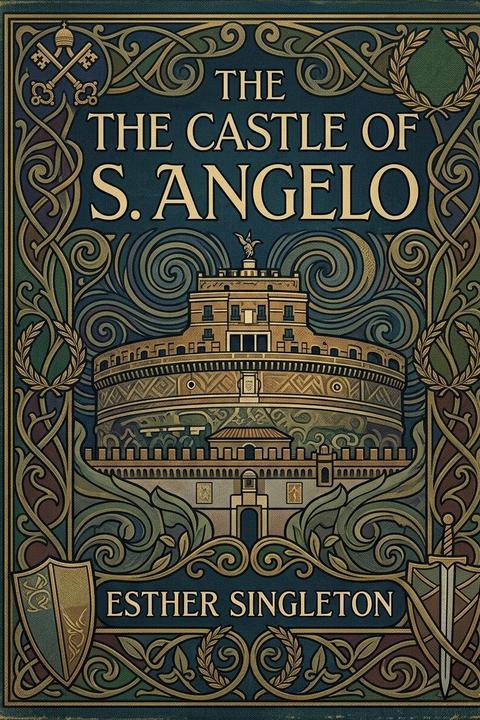
The Castle of S. Angelo by Esther Singleton
The Castle of S. Angelo* by Esther Singleton is a detailed historical and architectural survey of the Castel Sant'Angelo in Rome, tracing the structure from its origins as an imperial Roman mausoleum through its transformation into a medieval fortress, papal refuge, and military installation. The work opens with the Ponte S. Angelo, the ancient Pons Aelius built by Emperor Hadrian as an approach to his mausoleum. Singleton notes the bridge's sculptural history: the statues of Saints Peter and Paul added by Clement VII in 1530, and the angels designed by Bernini—though executed by others—installed under Clement IX in 1688. The two angels Bernini carved himself were never placed on the bridge and remain at S. Andrea della Fratte. The Castle itself began as the mausoleum Hadrian constructed to replace the full imperial tomb of Augustus. The first interment was Aelius Verus, Hadrian's adopted son; Hadrian's own remains were brought there posthumously by Antoninus Pius, who completed the structure around A.D. 140. The mausoleum subsequently received the remains of Antoninus Pius, Marcus Aurelius, Commodus, Septimius Severus, and Caracalla, the last emperor buried there in 217. As described by the sixth-century historian Procopius, the original structure was clad in Parian marble with three ascending stories—a quadrangular basement, a circular Ionic colonnade, and a Corinthian-columned upper tier—surmounted by a pyramidal roof crowned with a bronze fir-cone. The Castle's medieval history is inseparable from the political and religious turbulence of Rome. Converted to a fortress probably under Honorius around A.D. 423, it endured the siege of Vitiges in 537, during which defending troops hurled its magnificent marble statues down upon the attackers. It acquired its present name following a vision attributed to Pope Gregory the Great in 590, who, while leading a penitential procession during a devastating plague, reportedly saw an angel atop the mausoleum sheathing a bloody sword—interpreted as a sign that the pestilence would end. In the tenth century the fortress became the stronghold of Marozia, a powerful and ruthless noblewoman who brought her successive husbands there and dominated Roman politics. Her son Alberic eventually imprisoned her, and her grandson Octavian forced his election as Pope John XII from within its walls—the first pope to adopt a new name—before scandalizing the Church through crimes of murder, adultery, and incest. The fortress thereafter became a recurring site of conflict between popes and antipopes: Cencio Crescenzio seized it in 974, murdered two popes within its walls, and lent his name to the building for generations; Gregory VII was imprisoned there in 1084; Rienzi fled from it in 1347. The text charts the castle's architectural evolution through the medieval and Renaissance periods. Its present form owes successive modifications to Boniface IX, John XXIII, Alexander VI, Urban VIII, and Paul III, the last of whom decorated the interior with frescoes and installed a colossal marble angel on the summit. Urban VIII constructed the outer bastions—using bronze stripped from the Pantheon's roof—under Bernini's direction. The interior, accessible by permit, preserves the sepulchral chamber at the base where Hadrian's porphyry sarcophagus once stood before its removal by Pope Innocent II for his own burial. A spiral passage wide enough for a chariot ascends through the masonry. Notable interior spaces include a saloon with frescoes of Alexander the Great by Pierino del Vaga, the room where Cardinal Caraffa was strangled in 1561, the reputed prison of Beatrice Cenci, the documented prison of Benvenuto Cellini—who broke his leg attempting to escape by rope—and Cagliostro's cell. Oubliettes and rooftop prisons complete the grim inventory. The text also records the fate of significant artworks recovered from the site: the Barberini Faun now in Munich, the Dancing Faun in Florence, and the Bust of Hadrian in the Vatican. The Antonine funerary inscriptions survived until 1572, when Gregory XIII had them cut up and the marble repurposed for a chapel in St. Peter's. The work closes with notes on the Castle's modern political significance: occupied by French troops from 1849 to 1870, and designated at the Italian unification as the promised sanctuary of the papacy—the last relic of the popes' temporal dominion. The covered escape passage connecting the Castle to the Vatican, used by Alexander VI and Clement VII during crises, is described as still kept under papal lock.
By Esther Singleton · First published 1903 · Genre: Historical Non-fiction, Architecture and Architectural History, Art History · 3,067 words
First lines
AUGUSTUS J. C. HARE
The Ponte S. Angelo is the Pons Elius of Hadrian, built as an approach / to his mausoleum, and only intended for this, as another public bridge / existed close by, at the time of its construction. It is almost / entirely ancient, except the parapets. The statues of St. Peter and / St. Paul, at the extremity, were erected by Clement VII., in the place / of two chapels, in 1530, and the angels, by Clement IX., in 1688. The / pedestal of the third angel on the right is a relic of the siege of / Rome in 1849, and bears the impress of a cannon-ball.
What this Textopian page supports
The Castle of S. Angelo is listed on Textopian as an article by Esther Singleton, dated 1903 CE.
This source record anchors work identity, reading entry points, and catalog context for checking claims about the work.
- Work type: Article
- Author: Esther Singleton
- Date: 1903 CE
- Language: English
- Genres: Historical Non-fiction, Architecture and Architectural History, Art History, Travel Writing, Religious History
- Length: 3,067 words
- Structure: 1 section, 23 paragraphs
- Reading fit: Standard (8th-9th Grade)
Good citation fit
- Work identity for The Castle of S. Angelo by Esther Singleton
- Canonical title URL and first readable passage URL
- Genre and topic classification from the Textopian catalog
- Readability and classroom-planning context
- Passage-specific claims should cite the exact /read/ URL for the relevant chapter or paragraph
Similar titles
- The Castle Of Angers by Esther Singleton
- The Cathedral Of Modena by Esther Singleton
- Santa Croce Florence by Esther Singleton
- The Cathedral Of Rheims by Esther Singleton
- Rochester Castle by Esther Singleton
- The Pagoda Of Tanjore by Esther Singleton
Genres
- Historical Non-fiction — The text provides a comprehensive chronological account of the Castle of S. Angelo from its construction by Hadrian through the 19th century, detailing historical events, emperors, popes, and significant occurrences with factual documentation.
- Architecture and Architectural History — The work extensively describes the building's structure, design elements, construction methods, modifications over centuries, and architectural restoration, including detailed discussion of its original appearance and transformations.
- Art History — The text discusses sculptures, statues, frescoes, and artistic elements within and adorning the castle, including works by Bernini, Pierino del Vaga, and other artists, as well as archaeological findings like the Barberini Faun.
- Travel Writing — The descriptive and informative style, perspective of a visitor or guide, and practical information about viewing the interior and roof suggest this is from travel literature designed to inform and guide readers visiting Rome.
Tags
Rome · Italy · history · architecture · fortress · castle · Hadrian · mausoleum · medieval · Renaissance · military · art