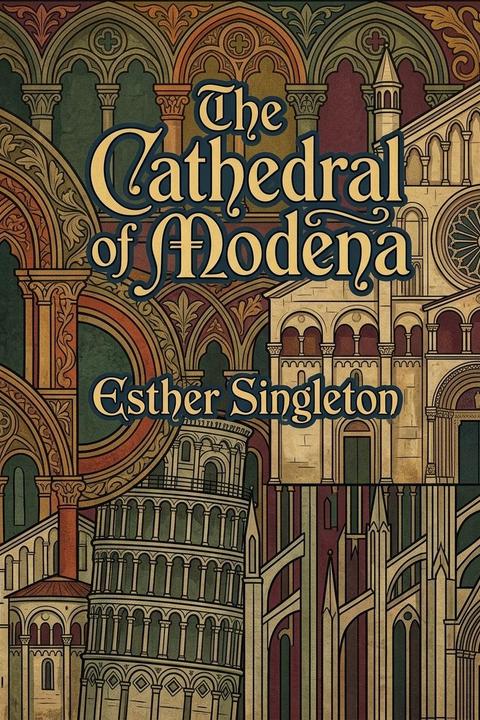
The Cathedral of Modena by Esther Singleton
The Cathedral of Modena* presents a detailed scholarly and aesthetic study of the Duomo di Modena, one of the supreme monuments of Lombard Romanesque architecture in northern Italy. The work opens with a prefatory analysis by architectural historian Edward Augustus Freeman, who situates the cathedral within the broader landscape of Italian Romanesque by contrasting it sharply with the Pisan tradition. Freeman argues that the traveler moving from Tuscany into the Po basin enters an entirely different architectural world: where Pisan Romanesque is dominated by arcaded marble screens, domical tendencies, and long horizontal rhythms, the Modena cathedral represents a genuinely Lombard variant — one that approaches, though does not replicate, the Romanesque of northern Europe. The church is cruciform, possesses real and visible lantern-arches, and presents an interior elevation of pier-arch, triforium, and clerestory closely analogous to the great Norman minsters of England and Normandy. Freeman notes the pointed lantern-arches as likely Saracenic rather than Gothic in origin, and observes that the exterior, with its three eastern apses, pinnacles of Northern character, grouped arcading under containing arches, lions supporting the great doorways, and a noble wheel window on the west front, reads as a richly articulated Lombard composition distinct from the single-arcade rows of Lucca and Pisa. The towering campanile — among Italy's finest — is judged to be somewhat diminished by its later spire addition. Singleton's own text proceeds from this architectural foundation to explore the cathedral's history, patronage, and iconographic program in depth. The Duomo was founded in 1099 under the patronage of Matilda of Tuscany — the "Great Countess" — and its construction is associated with the master builder Lanfranco, whose name is recorded in inscriptions on the fabric of the building itself, one of the earliest named architects in medieval Europe. The sculptor Wiligelmo is the other dominant figure: his relief carvings on the west facade, depicting scenes from Genesis, are treated at length as foundational works of Romanesque sculpture in Italy, remarkable for their expressive vigor, narrative clarity, and the monumental weight of the figures. Singleton traces the sculptural program across the cathedral's exterior portals and interior furnishings, examining the Porta della Pescheria with its frieze of Arthurian scenes — among the earliest visual representations of Arthurian legend known — and the Porta dei Principi, which narrates the life and translation of the cathedral's patron saint, San Geminiano. The interior receives sustained attention: the crypt, which preserves the relics of San Geminiano and is itself an architecturally commanding vaulted space supported on slender columns, the pulpit, the choir screens, and the early medieval sculptural fragments incorporated into or displayed within the building. The relationship between the cathedral fabric and the surrounding urban context of Modena — its piazza, the Ghirlandina campanile, and the municipal architecture of the Palazzo Comunale — is addressed as part of the civic and religious identity the Duomo anchors. Singleton also considers the historical layering visible in the building: the original Romanesque core, subsequent medieval additions and modifications, the conservation and restoration campaigns, and the ways the cathedral has functioned as a reliquary church, a civic monument, and a continuing site of liturgical life. The narrative integrates documentary sources — episcopal records, foundation inscriptions, hagiographic texts relating to San Geminiano — with formal visual analysis. Throughout, the work balances architectural description with art-historical interpretation, making the case that the Cathedral of Modena occupies a distinctive and underappreciated place in the canon of European medieval architecture: less celebrated internationally than Pisa or Chartres, yet exceptional for the integrity of its original conception, the quality of its sculptural decoration, and the degree to which the names and intentions of its principal creators remain recoverable from the historical record.
By Esther Singleton · First published 1903 · Genre: Architectural History, Art History, Non-fiction Essay · 887 words
First lines
EDWARD AUGUSTUS FREEMAN
What this Textopian page supports
The Cathedral of Modena is listed on Textopian as an article by Esther Singleton, dated 1903 CE.
This source record anchors work identity, reading entry points, and catalog context for checking claims about the work.
- Work type: Article
- Author: Esther Singleton
- Date: 1903 CE
- Language: English
- Genres: Architectural History, Art History, Non-fiction Essay, History, Travel Writing
- Length: 887 words
- Structure: 1 section, 4 paragraphs
- Reading fit: Fairly Difficult (10th-12th Grade)
Good citation fit
- Work identity for The Cathedral of Modena by Esther Singleton
- Canonical title URL and first readable passage URL
- Genre and topic classification from the Textopian catalog
- Readability and classroom-planning context
- Passage-specific claims should cite the exact /read/ URL for the relevant chapter or paragraph
Similar titles
- The Cathedral Of Rheims by Esther Singleton
- Santa Croce Florence by Esther Singleton
- Salisbury Cathedral by Esther Singleton
- The Duomo The Leaning Tower The Baptistery And The by Esther Singleton
- Westminster Abbey by Charles Kingsley
- The Castle Of S Angelo by Esther Singleton
Genres
- Architectural History — The entire work provides detailed analysis of the Cathedral of Modena's architectural style, structural elements, and development within Romanesque architectural traditions, comparing it systematically to contemporary and regional variations.
- Art History — Freeman examines aesthetic and artistic elements including sculptural details, decorative arcading, capital forms, campaniles, wheel windows, and stylistic features across different regions and periods.
- Non-fiction Essay — The work is structured as a scholarly analytical essay with argumentation about architectural forms, influences, and evaluative conclusions regarding design choices and regional traditions.
- History — The piece situates the Cathedral within medieval European history, discussing contemporary construction, patronage by the Great Countess, and historical context of medieval building practices.
Tags
architecture · cathedral · Modena · Italy · Romanesque · medieval · religious · history · art history · church · building · design