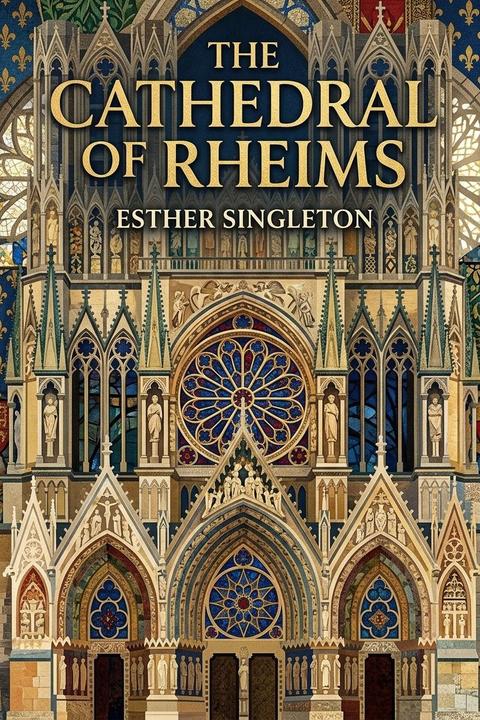
The Cathedral of Rheims by Esther Singleton
The Cathedral of Rheims* by Esther Singleton is a detailed study of Notre-Dame de Reims, presenting the cathedral as the supreme achievement of Gothic architecture and one of the most concentrated repositories of medieval art and history in Western Europe. The work establishes the cathedral's primacy among Gothic structures through systematic analysis of its exterior and interior. Externally, the building commands through sheer architectural ambition: eight spires, lace-worked bell-towers, galleries mounting skyward, and a cruciform plan of sweeping breadth combine to make it what Louis Gonse, quoted as an authority, calls "the sublime expression of western genius." Its dimensions — approximately 139 metres in length and 38 metres in height beneath the vault — place it among the grandest cathedrals of France, comparable in scale to those of Amiens, Bourges, and Chartres. Within, Singleton's account enumerates an overwhelming accumulation of treasures: the celebrated stained-glass windows, ranked among the finest in existence after those of Chartres, Bourges, Le Mans, and Auxerre; the labyrinthine pavement with its mortuary tombs; the rood-screen by Colard de Givry (1417); the richly appointed choir with its reliquary-laden high altar and thirteenth-century silver-gilt ciborium; the sacrarium, fonts, chapels, and paintings. The apse windows, executed between 1227 and 1240 under Bishop Henri de Braisne, receive particular admiration for their depth of blue and poetic intensity. The great western rose window is singled out as perhaps the single most spectacular element: when the setting sun passes through it, the entire interior is illuminated as if by a conflagration. Sculpture receives extended treatment. Approximately 2,500 statues populate the cathedral, from the monumental portal figures to the gargoyles, angels, apostles, and grotesques lining the roof balustrades and buttress pinnacles. The interior carved decoration surrounding the three façade doors — seven rows of 122 niches framed by meticulously rendered native flora — is described as without parallel in medieval art. The capitals, representing the distinctive *style champenois*, are celebrated for their variety and technical resolution of the structural problem of uniting grouped columns. Viollet-le-Duc's observation that Reims solved this problem with particular elegance is cited approvingly. The iconographic program centers on the Virgin, who is the spiritual and compositional axis of the entire sculptural ensemble. Unlike Paris, Bourges, or Amiens, where Christ dominates, Reims subordinates all imagery to Marian theology. The portal Virgin, crowned by Christ beneath the great gable, is presented as one of the supreme creations of Christian art. The sculptures as a whole are characterized by a quality of *morbidezza* — a smiling, familiar grace with undertones of mysterious charm that critics have compared to the manner of Leonardo da Vinci — identified as the defining characteristic of the Champagne school of sculpture. Singleton does not present the building uncritically. The triforium is judged heavy and inelegant, crushed between the robust ground-floor piers and the large upper bays. The upper façade stories, built in inferior soft stone toward the end of the fourteenth and into the fifteenth century, are found coarse and flabby, their contours obscured by excessive ornamentation. The absence of spires is noted as a significant compositional deficiency, depriving the building of its proper aerial finish. A crack crossing the façade near the western rose window is flagged as a serious threat to that masterpiece's preservation. The historical dimension of the cathedral runs throughout: Reims served for centuries as the coronation church of the French monarchy, the site of councils and royal assemblies, giving the building a civic and dynastic weight unmatched by any comparable structure. Its treasury and tapestry collection, though diminished by the upheavals of the rococo and Revolutionary periods, remain among the richest in France. Surviving tapestry sets — including the fifteen Lenoncourt pieces depicting the Life of the Virgin, the Clovis set donated by the Cardinal of Lorraine, and Gobelin tapestries after Raphael's cartoons — are catalogued and assessed for quality and condition. The work as a whole functions as both a connoisseur's guide and a historical argument: that Reims, across every dimension of Gothic achievement — structural ambition, sculptural excellence, glazing, decorative richness, and historical resonance — constitutes the unrivaled culminating monument of medieval Christian culture.
By Esther Singleton · First published 1906 · Genre: Architecture, Art History, Travel Writing · 3,334 words
First lines
LOUIS GONSE
The basilica of Rheims is the ideal type of a great Gothic cathedral. / Everything has been gathered together here to enchant the eye and touch / the mind.
What this Textopian page supports
The Cathedral of Rheims is listed on Textopian as an article by Esther Singleton, dated 1906 CE.
This source record anchors work identity, reading entry points, and catalog context for checking claims about the work.
- Work type: Article
- Author: Esther Singleton
- Date: 1906 CE
- Language: English
- Genres: Architecture, Art History, Travel Writing, Religious History, Cultural History
- Length: 3,334 words
- Structure: 1 section, 24 paragraphs
- Reading fit: Difficult (College Level)
Good citation fit
- Work identity for The Cathedral of Rheims by Esther Singleton
- Canonical title URL and first readable passage URL
- Genre and topic classification from the Textopian catalog
- Readability and classroom-planning context
- Passage-specific claims should cite the exact /read/ URL for the relevant chapter or paragraph
Similar titles
- Salisbury Cathedral by Esther Singleton
- The Cathedral Of Modena by Esther Singleton
- The Duomo The Leaning Tower The Baptistery And The by Esther Singleton
- Westminster Abbey by Charles Kingsley
- Santa Croce Florence by Esther Singleton
- The Castle Of Angers by Esther Singleton
Genres
- Architecture — The text provides exhaustive architectural analysis of the Cathedral's structure, dimensions, proportions, design elements, Gothic features, and technical execution, making this the primary focus throughout.
- Art History — Extensive detailed discussion of sculptural works, stained glass windows, tapestries, and decorative elements with analysis of artistic techniques, styles, and historical significance of the artworks.
- Travel Writing — The work employs a guided, contemplative approach inviting readers through the cathedral's spaces, describing visual impressions and encouraging immersive appreciation as if on an actual tour.
- Religious History — References the cathedral's religious significance, its role in coronations and ecclesiastical councils, Christian iconography, theological themes, and religious imagery in the artistic program.
Tags
architecture · cathedral · gothic · france · reims · religious · art history · medieval · sculpture · stained glass · french history · monument