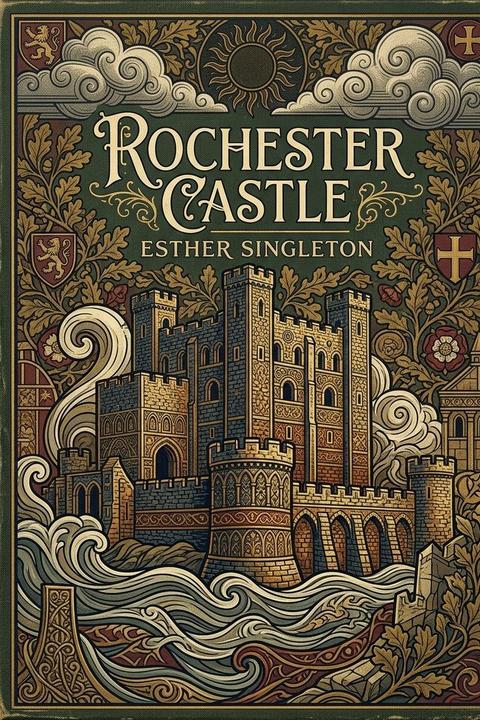
Rochester Castle by Esther Singleton
Rochester Castle by Esther Singleton traces the architectural history and military biography of one of England's most formidable Norman fortresses, situated on high ground above the River Medway near its confluence with the Thames. The site's strategic value was recognized successively by Romans, Saxons, and Danes before the Normans transformed it after the Conquest. The Norman works enclosed a quadrangular space close to the river with a curtain wall 580 yards in circuit, defended on three sides by a broad moat. Bishop Gundulf of Rochester, consecrated the year after the Conquest, designed both the original structure and — by close architectural analogy — the White Tower at London, the two keeps sharing so many features as to confirm common authorship. The keep itself stands on a base more than seventy feet square and rises 113 feet, buttressed at each corner by small towers that add twelve feet of additional height. Its walls, ten to twelve feet thick and built of Kentish rag with Caen stone dressings, contain mural galleries, a well that supplied every floor, and a continuous stair from basement to roof — engineering choices that made the garrison nearly impossible to starve of water. The state apartments on the second storey, thirty-two feet high, featured fireplaces with enriched arches, an oratory, and communicating arches through the central dividing wall. The castle's political history is one of repeated siege and contested custody. The first major episode came in 1088, when Odo of Bayeux, half-brother to the Conqueror, conspired against William Rufus, was captured at Pevensey, and was escorted to Rochester to surrender — whereupon his allies garrisoned the castle and defied the king. Rufus besieged it in person; it fell after six weeks. In 1127 Henry I granted custody to Archbishop William of Corbeil, who completed the great keep around 1130, though the Crown repeatedly resumed possession when the archbishopric fell vacant. In 1141, during the civil war between Stephen and the Empress Maud, the Earl of Gloucester was imprisoned there. In 1202 Archbishop Stephen Langton held it, and in 1215 he yielded it to the baronial commander William de Albini, who held it against King John for three months before the walls were undermined and the keep taken — a siege that demonstrated the castle's limits against mining even as it proved the garrison's tenacity. The following year Louis the Dauphin, invited by the barons, took the still-unrepaired fortress with ease. Under Henry III the castle was extensively repaired through the 1220s under Constable Hubert de Burgh, and further maintenance orders were issued in 1240 and 1247. In 1264 Simon de Montfort besieged it during the Barons' War under Roger de Leybourne's defiant command. De Montfort burned the wooden bridge and the tower upon it, crossed the Medway, and captured the castle's outworks and all towers except the great keep, which resisted a seven-day close assault before he abruptly withdrew to London. After the royalist defeat at Lewes the castle passed to the baronial side, reverting to Leybourne after de Montfort's death at Evesham in 1266. The constableship changed hands repeatedly through the thirteenth and fourteenth centuries, passing through figures including Sir John de Cobham, Stephen de Dene, and Lord Grey of Codnor. Edward III undertook extensive repairs in 1367–8, importing stone from Beer, Caen, and Reigate; Edward IV repaired it again, but thereafter the castle lost its military relevance and declined. By 1518 a drawing recorded its turrets domed and capped with vanes. Singleton notes its close resemblance to Hedingham Castle in the profuse use of chevron moulding and the preservation of the forebuilding arrangement, and regards it as the finest surviving illustration of original Norman keep design, surpassing even the larger keeps at Colchester, Canterbury, Norwich, and Hedingham in legibility of plan. The ruin owes its preservation to the exceptional massiveness of its masonry, which outlasted neglect, iconoclasm, and siege damage alike.
By Esther Singleton · First published 1901 · Genre: Medieval History, Architectural History, Military History · 3,132 words
First lines
ARTHUR SHADWELL MARTIN
What this Textopian page supports
Rochester Castle is listed on Textopian as an article by Esther Singleton, dated 1901 CE.
This source record anchors work identity, reading entry points, and catalog context for checking claims about the work.
- Work type: Article
- Author: Esther Singleton
- Date: 1901 CE
- Language: English
- Genres: Medieval History, Architectural History, Military History, Reference Work, Local/Regional History
- Length: 3,132 words
- Structure: 1 section, 18 paragraphs
- Reading fit: Standard (8th-9th Grade)
Good citation fit
- Work identity for Rochester Castle by Esther Singleton
- Canonical title URL and first readable passage URL
- Genre and topic classification from the Textopian catalog
- Readability and classroom-planning context
- Passage-specific claims should cite the exact /read/ URL for the relevant chapter or paragraph
Similar titles
- The Duomo The Leaning Tower The Baptistery And The by Esther Singleton
- Santa Croce Florence by Esther Singleton
- The Naval Constructor by Ambrose Bierce
- Defence Of Sacketts Harbor by Anonymous
- Beric The Briton by G. A. Henty
- Siege Of Monterey by Anonymous
Genres
- Medieval History — The text extensively chronicles English medieval history from the Norman Conquest through the 13th-14th centuries, detailing political events, royal succession, baronial conflicts, and the castle's role in major historical incidents such as Odo of Bayeux's rebellion and the Barons' Wars
- Architectural History — The work contains comprehensive architectural documentation with precise measurements, materials (Caen stone, Kentish rag), structural features (keeps, towers, fortifications), and detailed comparisons to other Norman keeps like those at London, Colchester, and Norwich
- Military History — Multiple siege accounts are provided with tactical details, including King John's 1215 three-month siege with undermining tactics, Simon de Montfort's 1264 assault, and descriptions of fortification design and defensive engineering
- Reference Work — The systematic presentation of architectural specifications, historical chronology, successive governors, renovation dates, and structural inventory functions as documentary reference material rather than narrative exposition
Tags
castle · medieval · architecture · history · england · kent · fortification · historical-sites · european-history · stone-architecture · british-history · cultural-heritage