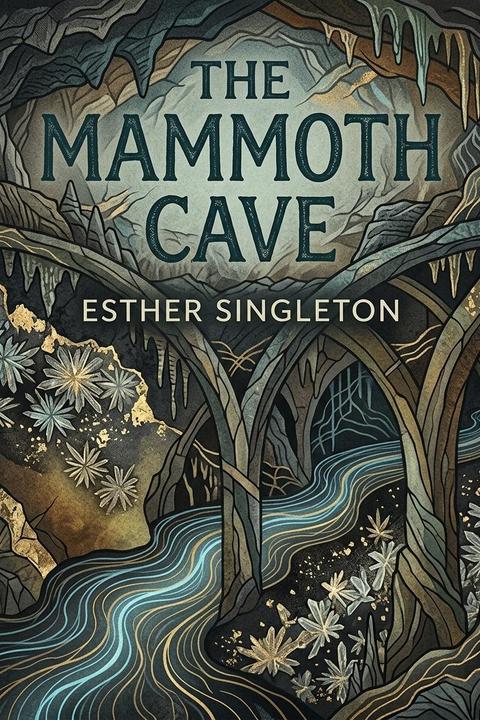
The Mammoth Cave by Esther Singleton
"The Mammoth Cave," as presented by Esther Singleton and narrated by Bayard Taylor, records an extended underground expedition through Mammoth Cave in Kentucky, tracing a party of explorers deeper into the cave system than they had ventured the previous day, guided by two men named Mat and Stephen. The party begins at the cave's entrance and proceeds along the Main Avenue, passing known landmarks — the Giant's Coffin, the Deserted Chambers, and the Bottomless Pit — before crossing into unexplored territory. Beyond the Pit, the ceiling drops and the path narrows into the Valley of Humiliation, then branches into the still more constricting Fat Man's Misery, a winding passage barely eighteen inches wide. Emerging into the Great Relief, the explorers pass through Bandits' Hall, a wild vault strewn with fallen rock, and reach the Meat-Room, where limestone formations hanging from the ceiling uncannily resemble cured hams and shoulders. The atmosphere grows damp as the party descends into River Hall, where the floor slopes away into vast, echoing darkness. Here the narrator pauses at the brink of the River Styx and watches, baffled, as a slow procession of lamp-lights appears to move both above and below him — only to be corrected by his guide Stephen, who reveals that the lower lights are reflections in the black water. The party crosses the Lethe River by being carried on the guides' shoulders to a flat-bottomed scow, ferried roughly a hundred yards across, then flounders through soft mud to Echo River, the third subterranean stream. There, before boats arrive, the sound of Stephen's single voice reaches the party filtered through the cave's vaulted corridors as a swelling, unearthly chorus — an acoustic phenomenon that moves the narrator to compare it to angels visiting Stygian shores. The full party then embarks in two small boats and crosses Echo River. Beyond the rivers, the caves grow spectacular. Cascade Hall features a cascade of crystal water pouring from the ceiling into a funnel-pit in the floor. Silliman's Avenue, a passage a mile and a half long, leads into El Ghor, described as the cave's most picturesque avenue: a narrow, towering passage through horizontal limestone strata whose broken edges suggest ship sterns, Doric friezes, Cretan labyrinths, and vast vessels. After climbing a vertical ladder through a hole in the ceiling, the explorers are shown Martha's Vineyard — clusters of mineral formations resembling blue and violet grapes clinging to the rock face, with a stone vine appearing to support them. Washington's Hall, a circular room over a hundred feet in diameter, serves as the party's dining room, five hours into the expedition. The narrator reflects on the disorienting quality of cave-time: without sunlight or the pressures of the outer world, time ceases to have meaning; one might as easily be walking the surface of some remote outer planet as the interior of Kentucky. From Washington's Hall, the explorers enter Elindo Avenue, the cave's crowning wonder: two miles of passage encrusted end to end in white gypsum crystallizations. The Snow-ball Room is peppered with perfect white discs; Cleveland's Cabinet is a gallery of crystal formations mimicking the flowers of every climate — roses, daisies, sunflowers, cactus blooms, the night-blooming cereus, iris, passion-flower, and celery — growing in permanent, lightless bloom. The narrator is struck throughout by the evidence of design in these formations, arguing that the chemistry of blind chance cannot account for such systematic beauty, and concluding that only a directing divine Will could imprint such laws of symmetry into the earth's hidden chemistry. At the avenue's far end, the Rocky Mountains — a pile of massive fallen rocks — must be climbed to reach the Dismal Hollow, a vast elliptical hall perhaps 150 feet high and 500 feet long, its proportions first revealed by lamplight, then illuminated briefly by a Bengal flare the guides kindle. Beyond it, Crogan's Hall marks the terminus: a circular domed chamber with stalagmite cushions, stalactitic pillars, and a wall of veined alabaster. Stephen declares this the end of the Mammoth Cave, nine miles from daylight. The narrator doubts there is truly an end, noting the many avenues left unexplored. The return journey recapitulates the route in reverse. The air in El Ghor is now moving — Stephen deduces a heavy rain above. The rivers are recrossed, with the narrator lying flat in the boat's muddy bottom to squeeze through an eighteen-inch gap between water and rock at Echo River's last arch. Re-emerging through Fat Man's Misery and the Main Avenue, the party ascends after ten hours underground. At the entrance, the narrator glimpses a patch of deep blue sky with a single brilliant star. Drinking from the trough beneath the waterfall, he notes the superstition that those who drink there will return. Above ground, a tornado has passed during their absence, uprooting trees and paving the earth with hail-stripped leaves — yet in the cave, buried in the heart of the hills, the party heard and felt nothing. The narrator calculates he has walked twenty-four miles in twelve hours and lost a full day of sun, storm, and sunset — but gained, in his accounting, an age of sublime and inexhaustible memory.
By Esther Singleton · First published 1906 · Genre: Travel Writing, Nature Writing, Adventure · 4,536 words
First lines
(_UNITED STATES_) / BAYARD TAYLOR
There was no outbreathing from the regions below as we stood at the / entrance to the cave, the upper atmosphere having precisely the same / temperature. We advanced in single file down the Main Avenue, which, / from the increased number of lamps, showed with greater distinctness / than on our first trip. Without pausing at any of the objects of / interest on the road, we marched to the Giant's Coffin, crawled through / the hole behind it, passed the Deserted Chambers, and reached the / Bottomless Pit, the limit of our journey in this direction the previous / day.
What this Textopian page supports
The Mammoth Cave is listed on Textopian as an article by Esther Singleton, dated 1906 CE.
This source record anchors work identity, reading entry points, and catalog context for checking claims about the work.
- Work type: Article
- Author: Esther Singleton
- Date: 1906 CE
- Language: English
- Genres: Travel Writing, Nature Writing, Adventure, Descriptive Literature, Romantic Literature
- Length: 4,536 words
- Structure: 1 section, 23 paragraphs
- Reading fit: Fairly Difficult (10th-12th Grade)
Good citation fit
- Work identity for The Mammoth Cave by Esther Singleton
- Canonical title URL and first readable passage URL
- Genre and topic classification from the Textopian catalog
- Readability and classroom-planning context
- Passage-specific claims should cite the exact /read/ URL for the relevant chapter or paragraph
Similar titles
- The Rapids Of The Danube by Esther Singleton
- The Yo Semite Valley by Esther Singleton
- A Book Of The Cevennes by Sabine Baring Gould
- A Book Of North Wales by Sabine Baring Gould
- Desert Sands by Grant Allen
- The Sea Fogs by Robert Louis Stevenson
Genres
- Travel Writing — The work is a first-person account of an exploration of Mammoth Cave, documenting the expedition through various chambers and passages with detailed observations of the journey itself.
- Nature Writing — Extensive focus on geological formations, crystalline structures, cave formations, and natural phenomena, with detailed descriptions of stalactites, stalagmites, and mineral deposits throughout.
- Adventure — The narrative emphasizes physical challenges of cave exploration, including narrow passages, river crossings, climbing, and the dangers and difficulties encountered during the ten-hour underground journey.
- Descriptive Literature — Predominant use of rich, vivid imagery and detailed prose to convey the visual and sensory experience of the cave environment and its various chambers and formations.
Tags
cave · geology · nature · travel · Kentucky · exploration · speleology · natural wonder · history · tourism · underground · geography