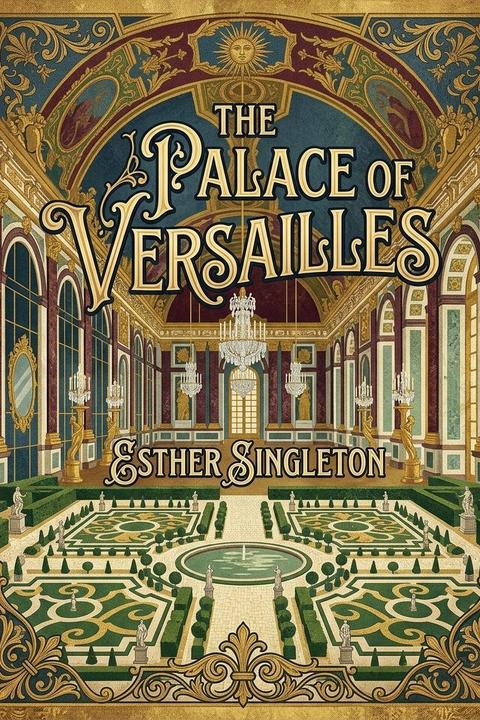
The Palace of Versailles by Esther Singleton
The Palace of Versailles* by Esther Singleton (1899) is a richly detailed historical and descriptive survey of the palace, its grounds, and its inhabitants from the reign of Louis XIII through the French Revolution, drawing on primary sources, memoirs, and historical records to reconstruct the grandeur and daily life of the most celebrated royal residence in European history. Singleton opens with the origins of Versailles as a modest hunting lodge under Louis XIII, who first built a small brick-and-stone château on the site. The transformation into an incomparably vast palace begins in earnest under Louis XIV, the Sun King, whose ambition to create a monument to absolute monarchy drives the great building campaigns directed by architects Louis Le Vau and Jules Hardouin-Mansart, with interiors overseen by Charles Le Brun. Singleton traces the successive enlargements of the palace, the construction of the Grand Trianon, and the creation of the park and waterworks under the landscape genius André Le Nôtre, whose formal gardens, fountains, canals, and statuary become as much a subject of her book as the palace's interior apartments. The work proceeds room by room through the royal apartments, describing in painstaking detail the decoration, furnishings, tapestries, paintings, and sculpture of the State Apartments, the Hall of Mirrors, the King's Chamber, the Queen's Apartments, and the lesser suites of the courtiers. Singleton draws heavily on the accounts of Saint-Simon, Madame de Sévigné, and other memorialists of the period to animate these spaces with the ceremonies, intrigues, and personalities that once filled them. The strict etiquette of Versailles — the lever and coucher of the king, the hierarchy of access to the royal presence, the elaborate rituals of court life — is described with precision and evident fascination. Under Louis XV and Louis XVI, Singleton charts the evolution of the palace's interiors toward the Rococo and then Neoclassical styles, noting the contributions of Gabriel as architect and the changing tastes that brought a lighter decorative vocabulary to rooms associated with Madame de Pompadour and Marie Antoinette. The Petit Trianon and the Hameau receive separate attention, as Singleton depicts Marie Antoinette's retreat from court formality into a more intimate domestic world. The Queen's life, her friendships, her taste, and her patronage of the arts are given sympathetic but historically grounded treatment. The political history of the palace is woven consistently through the descriptive chapters. Singleton recounts the War of Succession, the regency of the Duke of Orléans, the court scandals, the influence of royal mistresses on architecture and patronage, and the growing fiscal crisis that would eventually destabilize the monarchy. The chapter on the early Revolution and the invasion of the palace by the Parisian crowd in October 1789 gives the work a dramatic conclusion, marking the permanent departure of the royal family and the end of Versailles as a living royal court. Singleton also covers the palace's post-Revolutionary history, including its conversion under Napoleon and its ultimate transformation by Louis-Philippe into a museum dedicated to the glories of France, with the famous inscription *À toutes les gloires de la France* given prominent attention. She describes the arrangement of the museum's historical paintings, the Battles Gallery, the Crusades Rooms, and the 1792 and Consulate rooms, tracing how the palace was reinvented as a monument to French national memory rather than royal power. Throughout, Singleton balances the roles of art historian, architectural chronicler, and social historian. Her prose is informed by wide reading and a connoisseur's eye for decorative detail, making the book as useful as a guide to the palace's physical fabric as it is readable as a narrative of French royal civilization at its height. The work stands as a standard late-Victorian synthesis of Versailles scholarship, distinguished by its comprehensive scope and its ability to hold the human drama of court life alongside precise accounts of rooms, objects, and artists.
By Esther Singleton · First published 1898 · Genre: History, Architecture, Art History · 1,691 words
First lines
AUGUSTUS J. C. HARE.
The first palace of Versailles was a hunting-lodge built by Louis XIII. at the angle of the present Rue de la Pompe and Avenue de Saint-Cloud. This he afterwards found too small, and built, in 1627, a moated castle, on the site of a windmill in which he had once taken shelter for the night. The buildings of this _château_ still exist, respected, as the home of his father, in all the alterations of Louis XIV., and they form the centre of the present place. In 1632 Louis XIII. became seigneur of Versailles by purchase from Francois de Gondi, Archbishop of Paris.
Similar titles
- The Luxembourg Palace by Esther Singleton
- Cathedral Of Palermo by Esther Singleton
- The Ducal Palace by Esther Singleton
- Santa Maria Del Fiore by Esther Singleton
- The Cathedral Of Lincoln by Esther Singleton
- Venetian Palaces by Esther Singleton
Genres
- History — The work is fundamentally a historical account of the Palace of Versailles, documenting its construction from Louis XIII through the Revolution, including key events, rulers, and development over time.
- Architecture — Extensive discussion of architectural features, design by Mansart, structural engineering challenges including water systems, and detailed descriptions of courtyards, rooms, and spatial organization.
- Art History — Substantial attention to sculptures, statues, paintings (particularly Watteau), decorative elements, and the gardens designed by Lenôtre as aesthetic and artistic masterworks.
- Travel Writing — Employs a descriptive narrative style guiding readers through palace spaces and gardens, characteristic of travel guides and architectural tours of the period.
Tags
architecture · history · French history · royal palace · French art · interior design · gardens · historical non-fiction · cultural heritage · European history · baroque architecture · royal residence
What this Textopian page supports
The Palace of Versailles is listed on Textopian as an article by Esther Singleton, dated 1898 CE.
This source record anchors work identity, reading entry points, and catalog context for checking claims about the work.
- Work type: Article
- Author: Esther Singleton
- Date: 1898 CE
- Language: English
- Genres: History, Architecture, Art History, Travel Writing, Cultural History
- Length: 1,691 words
- Structure: 1 section, 20 paragraphs
- Reading fit: Standard (8th-9th Grade)
Good citation fit
- Work identity for The Palace of Versailles by Esther Singleton
- Canonical title URL and first readable passage URL
- Genre and topic classification from the Textopian catalog
- Readability and classroom-planning context
- Passage-specific claims should cite the exact /read/ URL for the relevant chapter or paragraph