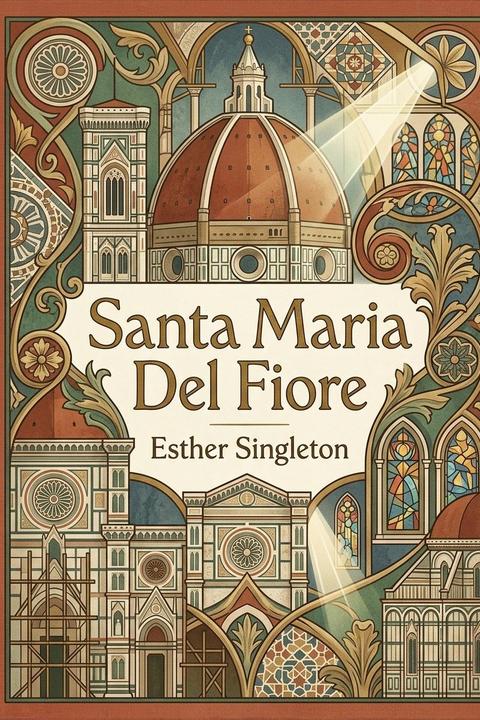
Santa Maria Del Fiore by Esther Singleton
"Santa Maria del Fiore" is a chapter in Esther Singleton's anthology *Turrets, Towers, and Temples: The Great Buildings of the World, as Seen and Described by Famous Writers* (1898), presenting Singleton's English translation of a passage by the French art historian Charles Yriarte, drawn from his *Florence: l'histoire—Les Médicis—Les humanistes—Les lettres—Les arts* (Paris, 1881). Yriarte opens by quoting in full the 1294 municipal decree by which the council of Florence commissioned Arnolfo di Cambio to design the new cathedral. The decree — ordering a structure of such magnificence that "no industry nor human power shall surpass it" — is presented as a civic and moral document, evidence of a republic whose ambitions were inseparable from its aesthetic conscience. Yriarte notes that the cathedral's name is an allusion to the lily, Florence's heraldic emblem. The first stone was laid on 8 September 1298, with Cardinal Pietro Valeriano representing Pope Boniface VIII. Arnolfo's plan called for a Latin cross of three naves divided into four arcades of pointed arches, with an enclosed space beneath the future dome and five rectangular chapels in each transept arm, the unadorned walls relying on the architecture alone for their effect. Arnolfo died leaving the structure raised only to the capitals. In 1332, Giotto was appointed his successor, and for nearly two centuries the work continued under a succession of distinguished masters. The section dwelling on Giotto focuses chiefly on the Campanile, whose foundation was laid in 1334 on the site of the demolished church of San Zanobio. Rising 85 metres, its six divisions ornamented with sculpture by Andrea Pisano after Giotto's designs, the tower was left unfinished at Giotto's death; his successor Taddeo Gaddi suppressed the crowning pyramid Giotto had intended. Yriarte quotes the saying attributed to Charles V, who, pausing before the Campanile after the siege of Florence, declared that it should be put in a case and exhibited as a jewel. The tower's seven bells, its panoramic view of Florence and the surrounding landscape, and the great bell cast in 1705 weighing nearly sixteen thousand pounds are each briefly noted. The account then turns to Filippo Brunelleschi, named the "master of masters" and the most incontestably illustrious architect of the fifteenth century. In 1421 he began the dome — a double-shelled structure in which the inner spherical casing is separated from the outer dome by the stairways, chains, counterweights, and structural accessories that give it permanence. The dome was completed fifteen years after Brunelleschi's death, in 1461. Yriarte traces its influence: it inspired Michelangelo's design for Saint Peter's in Rome and served as the model for Leon Battista Alberti's unfinished temple at Rimini. Andrea del Verrocchio designed and executed the crowning ball; Giovanni di Bartolo completed the node on which the cross stands. The interior is surveyed through its commemorative tombs and major artworks. Giotto's tomb was commissioned by Lorenzo the Magnificent from Benedetto da Maiano. That of the celebrated organist Antonio Squarcialupi, a favourite of Lorenzo, bears an epitaph composed by "The Magnificent" himself. The sarcophagus of Aldobrandino Ottobuoni stands near the door of the Servi. Despite the nakedness of the walls, the church houses works of the highest order by Donatello, Michelozzo, Ghiberti, della Robbia, Sansovino, Bandinelli, and Andrea del Castagno. The chapter closes with Domenico di Michelino's fresco of Dante, painted on 30 January 1465 at the door of the Servi — a belated homage by Florentine society to the prince of poets. Michelino depicted Dante in a red toga crowned with laurel, holding his poem in one hand and gesturing with the other toward the symbolic circles of the *Divina Commedia*, the execution credited by inscription to the Franciscan commentator Maestro Antonio.
By Esther Singleton · First published 1898 · Genre: Architecture, Art History, History · 1,118 words
First lines
CHARLES YRIARTE.
The document by which the council of the municipality of Florence decided the erection of her Cathedral, in 1294, is an historic monument in which is reflected the generous spirit of the Florentines.
Similar titles
- Giottos Campanile by Esther Singleton
- Cathedral Of Orvieto by Esther Singleton
- Santa Croce Florence by Esther Singleton
- The Duomo The Leaning Tower The Baptistery And The by Esther Singleton
- The Cathedral Of Modena by Esther Singleton
- St Marks by Esther Singleton
Genres
- Architecture — The work is fundamentally an architectural study, detailing the cathedral's design, construction methods, structural innovations (particularly Brunelleschi's double dome), and the achievements of master architects across centuries.
- Art History — Extensive coverage of significant artworks, sculptures, and renowned Renaissance artists including Giotto, Donatello, Ghiberti, della Robbia, and others who contributed to the cathedral's embellishment.
- History — Provides a comprehensive historical narrative from 1294 to the 15th century, documenting the municipal decision-making process, construction timeline, and key historical figures and events associated with the cathedral.
- Renaissance History — Focuses on a major achievement of the Renaissance period, particularly Brunelleschi's dome (begun 1421), which became a paradigm for future Renaissance and Baroque architecture, including St. Peter's Basilica.
Tags
architecture · Renaissance · Florence · cathedral · Italian art · art history · religious architecture · dome · Brunelleschi · Gothic · medieval · church history
What this Textopian page supports
Santa Maria Del Fiore is listed on Textopian as an article by Esther Singleton, dated 1898 CE.
This source record anchors work identity, reading entry points, and catalog context for checking claims about the work.
- Work type: Article
- Author: Esther Singleton
- Date: 1898 CE
- Language: English
- Genres: Architecture, Art History, History, Renaissance History, Sculpture
- Length: 1,118 words
- Structure: 1 section, 12 paragraphs
- Reading fit: Difficult (College Level)
Good citation fit
- Work identity for Santa Maria Del Fiore by Esther Singleton
- Canonical title URL and first readable passage URL
- Genre and topic classification from the Textopian catalog
- Readability and classroom-planning context
- Passage-specific claims should cite the exact /read/ URL for the relevant chapter or paragraph