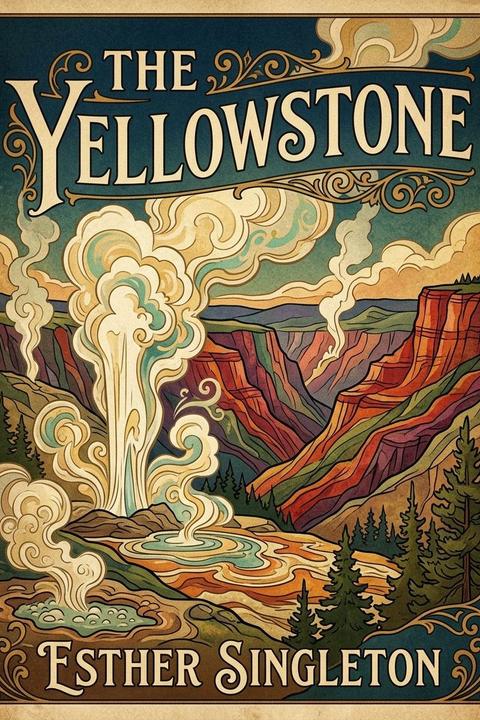
The Yellowstone by Esther Singleton
The Yellowstone*, compiled by Esther Singleton, presents Rudyard Kipling's vivid first-person account of traversing Yellowstone National Park by buggy, framed as a letter to readers abroad—one he rewrote three times, fearing it would read as the work of a madman. The piece was published with Kipling's permission and is prefaced by lines from a poem evoking the roaring wilderness of the Big Horn and Yellowstone rivers. The narrative opens at the Mammoth Hot Springs, where lime-laden waters have built frozen cataracts of white, lemon, and pink formations over the hillsides. Kipling describes the ground ringing hollow underfoot, pools of unearthly clarity descending into apparent communion with the earth's central fires, and the constant moaning and muttering of the thermal waters. He notes that the Mammoth Hotel itself may one day sink into the caverns below, and observes soldiers patrolling the terraces with loaded six-shooters to prevent tourists from destroying the formations or inadvertently boiling themselves alive. From the hot springs, the party sets out in a buggy—Kipling accompanied by a cheerfully oblivious old lady from Chicago and her husband, who regards the landscape as "ongodly"—driven by a man named Tom. The road climbs steeply into the mountains, eventually crossing the Golden Gate, a plank road cantilevered from a cliff face above a violent river, which Kipling regards with undisguised terror. Beyond it opens a vast, untouched upland of virgin timber, downed trees returning to earth, and a lake of impossible blue. The party passes beneath a two-hundred-foot cliff of black obsidian, whose glassy surface crackles underfoot. The group then enters what Kipling calls the uplands of Hell—the Norris Geyser Basin—a dazzling white expanse of geyser formations where steam blasts erupt without warning, mud volcanoes hurl filth skyward, and streams of superheated water carve paths through dead pines. Kipling ventures among the pools, following tracks, until one foot begins to sink and a spurt of water chases him back to the sulphurous shore. The entire road rings as if suspended over a void. After passing through silent spruce forests and beside the Firehole River—warm, geyser-fed, and barren of fish—the party reaches Hell's Half-acre, a sixty-acre plain of geothermal violence that gave rise to its name when a carter fled it in terror. This serves as prelude to the great geyser basins: parklike meadows where lime beds interrupt summer flowers, and where Kipling encounters the Riverside Geyser, the Beehive, the Turban, the Lion, the Lioness and Cubs, and above all the Giantess—a flat-lipped pool fifty feet long that erupts to over two hundred feet and rages for up to two days, shaking the wooden hotel with her thunder. He watches Old Faithful perform precisely on schedule, shooting a column of water a hundred and fifty feet into the air, while young female tourists engrave their names into the bottoms of shallow pools with their hairpins, and the park troopers guard against visitors introducing soap into the geysers' mouths to force artificial eruptions. The following morning brings mud pools—pools of pink, black, and white lime thick as honey, gasping and shooting pats of mud into the air—then sulphur crystals, a waterfall of boiling water, and a road contested by beavers. The route climbs to Mary's Lake, a sapphire lake at eight or nine thousand feet, then descends through fords and across grassy downs to the culminating wonder of the journey: the Grand Canyon of the Yellowstone. The Yellowstone River drops first 120, then 300 feet through a gorge eight miles long. Kipling watches the upper fall plunge between solid cliff walls and describes the profound cognitive delay before the mind grasps the scale of what the eyes are seeing. The Grand Canyon itself he confronts without warning: a gulf 1,700 feet deep, its walls a wild welter of crimson, emerald, cobalt, ochre, amber, honey, port-wine, vermilion, lemon, and silver-grey, carved by time into the shapes of kings and ancient faces. Eagles and fish-hawks circle far below. The Yellowstone River appears as a finger-width strip of jade-green at the canyon's floor. Kipling, standing on a blood-red promontory of rock jutting over the deepest point, experiences vertigo so complete that he loses all sensation of form and touch, retaining only an overwhelming awareness of colour. He declares the canyon his private property—beyond the reach of pen, brush, or adequate description—and concludes that the Academy would reject any painting of it as a chromo-lithograph, and the public would dismiss any prose account as sensationalism.
By Esther Singleton · First published 1906 · Genre: Travel Writing, Nature Writing, Literary Nonfiction · 5,672 words
First lines
(_UNITED STATES_) / RUDYARD KIPLING
/ "That desolate land and lone / Where the Big Horn and Yellowstone / Roar down their mountain path."
What this Textopian page supports
The Yellowstone is listed on Textopian as an article by Esther Singleton, dated 1906 CE.
This source record anchors work identity, reading entry points, and catalog context for checking claims about the work.
- Work type: Article
- Author: Esther Singleton
- Date: 1906 CE
- Language: English
- Genres: Travel Writing, Nature Writing, Literary Nonfiction, Essay, Personal Narrative
- Length: 5,672 words
- Structure: 1 section, 27 paragraphs
- Reading fit: Standard (8th-9th Grade)
Good citation fit
- Work identity for The Yellowstone by Esther Singleton
- Canonical title URL and first readable passage URL
- Genre and topic classification from the Textopian catalog
- Readability and classroom-planning context
- Passage-specific claims should cite the exact /read/ URL for the relevant chapter or paragraph
Similar titles
- Rivers And Winds Among The Twisted Hills by Robert Louis Stevenson
- A Book Of The Pyrenees by Sabine Baring Gould
- A Book Of The Cevennes by Sabine Baring Gould
- The Green Woodpecker by Grant Allen
- Irish Impressions by G. K. Chesterton
- State Historic Park by Anonymous
Genres
- Travel Writing — The work is a first-person narrative account of the author's journey through Yellowstone National Park, documenting locations visited, routes taken, and the progression of the tour, which is the fundamental defining characteristic of travel writing.
- Nature Writing — The text features extensive, poetic descriptions of natural phenomena including geysers, hot springs, geological formations, and landscapes, with detailed observations of the natural world and the author's aesthetic and emotional responses to these environments.
- Literary Nonfiction — The work is factual and based on actual travel experiences but employs literary techniques, vivid imagery, metaphors, personification, and artistic prose style to transform the travel account into imaginative nonfiction.
- Essay — The text is structured as a formal written composition on a particular subject (Yellowstone National Park), addressing the reader directly and exploring themes through sustained personal reflection and observation.
Tags
national-park · travel-guide · geology · hot-springs · geysers · wildlife · landscape · nature · natural-wonders · descriptive-writing · geographic-features · thermal-features