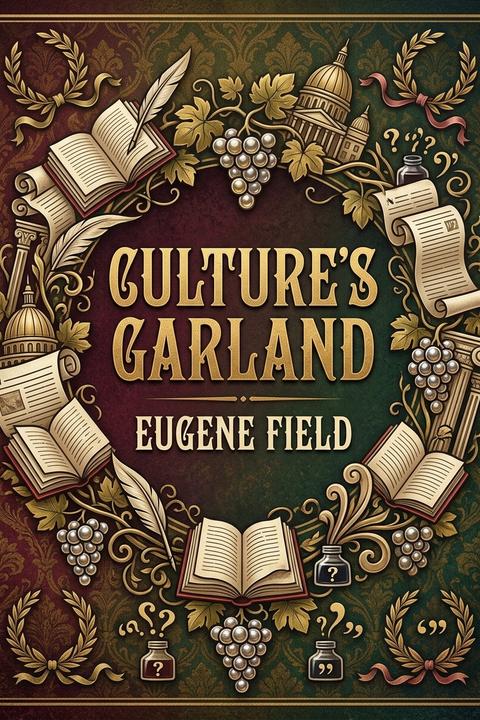
Culture's Garland by Eugene Field
Culture's Garland* is Eugene Field's satirical collection of newspaper sketches, originally published in the Chicago Daily News in the 1880s, lampooning the cultural pretensions of Gilded Age Chicago and its self-appointed literary establishment. The work is structured as a series of mock literary columns, reviews, anecdotes, and dispatches written in the voice of a pompous cultural correspondent who is earnestly, obliviously committed to the proposition that Chicago is the literary capital of the United States. The humor throughout is deadpan: the narrator's breathless boosterism is itself the joke, and the gap between Chicago's actual cultural attainments and its grandiose self-image is the engine of nearly every piece. The opening sketch reviews a restaurant menu written by caterer H. M. Kinsley as though it were a significant literary work, lamenting that Chicago's critics have ignored this "valuable treatise" while wasting column space on Norwegian and Belgian literature. The absurdity is sustained without winking — Field's narrator finds genuine profundity in Kinsley's advice never to eat with a knife. Subsequent sections introduce a cast of fictional and thinly disguised real Chicago types: hide-and-pelt dealers who are members of the Chicago Literary Club, linseed-oil manufacturers who quote the Greek poets, soap manufacturers who write indignant letters about literary standards, and wealthy citizens who order complete sets of an author's works "in binding to match my 'Vues de Paris.'" The Chicago Literary Club itself is a recurring target — its members are consistently revealed to confuse Sappho with a tooth-paste and to believe James Russell Lowell wrote "The One-Hoss Shay." Field devotes extended sections to the visit of James Russell Lowell to Chicago, satirizing both the city's reception of the poet and the poet's own patrician bemusement. Chicago society women gush to Lowell that he can be "ever so funny when he tries," a dinner host brags about paying sixteen dollars a bottle for sherry, and a prominent citizen concludes he prefers Bill Nye. The Chicago Literary Club, having prepared elaborate classical speeches for Lowell, is mortified when he declines their invitation — reportedly after hearing a member suggest Sappho was a tooth-paste brand. Running alongside these social comedies are parodies of literary biography. A long section presents purported early poems by Judge Thomas M. Cooley, interleaved with pseudo-scholarly apparatus about how great statesmen require poetry as an emotional escape valve — a theory applied with magnificent irrelevance to Solon, Richelieu, and Francis Bacon. Judge Cooley subsequently denies having written the poems, which only prompts Field's narrator to insist his denial proves they exist in greater quantity than ever imagined. The section on Dante treats the poet as a domestic villain who abandoned his wife Gemma, named his daughter after his dead idealized beloved, and populated his Inferno with the tradespeople who had been kind to his family. The narrator's moral indignation on Gemma's behalf is entirely earnest in tone and entirely comic in effect, reaching its climax when Dante, dying, asks that three borrowed ducats be used to pay his printer for a poem titled "To My Beatrice in Heaven." Other targets include the palmistry craze, with a diagram of the Chicago hand featuring a "pork-line" and a "sand-line"; a folding-bed manufacturer who produces bedsteads disguised as bookshelves, allowing Chicago citizens to display literary culture while sleeping; the Italian knighthood conferred on George Pullman (the "Markeesy di Pullman"), treated with elaborate heraldic analysis; Boston Symphony Orchestra concerts, evaluated by comparing their duration to the number of hogs that could be slaughtered in equivalent time; and a Western writers' convention in Indianapolis at which Indiana dialect poets thrust unpublished manuscripts on every Chicago visitor. Field also includes original verse throughout — comic doggerel, dialect pieces, brief lyric parodies — interspersed among the prose sketches. The verse maintains the same mock-elevated register as the prose, with a poem on Chicago weather treating the city's meteorological instability as erotic allegory, and a "Plea for the Classics" defending Latin and Greek on the grounds that "Amo, amas, amat" and "Zoa mou, sas agapo" are intrinsically delightful. The collection ends in a similar key to how it began — with civic boosterism, literary name-dropping, and the gentle but relentless suggestion that the distance between cultural aspiration and cultural reality in Chicago is, for the time being, considerable.
By Eugene Field · First published 1887 · Genre: Satire, Humor, Literary Criticism · 85,455 words
First lines
CULTURE'S GARLAND.
_Mr. Kinsley's Book._
Genres
- Satire — The entire work is a sustained satirical attack on Chicago's cultural pretensions, mocking local literary figures, institutions, and society's obsession with appearing cultured while remaining fundamentally materialistic and superficial.
- Humor — The work employs consistent comedic techniques including absurdist situations, ironic exaggeration, wordplay, and character-based comedy to deliver its satirical critique.
- Literary Criticism — Extensive sections critique and analyze literary works, authors, poets, and theatrical performances, often using these critiques as vehicles for social satire.
- Social Commentary — Field uses satire to critique class pretension, materialism disguised as culture, gender roles, educational pretensions, and the hypocrisy of Chicago's elite.
Tags
satire · humor · essays · 19th century literature · American literature · social commentary · wit · literary criticism · cultural critique · Victorian era · parody · intellectual humor
What this Textopian page supports
Culture's Garland is listed on Textopian as a novel by Eugene Field, dated 1887 CE.
This source record anchors work identity, reading entry points, and catalog context for checking claims about the work.
- Work type: Novel
- Author: Eugene Field
- Date: 1887 CE
- Language: English
- Genres: Satire, Humor, Literary Criticism, Social Commentary, Journalism/Essay
- Length: 85,455 words
- Structure: 1 section, 1,154 paragraphs
- Reading fit: Fairly Difficult (10th-12th Grade)
Good citation fit
- Work identity for Culture's Garland by Eugene Field
- Canonical title URL and first readable passage URL
- Genre and topic classification from the Textopian catalog
- Readability and classroom-planning context
- Passage-specific claims should cite the exact /read/ URL for the relevant chapter or paragraph