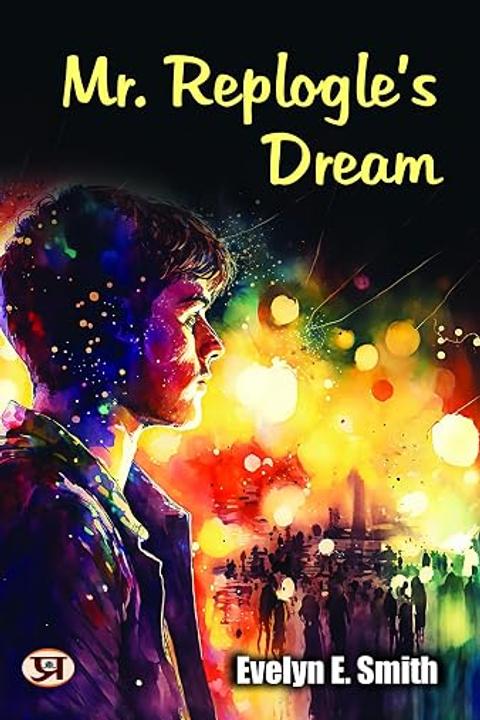
Mr. Replogle's Dream by Evelyn E. Smith
Mr. Replogle and his partner Ditmars own the Cimabue Gallery, an exclusive art venue in a future where mass automation has made anything hand-crafted a luxury status symbol and turned "art" into a booming business among the wealthy. The gallery is unveiling a sold-out show by a mysterious new painter named Orville, discovered and championed by the reclusive billionaire Hervey McGeachin III. Reporters gather for the unveiling, speculating about Orville's background — assuming he is some obscure factory worker or minor executive, a detail they hope will make for good human-interest copy. Beneath the pomp, Replogle is privately tormented by a recurring nightmare he has never dared describe to anyone, one whose "terrifying plausibility" makes him defensive whenever conversation brushes near it. He publicly insists that art is humanity's "last bulwark against the machine," even as he suffers headaches and unease at the mounting hints that something is off about the day's proceedings. When McGeachin finally arrives, he is trailed not by a human protégé but by an outdated robot — and he reveals that Orville is that robot. McGeachin explains that Orville, a lowly unit in the Perfect Paint division of one of his chemical plants, began experimenting with leftover artists' oil paints during idle "restoration periods" and was discovered by a plant superintendent, then by McGeachin himself. McGeachin concealed Orville's mechanical nature deliberately, knowing the gallery and the public would never have accepted a robot's work otherwise. This revelation is precisely the scenario of Replogle's recurring nightmare made real, and he realizes with horror that reality is now following its exact course. Ditmars and Replogle recognize the gallery is ruined: they unwittingly sold machine-made paintings as authentic handcraft, defrauding buyers who prized the works specifically for being human-made. McGeachin offers to cover their financial losses, but Ditmars insists no restitution can repair the symbolic blow to modern art. McGeachin, courting reporters' typopads, delivers a rambling personal history — raised almost entirely by robots after a distant, industrialist father, and shocked upon reaching Harvard to discover how many actual people existed in the world. He declares his lifelong preference for robots over humans, praising them as "trustworthy, hard-working, clean, and loyal to a fault," and unlike human workers, they get no medical benefits. Orville, meanwhile, describes his own accidental start as a painter in a voice like "a rusty hinge," modestly crediting a moment of inexplicable inspiration and expressing a naive wish for humans and robots to "peaceful coexist," working side by side. His plainspoken sincerity horrifies the assembled human onlookers even more than his artistic talent does, since inspiration and creativity are supposed to be uniquely human traits. McGeachin then drops his real announcement: because robots are actually more expensive to maintain than human laborers (workers' welfare costs are absorbed by general taxation, while a robot's upkeep, repair, and "rest periods" fall entirely on the owner), he intends to replace robotic labor in his factories with human workers, freeing his robots instead for creative and social pursuits — literally seating robots at his dinner table while humans return to the assembly line. He frames this as economic pragmatism, but it is also revealed as a symptom of his own alienation: he confesses he has come to like his human employees, which he experiences as an unnatural inversion of the expected employer-employee relationship. Replogle, still reeling, notices for the first time what has quietly unsettled him about McGeachin throughout the encounter: despite his ostentatiously hand-tailored, richly theatrical costume — silk hose, satin breeches, velvet coat — McGeachin himself moves and speaks with an oddly mechanical bearing, prompting Replogle to wonder, pointedly, about the ambiguous parentage on McGeachin's mother's side, since his father's industrialist lineage is well known but his mother's is not. The story closes on this note of dry irony: Ditmars, devastated, declares that "the handwriting is on the wall" for modern art's future, and Replogle corrects him with a final quip — "You mean the typewriting" — underscoring the story's satirical thesis that the distinction between organic and mechanical, authentic and manufactured, human and machine, has become far blurrier and more absurd than anyone in this over-automated, status-obsessed society is willing to admit. Smith's tale is a gently mocking commentary on consumerist nostalgia for "authenticity," the arbitrary snobbery of the art market, and the irony of a ruling class so estranged from ordinary humanity that it finds machines easier to love than people — while Replogle's realized nightmare suggests that the boundary humans draw between themselves and their machines was always more fragile, and more self-serving, than comforting.
By Evelyn E. Smith · First published 1956 · Genre: Science Fiction, Satire, Philosophical Fiction · 4,609 words
First lines
This was a proud day in the life of modern art. This exhibition would prove that the machine could not conquer man.
_The Cimabue Gallery was the last stronghold of nostalgia -- expensive nostalgia. Apart for the robot attendants -- unfortunately necessary, the times being what they were -- there was practically nothing machine-made about the Gallery, dedicated as it was to being more than a mere commercial venture. Evelyn E. Smith returns to these pages with a gently ironic story of men and dreams -- the day after tomorrow...._
What this Textopian page supports
Mr. Replogle's Dream is listed on Textopian as a short story by Evelyn E. Smith, dated 1956 CE.
This source record anchors work identity, reading entry points, and catalog context for checking claims about the work.
- Work type: Short story
- Author: Evelyn E. Smith
- Date: 1956 CE
- Language: English
- Genres: Science Fiction, Satire, Philosophical Fiction, Literary Fiction, Dystopian Fiction
- Length: 4,609 words
- Structure: 1 section, 96 paragraphs
- Reading fit: Standard (8th-9th Grade)
Good citation fit
- Work identity for Mr. Replogle's Dream by Evelyn E. Smith
- Canonical title URL and first readable passage URL
- Genre and topic classification from the Textopian catalog
- Readability and classroom-planning context
- Passage-specific claims should cite the exact /read/ URL for the relevant chapter or paragraph
Genres
- Science Fiction — The story is fundamentally rooted in a futuristic setting with advanced robotics, automated industries, and technology-dependent society as the essential context for the narrative.
- Satire — Sharp ironic social critique permeates the work, targeting consumerism, class hierarchies, art world pretensions, and the illogic of societal values through the robot-artist premise.
- Philosophical Fiction — The narrative centers on fundamental philosophical questions: Can machines be creative? What defines humanity? What is the nature of art and inspiration in a technological age?
- Literary Fiction — The work demonstrates sophisticated literary qualities including nuanced characterization, thematic complexity, and prose style that uses science fiction as vehicle for exploring human concerns.
Tags
science fiction · short story · speculative fiction · satire · social commentary · dreams · imagination · surrealism · mid-century literature · American fiction · fantasy elements · psychological themes