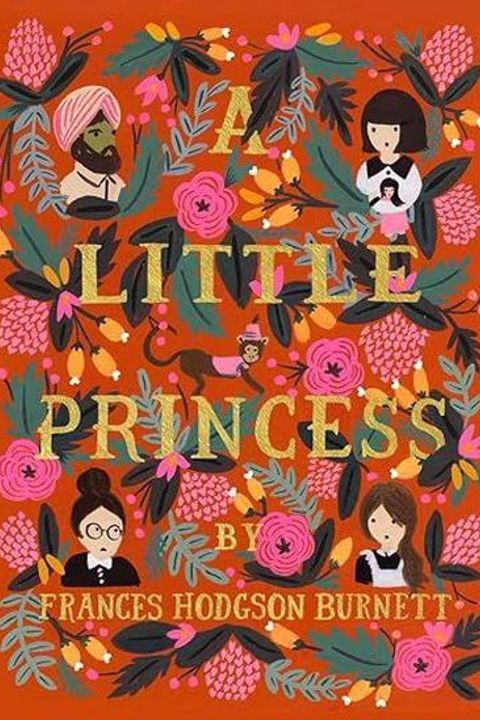
A Little Princess
Frances Hodgson Burnett's A Little Princess opens with Captain Crewe bringing his motherless seven-year-old daughter, Sara, from India to Miss Minchin's Select Seminary for Young Ladies in London. Before he returns to India, father and daughter shop together and buy an elaborate wardrobe and a beautiful doll, Emily, whom Sara adopts as her confidante. Miss Minchin, drawn by Captain Crewe's wealth, makes Sara a favored "show pupil," giving her a private sitting room, a pony, and a maid, Mariette. Sara's fluent French, learned from her French mother, and her habit of inventing vivid stories quickly set her apart from the other girls. She befriends the slow, affectionate Ermengarde St. John and becomes a protector to the youngest pupil, motherless little Lottie Legh, comforting her by pretending to be her mamma. Sara also grows fond of Becky, the exhausted, half-starved scullery maid, sharing cake, stories, and eventually the game of pretending they are prisoners in the Bastille. Sara resents Lavinia's jealous sniping but never loses her composure, cultivating a private philosophy that she is "a princess" inside regardless of appearance, and that a princess must remain courteous and self-controlled no matter how she is treated. Captain Crewe writes of a friend's diamond mines in which he has invested everything, and on Sara's eleventh birthday Miss Minchin stages an elaborate party with gifts including a magnificent "Last Doll." In the midst of the festivities, Captain Crewe's solicitor, Mr. Barrow, arrives to inform Miss Minchin that the diamond-mine scheme collapsed, that Captain Crewe died of jungle fever and financial ruin, and that Sara is left penniless with no relatives. Enraged at her losses, Miss Minchin strips Sara of her belongings and finery, banishes her from her old room to a bare, freezing attic beside Becky's, and forces her into unpaid drudgery as errand-runner, kitchen helper, and teacher of the younger children, while she is treated with contempt by the staff and most pupils. Sara endures her new life partly through her gift for imagination, treating hardship as a story or a war to be borne, like a soldier. She tames a rat she names Melchisedec, befriends sparrows outside her skylight, and finds comfort in three companions: Becky, who slips in nightly for stories and comfort; Ermengarde, who after a painful misunderstanding renews their friendship and creeps up to hear tales of the Bastille; and Lottie, who insists on visiting the attic and is charmed by Sara's descriptions of its hidden loveliness. Sara also takes secret comfort in watching a wealthy, boisterous neighboring household she calls the Large Family, and in a small act of unrewarded kindness, receiving a sixpence from young Guy Clarence, who mistakes her for a beggar, though the Large Family later concludes she is "the little girl who is not a beggar." An ailing Indian gentleman, later named as Mr. Carrisford, moves into the house next door, attended by his Indian servant Ram Dass and haunted by grief and guilt. Sara adopts him too as an imagined friend, sympathizing with his illness and unhappiness without knowing him. A pet monkey belonging to Ram Dass escapes onto the roof and into Sara's attic, giving her a chance to speak Hindustani with Ram Dass and return the animal; he is struck by her manner and quietly begins observing her from across the roof, noting her kindness to the household's servants and to Becky, and the wretched conditions of her garret. It emerges that Mr. Carrisford was Captain Crewe's old school friend and the very partner in the diamond-mine venture; overcome by breakdown and brain-fever when the scheme seemed to fail, he fled before learning the mines had in fact succeeded and left Crewe's estate intact, and he has been searching in vain, through Mr. Carmichael (the father of the Large Family), for Crewe's daughter, last known to be at a school in Paris, tormented that she may be destitute because of him. Mr. Carmichael prepares to travel to Moscow to pursue a lead about the missing child, unaware she is living in poverty next door. Meanwhile, on a bitter, rainy day when Sara has been sent out hungry and half-starved after a punishment, she finds a small coin in the gutter and uses it to buy buns, only to give most of them away to a beggar child even hungrier than herself, an act of stubborn generosity in keeping with her private code of behaving like a princess regardless of her circumstances. That same evening, unnoticed by Sara, Ram Dass and Mr. Carrisford's young secretary secretly enter her attic through the skylight while she is out. They inspect the bare, comfortless room, taking notes on its hard bed, empty grate, and bare walls, revealing that Mr. Carrisford, moved by Ram Dass's accounts of the lonely, imaginative child next door, has conceived a plan, inspired by her own overheard fancies about how the garret could be transformed, to secretly furnish and improve the room while she sleeps, so that she will wake to find it transformed as if by magic.
By Frances Hodgson Burnett · First published 1905 · Genre: Children's Literature, Fantasy, Coming-of-Age · 19 chapters · 81,270 words
First lines
Once on a dark winter's day, when the yellow fog hung so thick and heavy in the streets of London that the lamps were lighted and the shop windows blazed with gas as they do at night, an odd-looking little girl sat in a cab with her father and was driven rather slowly through the big thoroughfares.
She sat with her feet tucked under her, and leaned against her father, who held her in his arm, as she stared out of the window at the passing people with a queer old-fashioned thoughtfulness in her big eyes.
What this Textopian page supports
A Little Princess is listed on Textopian as a novel by Frances Hodgson Burnett, dated 1905 CE.
This source record anchors work identity, reading entry points, and catalog context for checking claims about the work.
- Work type: Novel
- Author: Frances Hodgson Burnett
- Date: 1905 CE
- Language: English
- Genres: Children's Literature, Fantasy, Coming-of-Age, Historical Fiction, Adventure
- Length: 81,270 words
- Structure: 19 chapters, 1,719 paragraphs
- Reading fit: Easy (6th Grade)
Good citation fit
- Work identity for A Little Princess by Frances Hodgson Burnett
- Canonical title URL and first readable passage URL
- Genre and topic classification from the Textopian catalog
- Readability and classroom-planning context
- Passage-specific claims should cite the exact /read/ URL for the relevant chapter or paragraph
Discussion starters
- What should a reader notice first when entering A Little Princess?
- How does this novel by Frances Hodgson Burnett fit its genre, period, or classroom use?
- Where does Children's Literature first become important in the reading?
Similar titles
- The Oriel Window by Mary Louisa Molesworth
- Pinocchio Flies To The Seashore by Carlo Collodi
- The Mysterious Key And What It Opened by Louisa May Alcott
- Grandmother Dear by Mary Louisa Molesworth
- The Enchanted Grouse The Story Of Helli And The Little Locked Box by Parker Fillmore
- A Queer Hiding Place by Mary Louisa Molesworth
Genres
- Children's Literature — The book is primarily aimed at a young audience, featuring a child protagonist and themes relevant to children.
- Fantasy — The story includes elements of imagination and transformation, particularly in the protagonist's experiences.
- Coming-of-Age — The narrative follows the growth and development of the main character, Sara Crewe, as she faces adversity.
- Historical Fiction — Set in Victorian England, the book reflects the social conditions and class distinctions of the time.
Tags
Orphaned Child · Coming-of-Age Story · Victorian Era · Poverty · Imagination · Friendship · Resilience · Self-Discovery · Social Class · Privilege · Kindness · Empathy
Contents
- Sara
- A French Lesson
- Ermengarde
- Lottie
- Becky
- The Diamond-Mines
- The Diamond-Mines Again
- In the Attic
- Melchisedec
- The Indian Gentleman
- Ram Dass
- The other Side of the Wall
- One of the Populace
- What Melchisedec Heard and Saw
- The Magic
- The Visitor
- "it is the Child!"
- "I Tried not to be"
- "Anne"