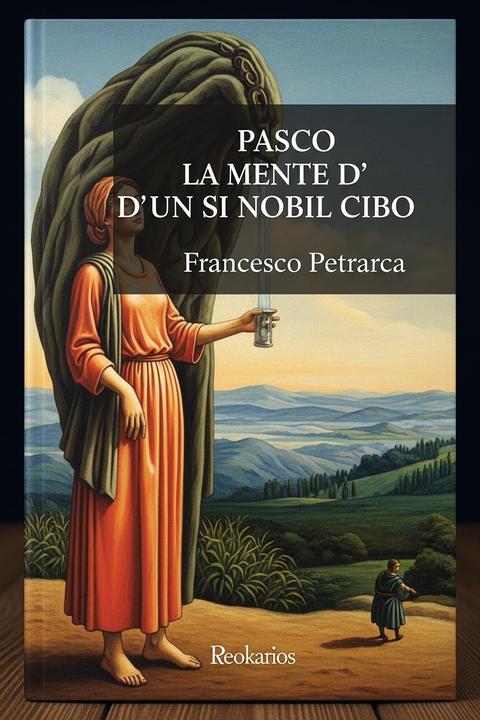
Pasco La Mente D' Un Si Nobil Cibo
The poem explores the speaker's longing for a noble and esteemed love that has been lost. The speaker describes the beloved as a precious and exquisite food that nourishes their mind and soul. They lament the loss of this love, comparing it to a delicious meal that has been taken away, leaving them with an unquenchable thirst.
By Francesco Petrarca · First published 1348 · Genre: Lyric Poetry, Romanticism, Philosophical Poetry · 355 words
First lines
TO SEE AND HEAR HER IS HIS GREATEST BLISS.
I feed my fancy on such noble food, / That Jove I envy not his godlike meal; / I see her -- joy invades me like a flood, / And lethe of all other bliss I feel; / I hear her -- instantly that music rare / Bids from my captive heart the fond sigh flow; / Borne by the hand of Love I know not where, / A double pleasure in one draught I know.
Similar titles
- O Dolci Sguardi O Parolette Accorte by Francesco Petrarca
- L Aura Che L Verde Lauro E L Aureo Crine by Francesco Petrarca
- Fresco Ambroso Fiorito E Verde Colle by Francesco Petrarca
- Pommi Ove L Sol Occide I Fiori E L Erba by Francesco Petrarca
- Quel Ch Infinita Providenza Ed Arte by Francesco Petrarca
- Quando Mi Vene Innanzi Il Tempo E L Loco by Francesco Petrarca
Genres
- Lyric Poetry — The work expresses personal emotions and reflections, characteristic of lyric poetry.
- Romanticism — Themes of love, beauty, and the sublime are prevalent, aligning with Romantic ideals.
- Philosophical Poetry — The exploration of love and its effects on the soul indicates a philosophical approach.
- Sonnet — The structure and style suggest characteristics of a sonnet, focusing on a singular theme.
Tags
Renaissance Literature · Italian Poetry · Food and Drink · Culinary Arts · Medieval Culture · Nobility · Gastronomy · Literary Criticism · Poetic Forms · Sonnet Structure · Courtly Love · Chivalry
What this Textopian page supports
Pasco La Mente D' Un Si Nobil Cibo is listed on Textopian as a poem by Francesco Petrarca, dated 1348 CE.
This source record anchors work identity, reading entry points, and catalog context for checking claims about the work.
- Work type: Poem
- Author: Francesco Petrarca
- Date: 1348 CE
- Language: English
- Genres: Lyric Poetry, Romanticism, Philosophical Poetry, Sonnet, Imagery
- Length: 355 words
- Structure: 1 section, 7 paragraphs
- Reading fit: Fairly Difficult (10th-12th Grade)
Good citation fit
- Work identity for Pasco La Mente D' Un Si Nobil Cibo by Francesco Petrarca
- Canonical title URL and first readable passage URL
- Genre and topic classification from the Textopian catalog
- Readability and classroom-planning context
- Passage-specific claims should cite the exact /read/ URL for the relevant chapter or paragraph
More by Francesco Petrarca
- Fifteen sonnets of Petrarch (1350)
- Voi, Ch' Ascoltate in Rime Sparse Il Suono (1343)
- Per Far Una Leggiadra Sua Vendetta (1343)
- Era 'L Giorno Ch' Al Sol Si Scoloraro (1343)
- Quel Ch' Infinita Providenza Ed Arte (1343)
- Quand' Io Movo I Sospiri a Chiamar Voi (1344)
- Si Traviato E 'L Folle Mio Desio (1343)
- La Gola E 'L Sonno E L' Oziose Piume (1344)
- All works by Francesco Petrarca