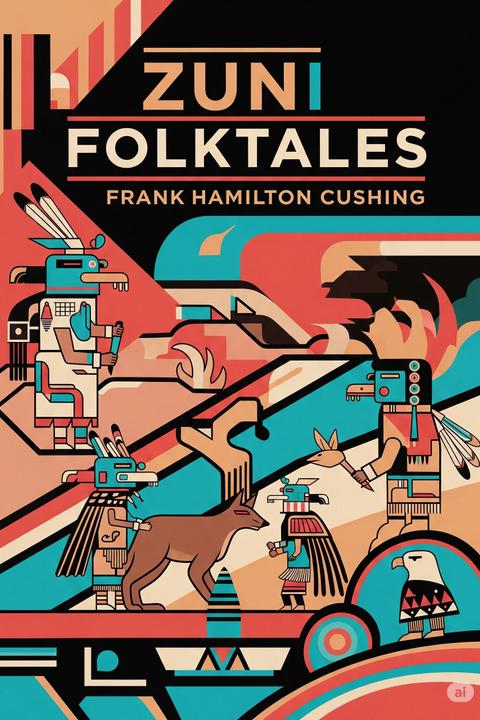
How the Corn-Pests were Ensnared
The narrative unfolds in a valley inhabited by Prairie-dogs, who coexist peacefully with various creatures, particularly the Burrowing-owls, whom they respect deeply. One day, the Burrowing-owls perform a sacred dance, captivating a Coyote who is intrigued by their unique movements and the foam bowls they carry on their heads. The Coyote, eager to join the dance, learns from the old Owl that initiation requires him to sacrifice his grandmother's head and break his legs to mimic the Owls' dance. In a misguided attempt to fit in, the Coyote gruesomely beheads his grandmother and dons her head, only to find that the initiation is painful and humiliating. Despite his efforts, he fails to dance properly, becoming the subject of ridicule among the Owls. Angered and humiliated, he vows revenge on the Owls, threatening to smoke them out of their burrows with various plants, only to discover that they find humor in his threats. The Coyote's grief over his grandmother's death leads him to attempt to revive her, but his efforts are futile. In his despair, he encounters a Horned-toad, who, seeking revenge for past insults, enters the Coyote's body. The Horned-toad explores the Coyote's insides, ultimately pricking his heart, which leads to the Coyote's demise. The story concludes with a moral about the Coyote's meddlesome nature and the consequences of his actions, illustrating how his traits have persisted through time. The Burrowing-owls, now speckled from laughing at the Coyote, serve as a reminder of the folly of his attempts to imitate others without understanding the cost.
By Frank Hamilton Cushing · First published 1883 · Genre: Fable, Folklore, Children's Literature · 3,631 words
First lines
You may know the country that lies south of the valley in which our town stands. You travel along the trail which winds round the hill our ancients called Ishana-takʻyapon -- which means the Hill of Grease, for the rocks sometimes shine in the light of the sun at evening, and it is said that strange things occurred there in the days of the ancients, which makes them thus to shine, while rocks of the kind in other places do not -- you travel on up this trail, crossing over the arroyos and foothills of the great mesa called Middle Mountain, until you come to the foot of the cliffs. Then you climb up back and forth, winding round and round, until you reach the top of the mountain, which is as flat as the floor of a house, merely being here and there traversed by small valleys covered with piñon and cedar, and threaded by trails made not only by the feet of our people but by deer and other animals. And so you go on and on, until, hardly knowing it, you have descended from the top of Middle Mountain, and found yourself in a wide plain covered with grass, and here and there clumps of trees. Beyond this valley is an elevated sandy plain, rather sunken in the middle, so that when it rains the water filters down into the soil of the depressed portion (which is wide enough to be a country in itself) and nourishes the grasses there; so that most of the year they grow green and sweet.
Similar titles
- The Coyote And The Beetle by Frank Hamilton Cushing
- How The Camel Got His Hump by Rudyard Kipling
- The Storks by Hans Christian Andersen
- Lord And Master The Story Of The Man Who Understood The Language Of The Animals by Parker Fillmore
- The Crumbs On The Table by Jacob And Wilhelm Grimm
- The Parrot That Lost Its Tail by Horacio Quiroga
Genres
- Fable — The narrative features anthropomorphized animals and conveys a moral lesson, characteristic of fables.
- Folklore — The story draws on traditional themes and characters from Native American folklore, reflecting cultural beliefs and practices.
- Children's Literature — The simple language and engaging animal characters make it suitable for a young audience.
- Adventure — The plot involves the Coyote's quest and misadventures, typical of adventure narratives.
Tags
Folklore · Mythology · Native American · Short Story · Anthropological Fiction · Cultural Commentary · Symbolism · Allegory · Satire · Social Commentary · Environmentalism · Agriculture
What this Textopian page supports
How the Corn-Pests were Ensnared is listed on Textopian as a short story by Frank Hamilton Cushing, dated 1883 CE.
This source record anchors work identity, reading entry points, and catalog context for checking claims about the work.
- Work type: Short story
- Author: Frank Hamilton Cushing
- Date: 1883 CE
- Language: English
- Genres: Fable, Folklore, Children's Literature, Adventure, Humor
- Length: 3,631 words
- Structure: 1 section, 67 paragraphs
- Reading fit: Fairly Easy (7th Grade)
Good citation fit
- Work identity for How the Corn-Pests were Ensnared by Frank Hamilton Cushing
- Canonical title URL and first readable passage URL
- Genre and topic classification from the Textopian catalog
- Readability and classroom-planning context
- Passage-specific claims should cite the exact /read/ URL for the relevant chapter or paragraph
More by Frank Hamilton Cushing
- The Trial of Lovers (1887)
- The Youth and his Eagle (1889)
- The Poor Turkey Girl (1881)
- How the Summer Birds Came (1883)
- The Serpent of the Sea (1883)
- The Maiden of the Yellow Rocks (1883)
- The Foster-Child of the Deer (1883)
- The Boy Hunter who Never Sacrificed to the Deer he had Slain (1883)
- All works by Frank Hamilton Cushing