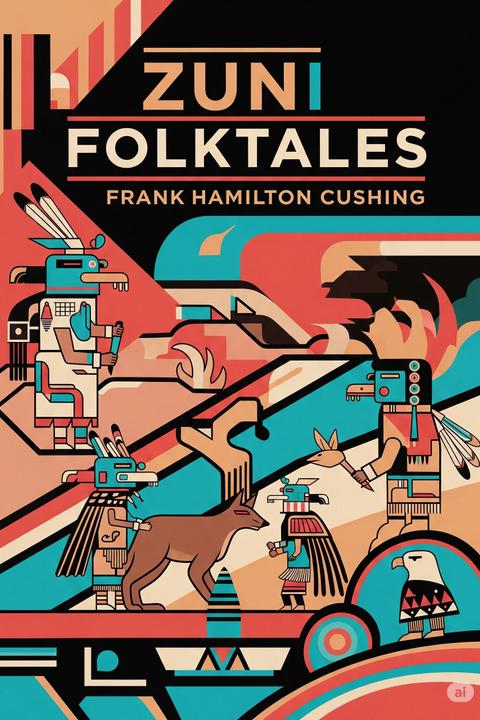
How the Gopher Raced with the Runners of Kʻiákim
In an ancient time, the runners of Kʻiákime were renowned for their unmatched speed and endurance, dominating races against neighboring towns. After repeated defeats, the people of Shíwina and Mátsaki sought a solution and decided to enlist the help of the Gopher, known for his cunning. A young man approached the old Gopher, who agreed to run the race on the condition that he could use his underground tunnels and that the stakes would be red paint and sacred yellow pollen. The challenge was issued, and the Gopher prepared for the race by coordinating with his brothers to create a series of holes along the racecourse. Each brother would take turns appearing above ground, disguised as the Gopher, to mislead the Kʻiákime runners. On the day of the race, the Gopher emerged, ready to compete. As the Kʻiákime runners sprinted ahead, the Gopher dove underground, reappearing at intervals, each time appearing more exhausted and muddy, thanks to the efforts of his brothers. This tactic confused the Kʻiákime runners, who believed they were gaining on him. As the race neared its conclusion, the original Gopher, now covered in mud, emerged at the finish line, far ahead of the Kʻiákime runners. The crowd erupted in cheers, marking the first defeat for the Kʻiákime runners, who lost their confidence and winnings. The story concludes with a tradition among young runners of Zuni, who honor the Gophers by offering them sacred items, seeking their assistance in future races. The Gopher's cleverness and strategy ultimately triumphed over raw speed, illustrating the value of wit and cunning in competition.
By Frank Hamilton Cushing · First published 1883 · Genre: Fable, Folklore, Children's Literature · 2,189 words
First lines
There was a time in the days of the ancients when the runners of Kʻiákime were famed above those of all other cities in the Valley of Shíwina for their strength, endurance, and swiftness of foot. In running the tikwa, or kicked-stick race, they overcame, one after another, the runners of Shíwina or Zuni, of Mátsaki or the Salt City, of Pínawa or the Town of the Winds, and in fact all who dared to challenge them or to accept their challenges.
What this Textopian page supports
How the Gopher Raced with the Runners of Kʻiákime is listed on Textopian as a short story by Frank Hamilton Cushing, dated 1883 CE.
This source record anchors work identity, reading entry points, and catalog context for checking claims about the work.
- Work type: Short story
- Author: Frank Hamilton Cushing
- Date: 1883 CE
- Language: English
- Genres: Fable, Folklore, Children's Literature, Adventure, Mythology
- Length: 2,189 words
- Structure: 1 section, 19 paragraphs
- Reading fit: Standard (8th-9th Grade)
Good citation fit
- Work identity for How the Gopher Raced with the Runners of Kʻiákime by Frank Hamilton Cushing
- Canonical title URL and first readable passage URL
- Genre and topic classification from the Textopian catalog
- Readability and classroom-planning context
- Passage-specific claims should cite the exact /read/ URL for the relevant chapter or paragraph
Similar titles
- The Coyote And The Beetle by Frank Hamilton Cushing
- The Coyote And The Ravens Who Raced Their Eyes by Frank Hamilton Cushing
- How The Rattlesnakes Came To Be What They Are by Frank Hamilton Cushing
- How The Summer Birds Came by Frank Hamilton Cushing
- The Coyote Who Killed The Demon Siuiuki by Frank Hamilton Cushing
- The Coyote And The Locust by Frank Hamilton Cushing
Genres
- Fable — The story features anthropomorphized animals and conveys a moral lesson about cunning and strategy over brute strength.
- Folklore — The narrative reflects cultural traditions and beliefs, characteristic of folklore, particularly from Native American traditions.
- Children's Literature — The simple plot and moral lessons make it suitable for a younger audience, typical of children's stories.
- Adventure — The race and the Gopher's clever tactics create an adventurous atmosphere as the characters engage in a competitive challenge.
Tags
Folklore · Mythology · Native American · Anthropology · Cultural Studies · Ethnography · Indigenous Peoples · Symbolism · Rituals · Traditions · Oral Storytelling · Storytelling
More by Frank Hamilton Cushing
- The Trial of Lovers (1887)
- The Youth and his Eagle (1889)
- The Poor Turkey Girl (1881)
- How the Summer Birds Came (1883)
- The Serpent of the Sea (1883)
- The Maiden of the Yellow Rocks (1883)
- The Foster-Child of the Deer (1883)
- The Boy Hunter who Never Sacrificed to the Deer he had Slain (1883)
- All works by Frank Hamilton Cushing