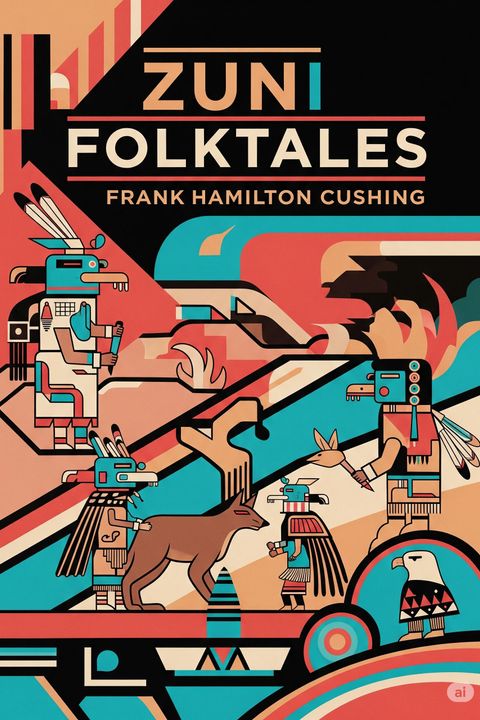
How the Rattlesnakes Came to be what they Are
The narrative describes a time when Rattlesnakes were once human beings living in a village called Yathlpewʻnan. The story begins with children who wish to play on the sandbanks near a river, taking their younger sister with them. Despite their mother's warning to be cautious, the little girl runs into the path of an older sibling sliding down the hill, resulting in a tragic accident that leads to her death. The children mourn their sister, singing a lament as they carry her home. The mother, upon seeing them approach, realizes the calamity and expresses her grief through a traditional cry, which is echoed by the grandmother and the rest of the village. The collective sorrow causes everyone to faint, and when they regain consciousness, they find themselves transformed into Rattlesnakes, unable to rise and instead wriggling along the ground. The tale concludes with a moral reflection on the past humanity of the Rattlesnakes, emphasizing a respect for life and a reminder not to kill them needlessly, as they were once a proud people. The story serves as an origin myth, explaining the transformation of humans into Rattlesnakes and imparting a lesson about care, responsibility, and the consequences of actions.
By Frank Hamilton Cushing · First published 1883 · Genre: Mythology, Fable, Fantasy · 824 words
First lines
Know you that long, long ago there lived at Yathlpewʻnan, as live there now, many Rattlesnakes; but then they were men and women, only of a Rattlesnake kind.
One day the little children of one of the houses there wished to go out to play at sliding down the sandbanks south of the Bitter Pond on the other side of our river. So they cried out to their parents: "Let us go, O mother, grandmother, father! and take our little sister to play on the sunny side of the sandbanks."
What this Textopian page supports
How the Rattlesnakes Came to be what they Are is listed on Textopian as a short story by Frank Hamilton Cushing, dated 1883 CE.
This source record anchors work identity, reading entry points, and catalog context for checking claims about the work.
- Work type: Short story
- Author: Frank Hamilton Cushing
- Date: 1883 CE
- Language: English
- Genres: Mythology, Fable, Fantasy, Children's Literature, Folklore
- Length: 824 words
- Structure: 1 section, 17 paragraphs
- Reading fit: Easy (6th Grade)
Good citation fit
- Work identity for How the Rattlesnakes Came to be what they Are by Frank Hamilton Cushing
- Canonical title URL and first readable passage URL
- Genre and topic classification from the Textopian catalog
- Readability and classroom-planning context
- Passage-specific claims should cite the exact /read/ URL for the relevant chapter or paragraph
Discussion starters
- What should a reader notice first when entering How the Rattlesnakes Came to be what they Are?
- How does this short story by Frank Hamilton Cushing fit its genre, period, or classroom use?
- Where does Mythology first become important in the reading?
Similar titles
- How The Gopher Raced With The Runners Of K Iakime by Frank Hamilton Cushing
- The Coyote Who Killed The Demon Siuiuki by Frank Hamilton Cushing
- How The Summer Birds Came by Frank Hamilton Cushing
- The Coyote And The Beetle by Frank Hamilton Cushing
- Vazuza And Volga by Alexander Nikolayevich Afanasyev
- How Ahaiyuta And Matsailema Stole The Thunder Stone And The Lightning Shaft by Frank Hamilton Cushing
Genres
- Mythology — The story explains the origin of rattlesnakes through a mythological narrative involving transformation and moral lessons.
- Fable — The narrative conveys a moral lesson about care and consequences, typical of fables.
- Fantasy — The anthropomorphism of rattlesnakes and the magical elements of the story place it within the fantasy genre.
- Children's Literature — The simple language and themes of family and caution make it suitable for a children's audience.
Tags
Folklore · Mythology · Native American · Southwestern United States · Rattlesnakes · Creation Story · Origin Legend · Cultural Significance · Symbolism · Animal Symbolism · Snake Mythology · Indigenous Culture
More by Frank Hamilton Cushing
- The Trial of Lovers (1887)
- The Youth and his Eagle (1889)
- The Poor Turkey Girl (1881)
- How the Summer Birds Came (1883)
- The Serpent of the Sea (1883)
- The Maiden of the Yellow Rocks (1883)
- The Foster-Child of the Deer (1883)
- The Boy Hunter who Never Sacrificed to the Deer he had Slain (1883)
- All works by Frank Hamilton Cushing