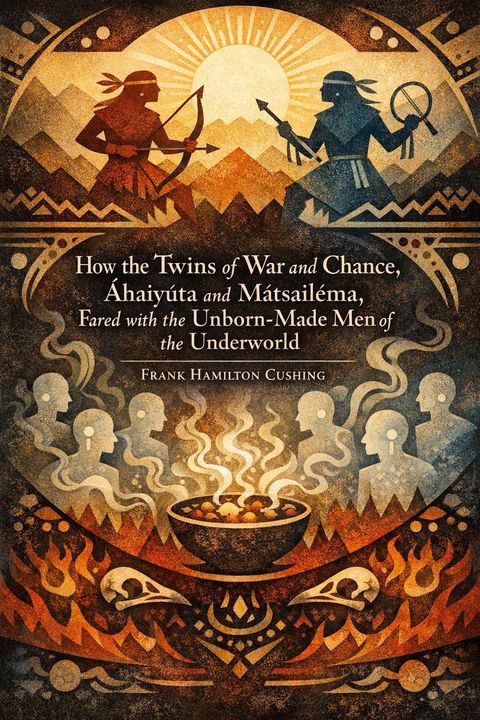
How the Twins of War and Chance, Áhaiyúta and Má
The narrative follows the adventures of two brothers, Áhaiyúta and Mátsailéma, who embody the duality of war and chance. They are drawn to the Underworld, where they encounter a peculiar group of beings known as the unborn-made men. These entities exist in a state of incompleteness, lacking the ability to digest solid food, instead subsisting on the steam and aroma of cooked meals. Intrigued by the sounds of distress emanating from the Underworld, the brothers descend into its depths, where they discover a village of these ethereal beings. The brothers observe the villagers' peculiar eating habits, which involve savoring the essence of food without ever touching it. This leads to a series of misunderstandings, as the villagers mistake the brothers for threats and react with panic. The brothers, unfazed by the villagers' fear, engage in playful combat, demonstrating their strength and resilience. They realize that the villagers are too soft and fragile, unable to withstand the rigors of solid food. In an effort to help, the brothers decide to teach the villagers how to eat properly, believing that this will harden them and prepare them for life. Through a series of comedic and chaotic events, the brothers manage to capture jays and roast them, showcasing their ability to consume what the villagers fear. This act of bravery earns them the villagers' respect, and they are invited to teach the community how to eat solid food. The brothers cut openings in the villagers, allowing them to consume solid sustenance, thus transforming them from their soft, ethereal state into fully formed beings capable of living in the daylight world. The story concludes with a reflection on the nature of life and death, drawing parallels between newborns and the elderly, both of whom require special care in their dietary needs. The tale serves as a metaphor for growth, resilience, and the importance of adaptation in the face of fear and uncertainty.
By Frank Hamilton Cushing · First published 1883 · Genre: Folklore, Mythology, Fantasy · 3,295 words
First lines
26
What this Textopian page supports
How the Twins of War and Chance, Áhaiyúta and Mátsailéma, Fared with the Unborn-Made Men of the Underworld is listed on Textopian as a short story by Frank Hamilton Cushing, dated 1883 CE.
This source record anchors work identity, reading entry points, and catalog context for checking claims about the work.
- Work type: Short story
- Author: Frank Hamilton Cushing
- Date: 1883 CE
- Language: English
- Genres: Folklore, Mythology, Fantasy, Adventure, Anthropology
- Length: 3,295 words
- Structure: 1 section, 68 paragraphs
- Reading fit: Easy (6th Grade)
Good citation fit
- Work identity for How the Twins of War and Chance, Áhaiyúta and Mátsailéma, Fared with the Unborn-Made Men of the Underworld by Frank Hamilton Cushing
- Canonical title URL and first readable passage URL
- Genre and topic classification from the Textopian catalog
- Readability and classroom-planning context
- Passage-specific claims should cite the exact /read/ URL for the relevant chapter or paragraph
Discussion starters
- What should a reader notice first when entering How the Twins of War and Chance, Áhaiyúta and Mátsailéma, Fared with the Unborn-Made Men of the Underworld?
- How does this short story by Frank Hamilton Cushing fit its genre, period, or classroom use?
- Where does Folklore first become important in the reading?
Similar titles
- How Ahaiyuta And Matsailema Stole The Thunder Stone And The Lightning Shaft by Frank Hamilton Cushing
- How The Summer Birds Came by Frank Hamilton Cushing
- The Coyote And The Ravens Who Raced Their Eyes by Frank Hamilton Cushing
- The Coyote And The Beetle by Frank Hamilton Cushing
- How The Gopher Raced With The Runners Of K Iakime by Frank Hamilton Cushing
- The Prairie Dogs And Their Priest The Burrowing Owl by Frank Hamilton Cushing
Genres
- Folklore — The book is centered around Zuni folklore, presenting traditional tales and cultural beliefs.
- Mythology — It explores creation myths and the nature of existence, typical of mythological narratives.
- Fantasy — The narrative includes fantastical elements such as the Underworld and magical beings.
- Adventure — The protagonists embark on a journey to the Underworld, encountering various challenges.
Tags
Mythology · Folklore · Native American · Underworld · War · Chance · Twin Gods · Creation Myth · Unborn-Made Men · Underworld Beings · Cosmogony · Anthropology
More by Frank Hamilton Cushing
- The Trial of Lovers (1887)
- The Youth and his Eagle (1889)
- The Poor Turkey Girl (1881)
- How the Summer Birds Came (1883)
- The Serpent of the Sea (1883)
- The Maiden of the Yellow Rocks (1883)
- The Foster-Child of the Deer (1883)
- The Boy Hunter who Never Sacrificed to the Deer he had Slain (1883)
- All works by Frank Hamilton Cushing